In an exclusive interview with Kyiv Post’s Special Correspondent in Warsaw, Michał Kujawski, the exiled Belarusian democratic oppositionist Andrei Sannikau describes Belarusian dictator Alexander Lukashenko as a monster who lives in fear and trades political prisoners. He also discusses Lukashenko’s relationship with the Kremlin, a game of bluff involving nuclear weapons, and the murky world of Belarusian intelligence operations in Poland.
Michał Kujawski: Recently, Belarusian opposition leader Siarhei Tsikhanouski was released from jail, along with a dozen other political prisoners. A few days later, Alexander Lukashenko pardoned another 16 people. When US Special Enoy to Ukraine Keith Kellogg returned from Minsk with Tsikhanouski, your story immediately came to mind. On May 14, 2011, you were sentenced by a Minsk court to five years in a penal colony for “organizing mass riots” after the rigged Dec. 19, 2010 presidential elections. You were released early in April 2012. The US was also involved in that case. Is history repeating itself?
Andrei Sannikau: In a way, yes, but now the situation is much more dangerous. The scale of repression is unprecedented. Lukashenko has been using the same tactics for years: he takes hostages to later trade them. Of course, I’m glad the prisoners were released, but Kellogg’s visit to Minsk raises concerns – it may signal another round of political human trafficking.
MK: What can the West, especially the US, offer Lukashenko in return?
AS: It’s the same scenario we’ve seen for over 25 years. Lukashenko tries to create the illusion of distancing himself from the Kremlin. Although he does this skillfully, true independence from Russia is impossible for him.
Alexander Lukashenko and Vladimir Putin
MK: In 2010, Belarus was also a dictatorship, but it was noticeably more independent from Moscow than today. Now, the security ministries are effectively subordinated to Russia, and Russian troops are stationed in the country. Can Lukashenko still play both sides?
AS: It’s a game of appearances. Lukashenko has no independent foreign policy – he just needs money. For years, he’s been saying the same thing: “I want to be independent, but I need resources.” He says this to both the West and China. Nothing changes.
MK: So again, the same story.
AS: Yes. But today, the money is needed to tighten repression even more – to imprison more people, to maintain fear. He crossed every line long ago – this won’t stop on its own.
MK: Although some prisoners were freed, their overall number doesn’t decrease. On the contrary, it’s rising.
AS: Yes. Today, we are dealing with tens of thousands of victims of repression. Human rights defenders talk about around 1,000 political prisoners, but that’s only the documented cases. The real number might be far, far higher. People are afraid to speak the truth, fearing repression against themselves and their families.
MK: Some don’t even admit they are political prisoners, is that right?
AS: It’s a tragic situation. Lukashenko lives in paranoia and fear – that’s why he won’t stop at anything. The repression system today is deadly dangerous. People are beaten, tortured, even killed in prisons.
MK: Why does the West still fall for the same tricks?
AS: It’s not just about Belarus. Look at Venezuela – elections clearly showed that people want change, not Nicolás Maduro. Where was the West then? Tough sanctions were needed – economic, individual, hitting the cartels. But nothing happened. Dictators like Lukashenko and Maduro are needed by certain interest groups because of weapons, drugs, smuggling. Remember, Belarus for years was a leading exporter of arms components. If the West truly wants to survive, it must change its approach. Today, we are fighting your fight – be it in Belarus, Iran, Venezuela, or Tibet.
MK: Many prisoners regain freedom only after signing pardon requests and admitting to fabricated charges. What is the goal?
AS: It’s a form of psychological humiliation. My advice: sign if it saves your life. Survive, don’t do anything stupid, beware of provocations. Signing means nothing unless someone cooperates with the regime after release.
MK: How can the West, or neighboring Poland in particular, exert influence on Belarus?
AS: Poland has real leverage and it’s a trade, which still exists between Poland and Belarus. Greater economic pressure would mean less money and less freedom for Lukashenko. Concrete ultimatums and involving China could help too.
MK: After Polish President Andrzej Duda’s visit to China, migration pressure on Poland’s border decreased.
AS: Yes, but don’t be mistaken, this tool won’t be abandoned. Lukashenko will always use it. Including China and others could help free prisoners.
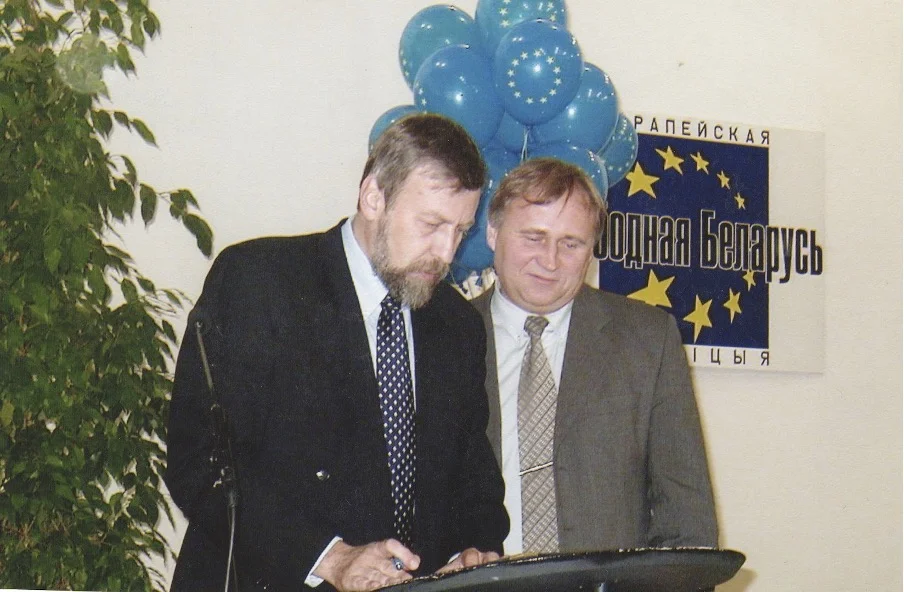
MK: In 2008, you co-founded the “European Belarus” campaign. In 2020, during protests, EU flags were absent – white-red-white national colors dominated. Did Belarusians want independence or to join the West?
AS: Two months of free media would show that most Belarusians want EU membership. People lack access to independent information – everything is banned and repressed. In 2020, showing national colors banned by the regime was symbolic. If Belarus had started EU integration in 2010, it would be a member today. We worked on that plan with expert and it takes seven years to meet the criteria.
MK: Yet Lukashenko was already a dictator then…
AS: People were beginning to understand who he was. Belarus’s history is not Soviet history, it’s a history of free people. Only the West doesn’t see it.
MK: Has the EU changed since 2008?
AS: It was too passive then. Instead of defending values, it did business with dictatorships. Nord Stream, deals with China – nobody saw the threat. Today, we defend your principles.
MK: Ukraine is fighting and Belarusian opposition works from abroad. Could Lukashenko be ousted?
AS: Yes.
MK: How?
AS: War. It can topple the regime. Lukashenko is a co-aggressor. Belarusian territory was used for attacks and Ukrainian children are held in Belarus. It’s a war crime.
MK: But he didn’t send troops to the front.
AS: Because he knows that if he did, everything would collapse. We told Belarusians: if you’re sent, surrender and join Ukraine’s side. We must be on Ukraine’s side without conditions.
MK: Belarusian opposition members in exile have been infiltrated by secret services. How extensive is their activity?
AS: Huge. Lukashenko’s services have one goal – to infiltrate everywhere. They send agents posing as refugees. Their actions are coordinated together with Russian services.
MK: Some say they’re more active in Poland than Russians?
AS: Possibly. Belarusians know Poland better than Russians, that’s why they’re sent here.
MK: Is Russia today just the USSR under another name?
AS: It’s the USSR’s successor with a Soviet mentality. Moscow is not Russia. It’s the imperial center. But it will fall one day.
MK: The West fears that collapse – especially regarding nuclear weapons.
AS: After the USSR’s collapse, I was on the team negotiating nuclear withdrawal from Belarus. Belarus today lacks infrastructure to store it. Lukashenko lies. None of the Soviet-era hangars remain. It’s easy to verify.
MK: But this narrative is used to intimidate.
AS: And deepen dependence on Russia. Russian troops guard that arsenal. Lukashenko will give up what’s left of independence. The West should send a clear message: any nuclear use means the Kremlin’s end. I also doubt Russia’s arsenal is fully operational.
MK: What are your goals today?
AS: To support Ukraine – morally, financially, politically – and campaign for political prisoners. I dream of Belarus in the EU and NATO. But many are afraid to say it.
MK: Why?
AS: Soviet mentality – seeing NATO as a threat, not a peace guarantor.