Mykola has titanium plates screwed into his spine. Oleksandr is missing a leg – he wears a prosthesis. Musika is in a wheelchair – he does not yet have a prosthesis. Kyril has a paralyzed arm hanging in a sling, a shattered hip joint, and a scarred eye. And Sasha Kikin stands there on the practice green with his prosthetic leg, leaning on his golf club as if it were a saber, a cigar in the corner of his mouth.
It’s Monday morning at the Kozyn golf course near Kyiv. And the 20 or so men with stabilizers in their legs, fixed arms, prostheses, sitting in wheelchairs or on crutches, hit balls into the holes – or past them. And Sasha Kikin, who staggers among them, a cigar in his mouth, like a steam locomotive, trailing a cloud behind him, gives tips on how to hold the club, where to focus your gaze, how to stand – or sit – in relation to the ball.
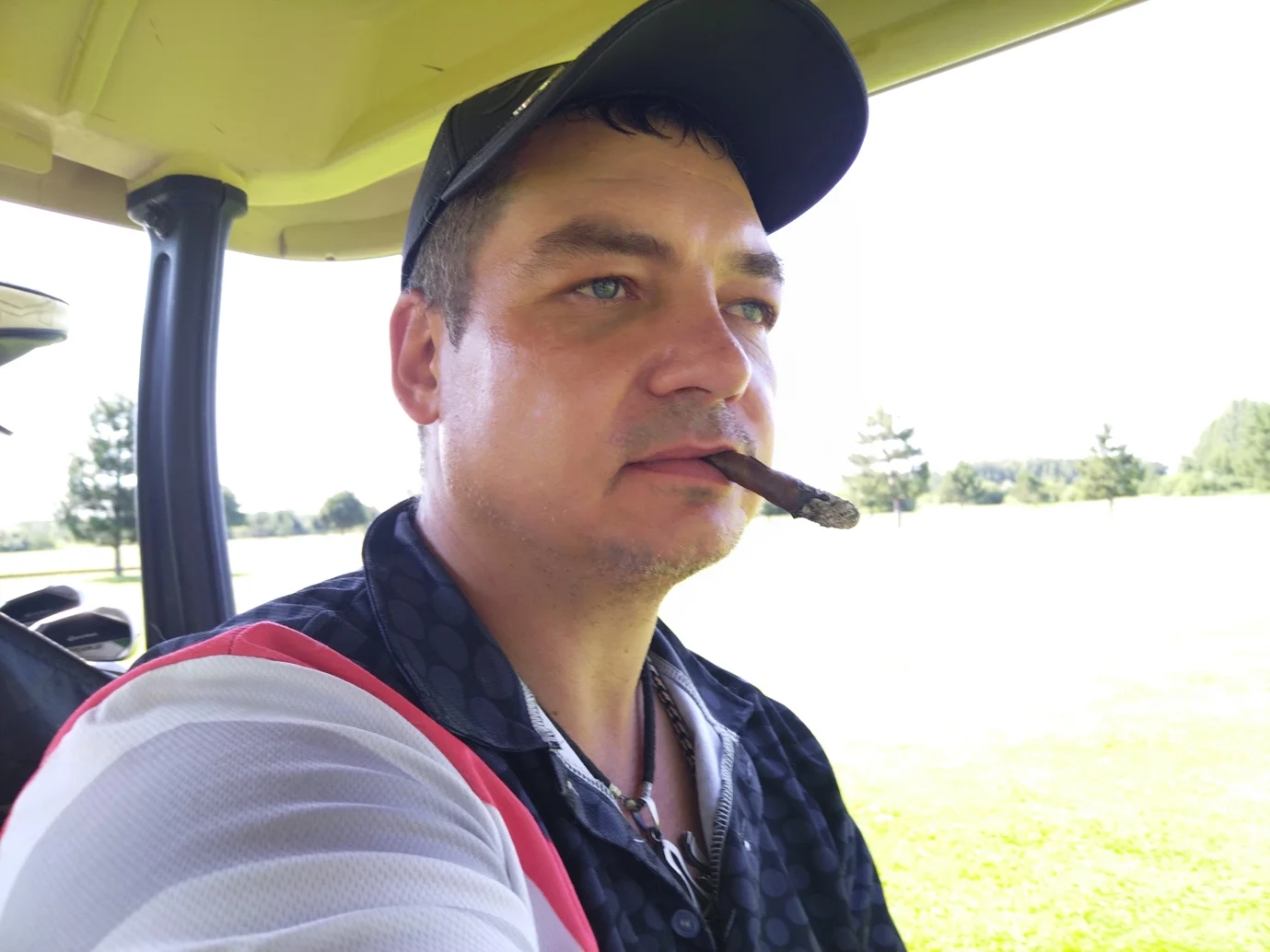
Sasha Kikin is a golf coach. The group he trains consists entirely of veterans and war invalids. Sasha Kikin is one of them. He also fought and lost his left leg in Sloviansk. Today, he trains people whose bodies and lives will forever be marked by explosions, gunshot wounds, shrapnel, contusions and trauma. Because it makes a difference whether someone who has seen war is there.
Eleven years of war and three and a half years of large-scale Russian invasion have made disability a visible issue in Ukraine – one all too often swallowed up in the prefabricated buildings of a big city like Kyiv. Or even in the small houses of a village without any paved roads.
Sasha Kikin says: “The difference between the EU and Ukraine is 15 cm.” That is the average height of steps. For a healthy person with two functioning legs, this is no problem – but for someone like Sasha Kikin, they were insurmountable. “I didn’t pay attention to them before I became disabled – and then I saw how dangerous a 15-cm curb can be when you have to climb down it.”
And then he started playing golf.
That was in 2017. Why golf in particular? Sasha Kikin says: “Practically all groups of disabled people can participate in this sport. Secondly, golf is a sport that aids both physiological and psychological rehabilitation, and promotes concentration.” What’s more, it’s simply fun, it’s communicative, you get together, you can chat, but in a completely different environment – in a well-kept setting, in nature, outdoors. This helps you to “detach yourself from external factors and problems.”
A man interjects: “And it’s the only sport where you can smoke and have a drink – if it’s later in the day.” He pats Sasha on the shoulder.
The golf novices have now moved on to the practice fairway. The aim is to hit the ball from slightly taller grass onto the green and, if possible, straight into the hole. Kyril is here for the sixth time. He has to do it with just one hand. The forearm of his healthy right arm is tattooed with the word “Death” in large, thick letters. He is 34 years old. A Grad rocket hit him in 2022 in a village near Donetsk. He was in a mortar unit there. Now he has undergone 28 operations, months of rehabilitation, a gauntlet run through the authorities.
These are things that Sasha Kikin knows well. When Russian special forces sought to annex eastern Ukraine to Russia in the spring of 2014 and there was virtually no army in Ukraine to prevent it, Sasha Kikin moved to the Donbas with a volunteer battalion. He lost his leg there. At that time, there were no applicable laws, no practical regulations, and no automatic state compensation for such cases. And certainly not for members of a volunteer battalion. In 2015, he founded a veterans’ organization. Since then, he has also been fighting for the rights of disabled people at the political level.
This is because there is still a jungle of bureaucracy between the disability itself and legally secured status. No single ministry is responsible for this area or has all the relevant data at its disposal. This is why the figures vary. According to Sasha Kikin, however, it can currently be assumed that around three million people in Ukraine have disability status – although this also includes many pensioners and people who are not war victims.
But there’s another problem: even a catalogue of criteria for granting status exists only in rudimentary form. This, in turn, opens the door to arbitrariness. And even after 10 years of lobbying in this field, Sasha Kikin says of the authorities: “They work with us – but without us. They don’t listen.”
The driving range is now crowded. So crowded that a warning is necessary. Because people are swinging hard here. It’s all too easy to get hit on the head – and that can end badly. Mykola manages 200 meters. He is a muscular man, and you would never guess that he has screws in his back. He jokingly calls himself the “star without crutches” in this group. He was a machine gunner in an infantry vehicle during the offensive in Kursk. Then there was an ambush. That was a year ago. He is still in rehab – he does not yet have official status. Swimming has helped him a lot, he says. Before that, he could hardly stand upright and sat in his flat. Golf, he says, is “just a game” where you can get out, be in company and forget your problems.
Kyril, who can only play with one arm, also takes a swing. He manages 20 meters. The sun is rising higher. He is sweating. He maneuvers a new ball onto the tee with his club. He tries again. 40 meters.
The fact that veterans gather here every Monday is thanks to an initiative by the organizations United through Golf, Mission Ukraine, the club itself and the Ukrainian Golf Association. Demand is high. Several clubs now offer free days for veterans. Over the months, one free Monday for veterans has turned into one free Monday and one free Tuesday.
The warm-up is over. It’s time to head out onto the course. The men place their crutches next to their clubs in the golf caddies. Musika holds on to the back of one of the carts and lets himself be pulled along in his wheelchair – over a flat gravel path, across a small bridge over a pond, onto the course. Then it’s tee time. And then: on and on towards the hole.
When he started playing golf, he couldn’t stand on his feet for five minutes, says Sasha Kikin, cigar still in mouth. And today: his walking stick with the silver skull knob is in his bag next to his clubs – and that’s where it stays. Kyril slowly feels his way across the driving range. Sometimes he manages 3 meters, sometimes 15, to the green, to the hole. The third member of the group is an unscathed veteran. One who, as he says, was just lucky. In Bakhmut, they had their position in a three-story house – and then a rocket hit it. Only one room remained relatively unscathed. That was the one he was in.
Some men sit together smoking, others are about to head back to Kyiv. Sasha Kikin sits in the shade with a mocha orange with ice cubes, smoking, shaking hands. “This is a game for gentlemen,” he says.