“Buon Appetito,” Fedir says warmly, smiling. He sits alone at the table; three seats remain empty. Around his neck, he wears a lanyard with a badge that reads “Artist.” He says he is a poet and loves hiking in nature. The next day, he will recite some of his poems at the festival. He was in Lviv seven years ago. However, circumstances were different back then. He lowers his head and laughs, as if remembering a funny story, as if he were briefly back there, and then he falls silent.
Fedir is also a soldier. The 31-year-old fought in the trenches for a year and a half. He served in the Ukrainian Army’s 72nd Mechanized Brigade, which defended the city of Vuhledar against the Russian advance for two years. Now, he is part of the Cultural Forces of Ukraine, an association that supports soldiers through artistic projects. Just a few kilometers from the front line, he reads his poems to soldiers. This is important for their mental health. On some days, bombs strike the area several times.
“It’s not safe, but for me, it’s become normal.” The war has already claimed the lives of numerous Ukrainian artists, including writers and singers. The world wonders where, on behalf of all artists, the Hemingway of Ukraine might be. The answer is, “In the cemetery.”
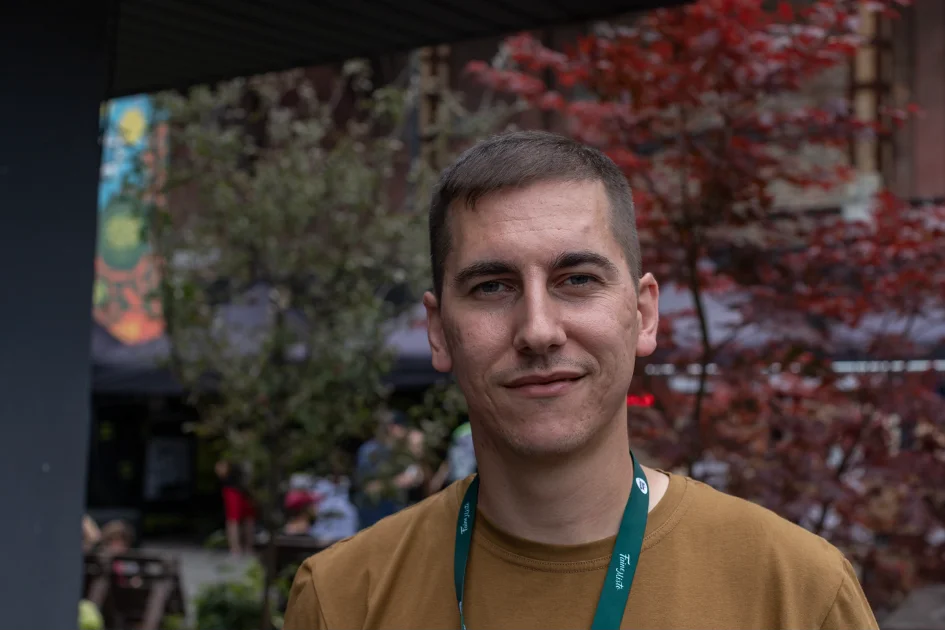
The Faine Misto Festival has been held since 2013. With the start of the full-scale invasion, the venue moved from Ternopil to Lviv. Over three days in early August, 69 bands performed here, with the music ranging from acoustic folk to death metal.
Even before the festival begins, the unusual features of this event become clear. The organizers announce that drones will be used for recording purposes but that there is no cause for concern, as these are not Russian attacks. Headliner shows on the main stage will end before 10:00 p.m., and the curfew will begin at midnight. None of this dampens the mood. After more than three years of full-scale war, people here seem to have become accustomed to many things.
The press center is located right next to the staff entrance. In the light-filled foyer, Olha and her colleague Nataliia are busy making a camouflage net that will soon be sent to the front line. On average, it takes two days to complete, but demand is currently high, explains Olha. “If we receive an order today, it will take until September to process it.” The nets don’t last long. They burn up after just a few days due to attacks, so new ones are needed quickly. What motivates her to do this work? “If you’re not directly involved in the war yourself, you live and work for the Ukrainian armed forces. So, when I hear that they need a camouflage net, I come and give my time for it.”
Press conferences take place just a few meters away. Tori, 34, is the festival’s media coordinator. For her, the festival is more than just work: “It’s a place where you feel freedom. It’s a powerful act of resistance that demonstrates our unbreakable spirit and desire to live, create and support each other.”
She explains that holding the festival during wartime is not without controversy. However, she emphasizes that it is a charity festival. All donations go to the Ukrainian military, particularly to purchase evacuation vehicles for the Azov medical services. “Isn’t that the most important thing when Ukraine is at war?”
For Lena, the singer of the Ukrainian hardcore band 0%Mercury, the festival represents an opportunity to be heard. Bands from Ukraine currently have few opportunities to express their views on important issues. The festival is also a “great opportunity to raise funds for our cause.”
How has the war influenced her songwriting?
“We had to write songs in very unusual circumstances. For example, we had to work quickly while the electricity was on or record while there was heavy shelling.” She doesn’t see music as a weapon but as a form of medicine: “It helps you get through difficult times and motivates you to keep going, even on the darkest days.” The next day, she will transport her fans away from their difficult reality with her powerful screams.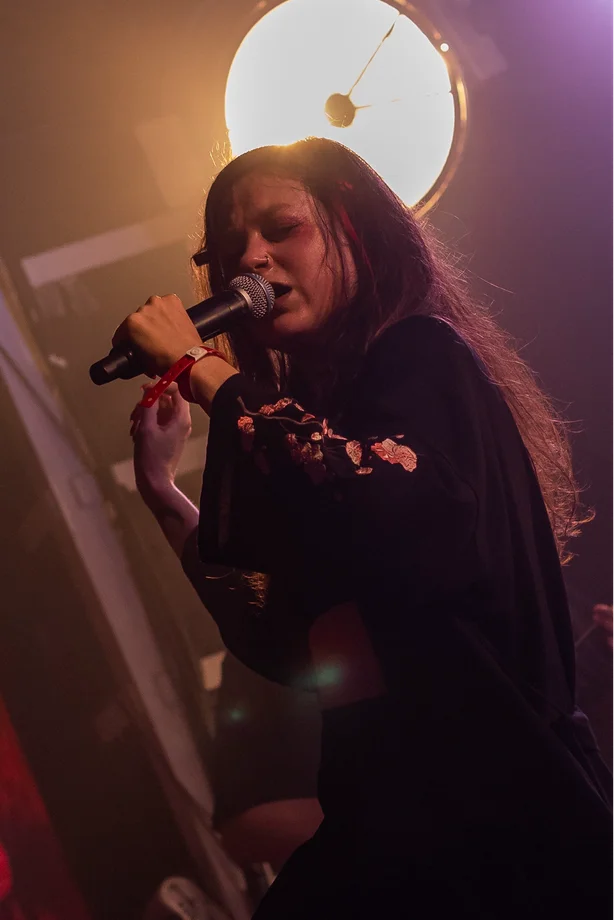
The Underground Stage is located in the building next to the press center. It is Saturday, 6:20 p.m., and the Ukrainian band Telema is performing. Singer Vlad is singing about how pleasure is not a sin when the air raid siren sounds. Within minutes, 6,000 people are expected to seek shelter. Twenty-four minutes later, the all-clear sounds and the visitors immediately flock back to the stages. Here, they have learned that time is precious.
Margaryta, 40, a Ukrainian living in Vienna, says it means a lot to her to support her soldiers by collecting donations. Even though it is a music festival, she also sees it as a form of protest “against the death, suffering and tears that Russia is bringing upon us. We have learned to value every minute, every day, and have decided to spend it meaningfully.”
From the Underground Stage, the path leads past numerous food and merchandise stalls to a shallow water basin. On this day, many visitors take the opportunity to cool off and enjoy spending time together. However, Fedir reveals that it feels strange for him to be at this festival. “I don’t feel comfortable seeing so many people having fun.” But he knows that people have to live. “Every day, our houses are being destroyed. We have to laugh, too,” says the 31-year-old.
Vlad is singing about how pleasure is not a sin when the air raid siren sounds.
Fedir wants to show a small bookshop that is not far from the main stage. A soldier sits outside, next to a large, dark, worn military box containing a few books. Fedir explains that these are donations that will be taken to the soldiers on the front line. Reading allows them to escape the horrors of war for a moment: “It’s like being in another world.” However, he himself lost the ability to read some time ago: “After the trenches and mental exhaustion, the brain refuses to do anything that requires concentration and attention.”
Which books are suitable for donations? “Perhaps ‘Dancing with Bones,’” says Fedir, referring to a medical thriller by Andriy Semiankiv. It tells the story of Severin, a pathologist working in a provincial hospital under the most adverse conditions. One day, he receives an offer to perform illegal organ transplants. He agrees, hoping for a better life, but he gradually loses his moral compass. Is he really sure that this book is suitable for soldiers on the front line? “Yes.” What did he do for a living before becoming a soldier? “I made gravestones,” he says, laughing.
Only a few military personnel are professional soldiers. Most are civilians, mainly from villages. All of these men felt fear when they joined the army, but they also felt a great sense of responsibility. They all asked themselves, “If I don’t protect my family, who will?”
Near the bookshop stands a pavilion, and underneath it, almost hidden, lies the festival museum. Since 2024, a memorial has stood here to commemorate six team members who died in the war. Viktoriia, the director of the museum, displays their portraits, personal belongings and uniforms. The last of the six she introduces is Vladyslav Voronin, the former festival coordinator. She describes him as a passionate partygoer, festival-goer and volunteer at numerous events. And he was her own husband.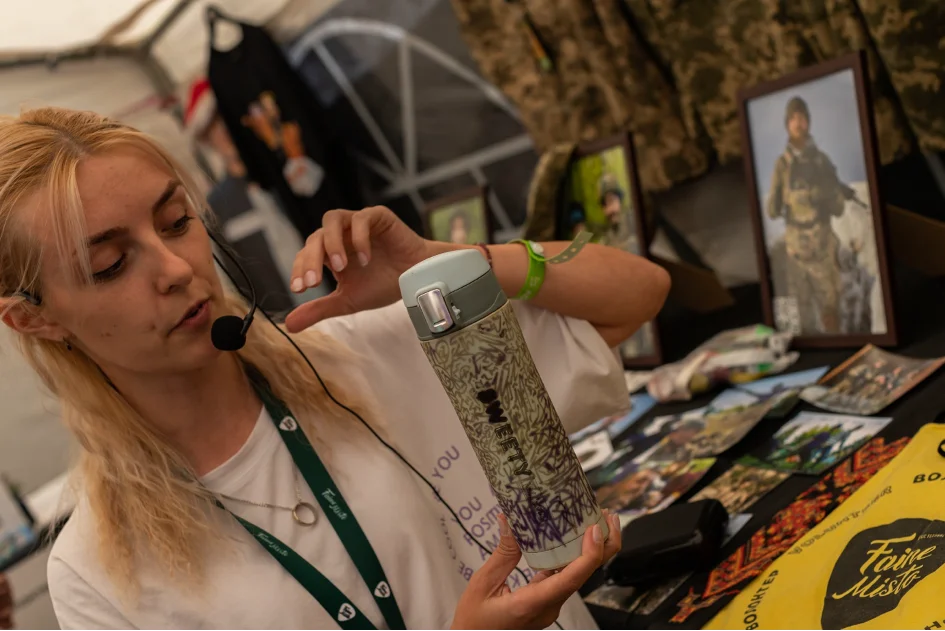
Vladyslav, a trained lawyer and university lecturer, joined the Ukrainian army on March 20, 2022. Even while serving, he remained active in the legal field, protecting the rights of military personnel, according to Viktoriia. In April 2023, he joined the 47th Mechanized Brigade and took part in infantry battles in Robotyne and Avdiivka. When his company commander was seriously wounded in October 2023, he became the sole remaining officer and took over as deputy commander.
Born on April 23, 1995, in Dnipro, Vladyslav (callsign: Woodstock) fell in battle on Nov. 29, 2023. According to his comrades, he “destroyed a large number of occupiers’ before he died, reports Viktoriia. On that day, the advance of Russian troops on the village of Stepove was halted. However, just three months after his death, the village was occupied by Russia.
Vladyslav showed the utmost honor, Viktoriia says: “Love for his country, his homeland and his people. He had everything: dreams, plans, adventures, friends, a loved one and a family. Yet he chose the highest values: freedom and dignity. He threw himself into open combat with the enemy and sacrificed the most precious thing he had, his life, for the freedom of each and every one of us. He is our hero and was awarded state honors. He is a role model for courage and bravery. He is the pride of our nation.”
Right next to the museum, a narrow corridor covered in black fabric leads to a pavilion. Relatives of fallen soldiers can record video messages and leave handwritten words of remembrance, says Director Oleksandra. While most obituaries are in Ukrainian, there is also a message in English. It was written just a few minutes ago: “Benjamin Aser (21). A brave Hungarian who did what his heart said: Tough in Azov and he fell. He showed everyone in the world: not all Hungarians are bastards!” A Hungarian citizen and former soldier in the Hungarian army, Benjamin Aser fought as a volunteer against Russia and was killed in action on May 24, 2025, shortly after his 21st birthday.
It is evening in Lviv, and the festival is drawing to a close. Behind the main stage, the sky is partly gray. From across the way, rays of sunlight bathe the stage in warm light. A little girl sits on her father’s shoulders, playing around and tying his hair into a ponytail. A man as big as a wardrobe sings powerfully along to Iryna Shvaidak’s moving vocals. A young redhead lies in her partner’s arms, comforting him.
As punks with colorful hair celebrate a last moment of freedom, Fedir is already on his way to the train station. At 6:52 p.m., he will take the train to Kramatorsk. His thoughts will later be reflected in the lines of one of his poems. On May 31, 2024, in the trenches, he wrote: “It’s hard in war to be the last, the very last; it’s hard here... actually. Why didn’t I want to stay at home?”