If you missed Part 1, you can read it here.
Mysterious and other-worldly, the frozen wasteland we call Antarctica was, millions of years ago, prowled by dinosaurs. In its ancient rocks are the fossils of these magnificent creatures that roamed through polar rainforests.
Today, this world is lost in time. Separated from the other continents by the vast Southern Ocean, Antarctica was plunged into a deep freeze. In the last century, its icy and foreboding allure brought famous explorers to its shores to seek its scientific treasures and pursue their quest to reach the geographic pole. Today, it is home to scientific research bases, including Ukraine’s Akademik Vernadsky station on Galindez Island in the Antarctic Peninsula.
Antarctica has never been easy to reach. Some stations are served by aircraft, others by ship. Since 2022, the ice class vessel “Noosfera” has brought Ukrainian scientists to Vernadsky station, with all their scientific supplies and food.
Vital scientific research at Vernadsky station, Antarctica
Peer into the murky waters around Vernadsky station, and you will find strange aquatic microorganisms adapted to their frigid temperatures. Many of them are called ‘extremophiles’ because they thrive best when faced with the extremities of the continent. Living in the cold salty depths, some of them are known to produce chemical compounds that could be used in pharmaceuticals to treat disease or as antibiotics; others may have novel applications in industry such as speeding up chemical reactions in industrial processes.
It is in these unusual single-celled creatures that many scientists who work in Antarctica, including those at Vernadsky, are looking for answers to some of our pressing medical and industrial challenges.
The search for these valuable new compounds is the task of EXPLORA – just one of the many scientific projects run by the seven or so scientists who come to the station each year, along with a doctor, a cook and engineers.
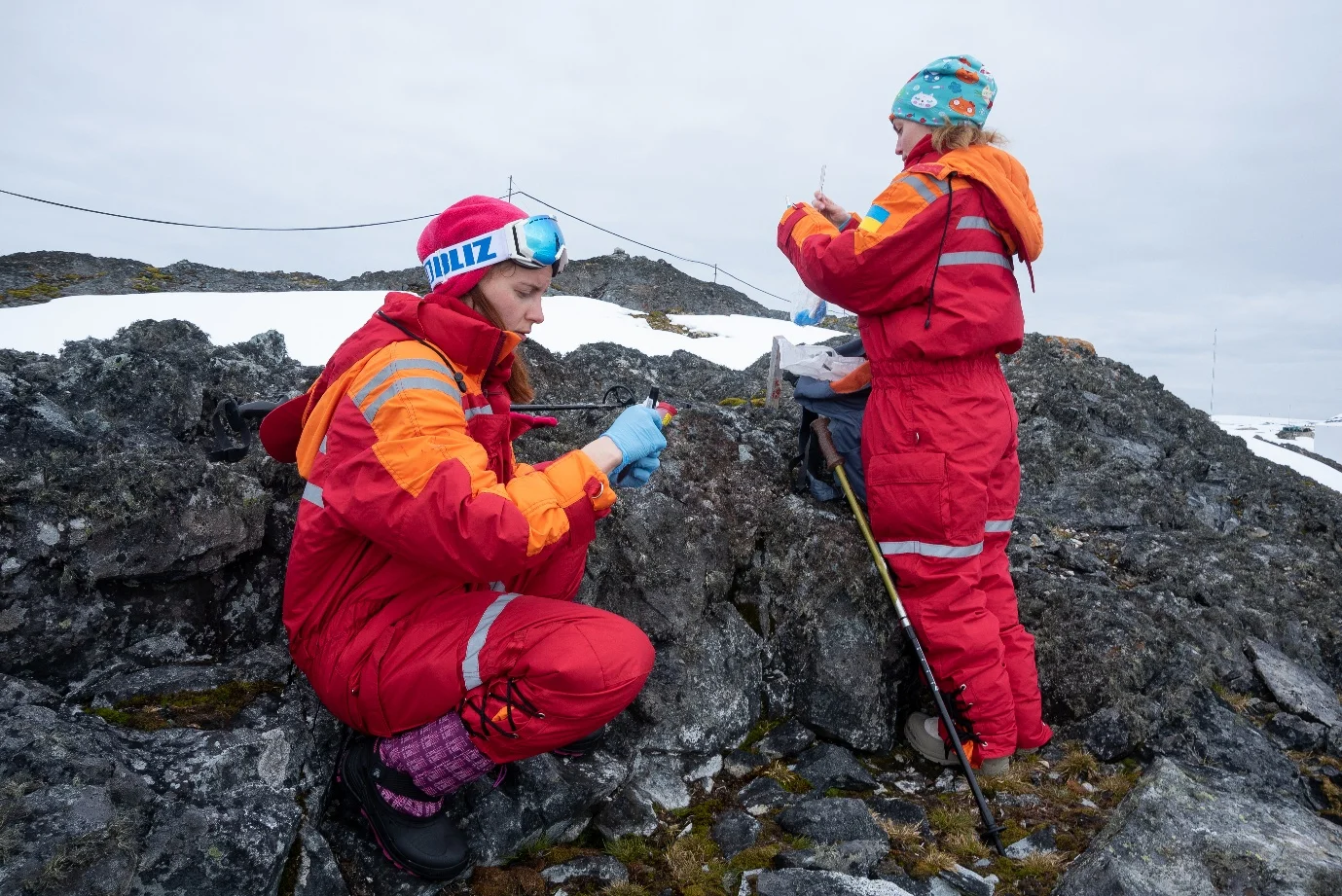
Life at the station is comfortable – there is even a small cozy bar for an evening drink – but it is not an easy life within a forbidding and unforgiving environment. In the six-month winter, which plunges the station into darkness, no ships can visit. You must have everything you need for repairs on site. Survival demands people with tenacity, courage, resourcefulness and mental strength. For those with the right character, a season at Vernadsky station is a life-changing and much sought-after accolade.
Investigating our planet’s climate
Ukraine’s scientists focus some of their attention on the Southern Ocean, part of the global system of waters that circumnavigate the planet, carrying heat and affecting climate, winds, rainfall and thus the biosphere.
The man after whom the station is named, Volodymyr Vernadsky, coined the term ‘biosphere’, and knew the importance of the oceans to all life on the planet. The name of the station is a fitting tribute to the person who was the first president of the National Academy of Sciences of Ukraine.
Ukrainian scientists are participants in the EU project OCEAN:ICE, which explores the effects of the Earth climate on the Antarctic ice sheet and the behavior of the ocean around the continent. Buoys deployed in the Southern Ocean from the “Noosfera” monitor the currents around Antarctica, contributing to the global effort to understand life on our planet, and how it is sustained and changed in conditions of global warming.
The station has been the home not only of Ukrainian scientists, but visitors from other countries too. They come to Vernadsky to join Ukraine in carrying out its program of scientific research. Overseen by the Ministry for Education and Science of Ukraine, the National Antarctic Scientific Centre formulates and develops the projects at the station as well as on board “Noosfera”.
The scientists look outwards to the extreme biology and the global circulation of oceans, but they also look upwards. The clear Antarctic skies and the location of the station give scientists the opportunity to make startling new discoveries.
It was at Vernadsky station, during its former incarnation as Britain’s Faraday station, that humanity discovered the hole in the ozone layer – chemical reactions which break down the ozone gas that protects us from the damaging effects of ultraviolet radiation. At Vernadsky, Ukrainian scientists continue the valuable and important series of measurements of these tenuous molecules formed high in the atmosphere – investigations that have been uninterrupted since 1957.
Thanks to the Montreal Protocol, signed in 1987, ozone-destroying chemicals were banned, and the hole has begun to repair. But new sources of ozone-destroying gases mean that we must continue to monitor the health of our atmosphere.
Recently, Ukrainian scientists have played an important role in the discovery and study of so-called “atmospheric rivers.” These are rare, but influential air streams in the atmosphere that bring warm moist air from the subtropics to Antarctica. When these invisible currents reach the continent, they cause relatively extreme heating, melting the ice and triggering the collapse of ice shelves, with knock-on effects contributing to sea level rise and changes in the global climate.
If we want to understand natural climate cycles in the past and how human activities can change planetary conditions, then we need to know what the atmosphere is doing, and how these enigmatic “rivers” transport heat around the planet.
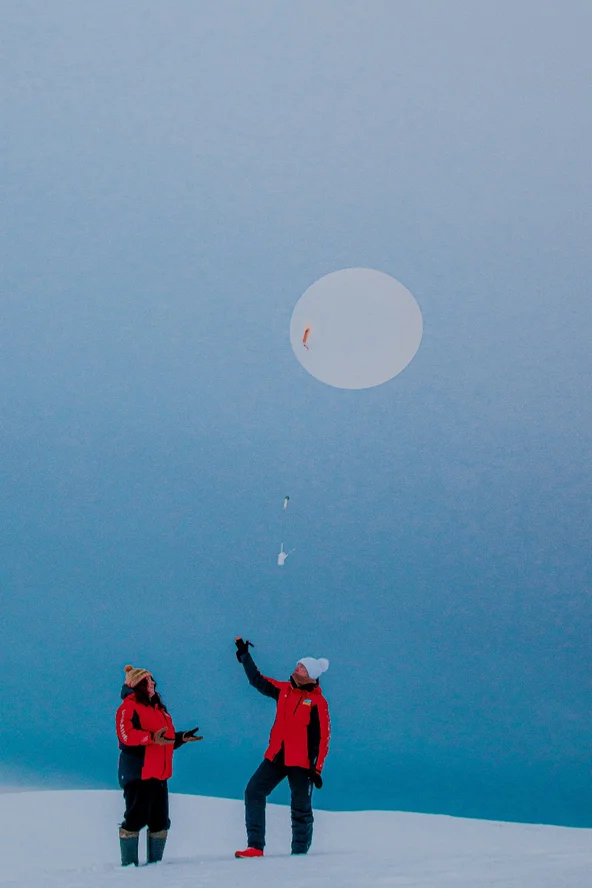
In a landmark paper in the journal Nature in 2023, Ukrainian scientists jointly with other international scientists described historically high temperatures and ice melt associated with a strong atmospheric river, significantly advancing our understanding of how the Antarctic continent is coupled to the rest of the world though the atmosphere. Scientists predict that a changing climate will lead to more frequent atmospheric rivers, with consequences for the rate of ice melting in Antarctica. To successfully predict the future of our planet, this research at Vernadsky is essential.
Global science
Vernadsky does not sit in isolation. It is part of the international network of Antarctic and Arctic stations – POLARIN. This network coordinates scientific research across both poles, working to train the next generation of scientists and share scientific facilities, from instruments to data. In this way, polar research can be made more effective and efficient, with a vibrant exchange of ideas and information between national polar programs.
Vernadsky station’s purpose in Antarctica is emblematic of the culture of collaboration that has characterized the White Continent since the founding of the International Antarctic Treaty in 1959 – a global agreement that keeps Antarctica as a world science park. Military conflict and weapons are banned, and everyone works together to further scientific interests.
As our impact on the planet has become better understood and the astonishing diversity and practical applications of scientific research on the continent are better appreciated, including the unique properties of its extraordinary life forms, so research at Vernadsky continues to play a vital part in humanity’s scientific advances. Vernadsky Research Station places Ukraine in the ranks of the world’s major scientific nations.
Charles Cockell is Professor of Astrobiology at the University of Edinburgh.