This week saw the weather turn colder in Ukraine and the fighting turn more mechanized, but there weren’t any surprising results, the Russians tried to turn Ukrainian homes into iceboxes but the Ukrainians already are pretty practiced staying warn when the Russian Federation is bombarding them.
Also, the Russian army, using its own internal logic, returned to optimistic, armored attacks with tanks and infantry fighting vehicles, in a definite bid to gain ground by overwhelming Ukrainian defenses with massive, modern combined arms firepower. Way back in February 2023 the Ukrainians first put together a solid combined arms defense that cut attacks like that to pieces, and since then pretty much neither side has been able to make much progress with armored forces against an organized defense. This week we saw that nothing really has changed.
In this war, you drive a lot of armored vehicles out into the open, it attracts drones (sorry) like flies on… something. Why the Kremlin thought this week would be different, well, it seems like they were hoping something had changed. Nope.
Also: Some of you will have noticed Trump and the White House are blathering about another “summit” with Putin. I ignored the last one because I thought it was stupid and nothing would come of it, I see no reason to change that approach.
The armored “battles” around Dobropillya and Shakhove
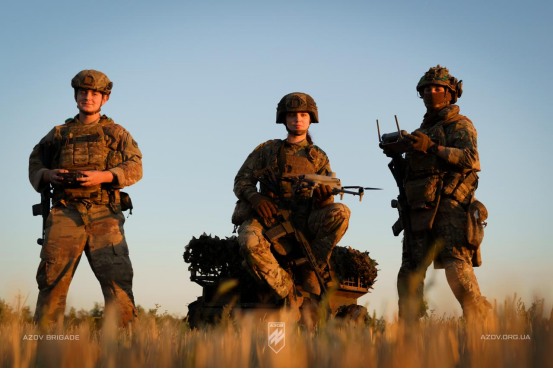
Lead image is a publicity pic from 82nd Air Assault, who notched up another battle streamer this week.
Here are the battles – and really this means “Russians drive forward and Ukrainians hit the column with drones and artillery – that I saw reasonably reliable evidence of this week:
October 10 – Pokrovsk sector, Dobropillya battle area, near Shakhove village, 35 armored vehicles, tanks and IFVs, plus 41 motorcycles, head towards lines held by Azov/1st Corps. Some reports say attackers were “Russian marines.” Attack fails, Russians retreat, Azov claims it destroyed or damaged 3 tanks, 16 IFVs, 1 armored recovery vehicle, 41 motorcycles, 107 Russian personnel KIA. A source inside Azov told me that was the internal unit reporting but he wasn’t at the fight.
Oct 13 – Pokrovsk sector, Dobropillya battle area, near Shakhove and Volodymyrivka villages. Elements reportedly of 3 motorized rifle brigades, plus 40th Marine Infantry brigade, attack with 9 BMP-type IFVs, 4 BTRs, 3 tanks, 2 cars, undetermined number of motorcycles. Overall defense again is Azov/1st Corps, but this time air assault infantry assigned to 1st Corps also was involved in the defense, as were SBU drone operators. No ground gained, Russians retreated. Losses claimed by the Ukrainians: 9 IFVs, 4 APCs, 3 tanks, 2 cars, “motorcycles, 78 (roughly) Russian KIA.
October 15 – again Shakhove, but this time with 155th Marine Infantry leading the attack. The attack force this time was 17 armored vehicles (1 tank , 16 IFVs/APCs including pretty modern BTR-82A. The attack hits a sector manned by 93rd Mechanized Brigade and 82nd Airborne Brigade – these are both seasoned, well-commanded, veteran units. The Russians managed to reach a big anti-tank ditch but stopped there, were cut up by all manner of attacks, gained no ground and retreated. The Ukrainians claim they destroyed or damaged: 1 tank, 12 AFVs; 100 (roughly) Russian KIA/WIA.
Thanks to the 82nd and 93rd Brigade press sections and drone units working for the 82nd, we have good information on the maelstrom the Russians drove into: HIMARS, artillery, FPV drones, bomber drones and mines. Here is a list of the drone units that were flying just in the 93rd Mech sector: SSO special ops, Phoenix and Kryl Omega. Also 93rd Mech’s rocket battalion launched Hrad strikes.
Russian sources confirmed the disaster, and those willing to gripe are repeating once again the ancient Russian military refrain that the army is run by idiots and drunkards.
I would say at least this is hard evidence of a competent, well-run, combined arms defense. Anyone who thinks the Armed Forces of Ukraine (AFU) is a sad-sack bunch of militia that should bow down to NATO “combat skill” is a moron.
October 16 – yet again Shakhove, 155th Marine Brigade and 40th Marine Brigade attempt another massed armor attack, this time with 2 columns, 11 tanks and/or IFVs in the main column, and 11 more in a follow up column. The Russian marines are engaged by 82nd Airborne Brigade, Azov Brigade (this is the core brigade for 1st Corps) and now Unmanned Systems Forces.
Azov Brigade probably has the most skilled and battle-seasoned chain of command in the entire ZSU, if not Europe. I am not kidding, most of the field grades in Azov have been in the brigade since 2014 and in command since 2017 at the latest.
The Ukrainians claimed they destroyed 8 AFVs including 1 T-80BV tank; damaged 4 AFVs; “heavy” personnel losses. No Russian gains, first column destroyed en route to combat area, second one retreated, by Friday the battle was FPV drones hunting survivors or observation drones calling in artillery on survivors.
I leave it to someone else to do the math and figure out how this intensity of combat stacks up against say the Middle East, but in terms of objectives, pretty obviously someone high up in the Russian army said: “The Naval Infantry will mass its armor and break through around Shakhove and that will turn the Dobropillya salient defeat (reported two weeks ago by me and others) into a Russian victory.”
In other words, this week saw the Russian high command wipe out the better part of at least two elite naval infantry units in futile attacks against prepared Ukrainian positions, using tactics that have been obsolete for at least 18 months.
I think the best sum-up of this outcome has been provided by the Russian military media and milbloggers, which has been to pretend the battles around Shakhove this week never took place.
Check out the video:
The fighting generally
The fighting was generally static and neither side made significant ground gains. Russian net gains for the week, I read, were about 124 square kilometers, mostly in the Donetsk region, while the Ukrainians picked up about 8 kilometers, also in Donetsk region. Some of the Russian “gains” were/are infantry still scattered around Dobropillya/Shakhove battlefield, meaning they are on a piece of ground and are capable of fighting for it, but they are dismounted infantry without supply, and being hunted down by the Ukrainians. So “gain” is kind of a flexible term.
The biggest Russian gain of the week seems to have been some motorized rifle units that secured a few outlying houses in Myrnohrad, for which they had to cross two kilometers of ground. This reportedly took advantage of Ukrainian troops repositioning/rotating.
The most unstable, worrisome sector seems to be around Kupyansk, where independent sources are saying it’s not at all clear which side controls the city. Official Kyiv sources are saying it’s the Ukrainians and it’s just Russian saboteur groups.
Finally, I read in a channel associated with Ukrainian army intelligence that in the Sumy region, near Novy Put, the Russians have moved up “fresh” soldiers from the 234th Airborne Assault Regiment, and near Varachyne, reinforcements from the 83rd Airborne Brigade are moving into position. Supposedly troops from the 119th Airborne Regiment are being prepared for new assaults in Yunakivka, and 51st Airborne Battalion and the 137th Airborne Regiment are entering Sadky. This may all be true, and it may also be Ukrainian intelligence pushing out detailed information to scare the Russians with their level of “secret” knowledge. In any case it’s Russian paratroopers, and so at least a curious report.
Ukraine bombarding Russia
The list for the week by my count looks like this:
- Volgograd, Transneft Oil Pipeline, pumps and pipelines, 5-7 explosions, fire Oct. 11.
- Bashkorstan, Bashneft-Novoil refinery, fires, Oct. 13.
- Feodosia, Oct. 14. Fuel storage facility hit again, 10 reservoirs on fire
- Simferopol Crimea, power transmission stations, Neptune cruise missiles and drones, fires, Oct. 14.
- Bashneft, Ukrneftekhim oil refinery, fires, Oct. 15.
- Saratov, oil refinery, SSO drones, second time this month, one tower stopped work, Oct. 16.
- Nizhny Novgorod, Ksotovo oil refinery, Nizhnegorodnefteorgsintez, Lukoil – Oct.16.
- Sochi, explosions vicinity, oil refinery, Oct. 17.
- Gvardeyske Crimea, Atan filling station central fuel depot, fire visible from 18 kilometers. Oct. 17.
- Vologograd, Balashkovo power station – Oct 17.
The not very clever conclusions to draw from this is that first, the Ukrainians seem to be widening their strike footprint to hit power stations. And second, they are not running out of tools with which to hit Russia’s power and energy infrastructure, the damage is accumulating, close to everything that was hit this week, was hit in the last month.
Indicative particularly is the Feodosia oil storage facility, which was still burning from the first strike, major fires, when the Ukrainians hit it again. Reports are 10 (!) fuel storage containers are on fire, and 3 years-plus of war experience tells me the firemen won’t be able to put out those fires. But we’ll see.
Russia Bombarding Ukraine
The Russian objective as noted earlier seems more focused on making Ukrainian civilians miserable than achieving war goals or having an effect on Ukrainian war-making capacity, but it still works out to focused attacks targeting the power grid.
Like the Ukrainians, Russian strike planners are continuously working to improve strike efficiency. According to Ukrainian power grid watchers, the latest Russian strategy is selective targeting of a section of the Ukrainian power grid, to overload the whole thing and cause cascading blackouts.
I can tell you this strategy is having effects several ways, all open sources. First local authorities are talking a lot more about generators, candles, stocking in a water supply, and having a plan when the power goes out. Second, the places the Russians are hitting are obvious critical nodes in the Ukrainian power grid. Third, there have been big power outages – so far never for days, but a couple of times in a couple of places for part of a city most of a day.
It’s worth noting the Ukrainians have achieved the same result hitting Belgorod and environs more than once. But this section is about the Russians.
The big strike this week came overnight Oct. 15-16. The Russians launched from multiple directions (Lipetsk, Rostov, Bryansk, Crimea) with what the Ukrainians counted to be 320 strike drones, 26 Iskander-M/KN-23 ballistic missiles (a record number in a single attack, none intercepted, but see below), 2 Kh-47M2 Kinzhal air-launched “hypersonic” missiles, 7 Kh-59/69 air-launched cruise missiles, and 2 Iskander-K ground-launched cruise missiles.
The announced targets was Ukraine’s oil and gas infrastructure because, Russia’s Ministry of Defense said, evil Ukraine is targeting Russia’s oil and gas infrastructure, and that should stop.
The critical piece of news is, supposedly, no intercepted ballistic missiles. This is probably more a function of where the Russians were bombarding than Patriot missile shortages per se, but that probably didn’t make anyone hit by an Iskander feel any better. However, some reports said 18 ballistic missiles were “lost,” meaning usually they went off track. This could be either a successful jamming, or a new terminal phase trajectory.
All in all, the Ukrainian air force eventually reported 13 missile hits and 56 drone hits, in 19 locations. Broken down it seems to be two Iskander hit gas production facilities near Poltava, in Kharkiv vs. Various targets, one or two against gas facilities in Chernihiv region, and power grid facilities in the Dnipropetrovsk, Vinnystia, Zaporizhzhia regions and Kyiv city. In the capital, hits on the power stations in the north of the city cut off electricity to the left/northern back for four to twelve hours.
But because of the strikes and the overloads on the grid from places that weren’t hit, there were massed emergency shutdowns in the Rivne, Khmelnytsky, Volyn, Ternopil, Lviv, Ivano-Frankivsk and Bukovina regions.
Ukrenergo the next day said: “Russia can control the blackout by creating a deficit at the end of the border and gradually paralyzing the flow of electricity from entering similar regions – the enemy is successfully implementing blows.”
The record should reflect that neither Russia nor Ukraine, yet, have gone after nuclear power stations. One of the interesting things about Ukraine is that even in peacetime it generates more than half of its electricity with nuclear power, in war it’s more. In western Russia the figure is 24-25 percent, I read. This means that, unless Russia figures out way to break down the grid itself, Ukraine should have some electricity, the Russian plan for blacking out the country can’t work. Hence the current plan, which is trigger overloads and rolling blackouts.
Black Sea raid
According to Russian sources on Thursday the Ukrainians sent at least nine robot boats from the Odesa region towards Crimea, they supposedly sailed on Wednesday and were engaged overnight and in the morning, allegedly eight destroyed. A Mi-8 helicopter on Thursday morning supposedly sighted one more about 80 kilometers south of Sevastopol, and yet another “group” of robot boats put to sea that day as well.
As I write this on Friday no further reports. Which means maybe the Russian info was bad, and maybe there’s two groups of robot boats plowing around the Black Sea looking for trouble. I read that the sea conditions are light winds and small waves.
Bash the railroad
Interesting statistic, Russian forces hit Ukrainian railways equipment or personnel with almost 300 strikes since the beginning of August. This works out to an average of one attack every four hours 24/7. Image of a burning Ukrainian train.
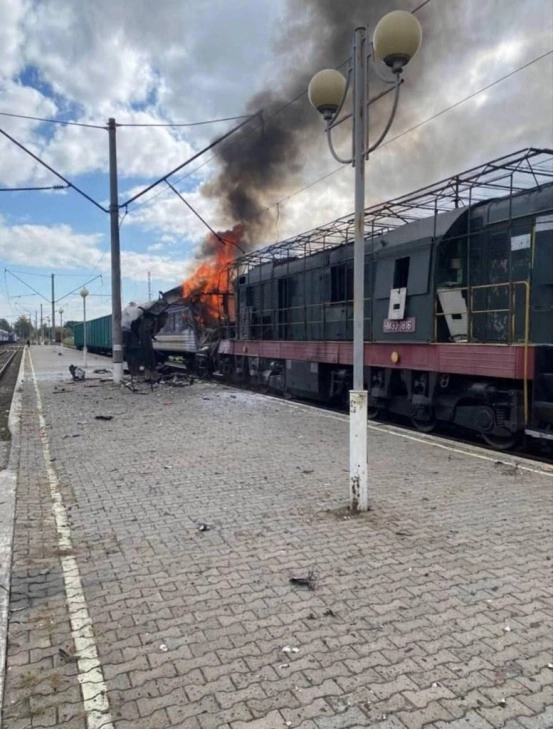
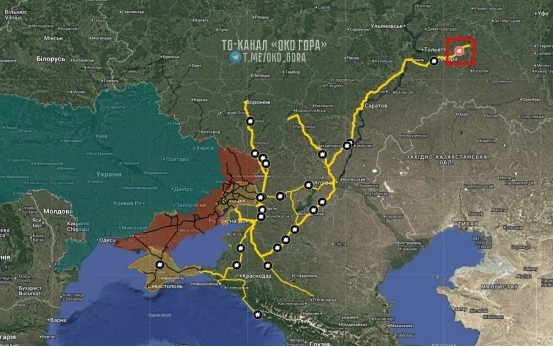
It is worth noting the Ukrainians have their own version of that strategy, they are visibly concentrating on southwest Russia, excellent map on that.
Downbeat news from Russia
The graphic for this section shows US liquefied gas coming on line this year and in future, this is bad news for Russian hopes to pull their economy out of the hole with energy exports. It’s not just Europe, the Americans say they can deliver gas to the Far East cheaper than the Russians can.

Tuesday
- Fuel shortages reported first time Novosibirsk
- Denis Pushilin, head of the so-called Donetsk People’s Republic (DPR) bans satellite dishes in the DPR, the people don’t need access to international TV
- Russia legalizes forced mobilization of a citizen abroad – five million reservists outside Russia
- In Chuhuiv, the Russian air force bomb a Ukrainian school that was bombed, repaired, and getting ready to have education and students until the Russians bombed it again.
Wednesday
- Fuel station shortages in Irkutsk region, first time there.
- BBC reports 57 Russian regions are suffering from fuel shortages caused by Ukrainian bombardment of Russian oil refineries
Thursday
- International news agencies quoting the White House say India has cut its imports of Russian energy products by 50 percent.
- India refiners buy Guyana oil for the first time ever, from ExxonMobil.
- Chinese car manufacturer Geely accuses Russian oil companies of causing mass engine failures in cars sold in Russia, engines are failing after a year, supposedly due to low qualify Russian fuel.
Friday
- Reuters among others reports that Russian oil exports are down 17 percent in September
- Bloomberg quoting the IEA reports Russian refining won’t recover from Ukrainian drone strike damage for six months, assuming the Ukrainian drones don’t strike again.
- News from India, the government has no idea of a plan to cut oil imports from Russia
Well, sanctions are sanctions, but the bottom line is the bottom line
This isn’t really directly war-related, but, a group called Dallas Park recently published an excellent piece of journalism chronicling how the big-time oil and gas player Schlumberger is helping Russia dodge energy sanctions.
It is also an interesting insight into Ukrainian targeting against Russia. Because there are companies like Schlumberger, it is improbable the Russian oil and gas production in terms of product pumped out of the ground can be seriously affected by the Ukrainians; the oil and gas fields are too far away and when they are in range there are western companies who will gladly sneak the Russians the tech needed to keep the product flowing.
BUT… for the product to get to market, it needs to be pumped via a pipeline through west Russia to a seaport, or turned into a more transportable product at a Russian refinery. Which is exactly what we see the Ukrainians hitting.
It’s almost surreal to report on sophisticated Ukrainian targeting of Russian energy export nodes, and how matter of fact it is that the Ukrainians will certainly have some real effect on that, it’s just a question of how much, when in 2022 the question was whether the Ukrainian lines around the capital would hold or was their going to be a siege of Kyiv like there was of Sarajevo.
Wedding bells in Poland
This is another item you can skip if your thing is war news and just war news. Still, on Friday Polish media citing government statistics reported a record number of Polish-Ukrainian marriages were recorded in Poland. The numbers for 2024 are 5,359 marriages involving Ukrainian citizens were registered, of which only in 535 cases did Polish women marry Ukrainian men.
This is probably less down to the fact that Ukrainian women have held a reputation (I would say deserved) of generally being excellent wives, for a good millennium, than the Ukrainian law that during war pretty much no men aged 18-60 may leave Ukraine, but women and children may.
Heroic female Ukrainian medics save British man’s life, apply first aid without regard to possible lawsuits
Three Ukrainian combat medics identified as Mivina and Rebekah, who this week, whilst in London for a conference, witnessed an auto accident and saved a victim’s life by stopping bleeding, applying bandages and monitoring vital signs until the ambulance arrived. Perhaps it was battle-honed survival skills, and maybe it was the young ladies didn’t know that in places like London putting hands on a stranger, even to help, risks lawsuits and legal attacks.
I think most of us already could predict that this photogenic, but unquestionably skilled and capable trio were from 3rd Assault Brigade. Some of us may have reminded ourselves that it is not just 3rd Assault that’s winning the war, it’s just that in the media sometimes it seems that way. But the story is confirmed in Ukrainian media.

Reprinted from Kyiv Post’s Special Military Correspondent Stefan Korshak’s blog. You can read his blog here.
The views expressed in this opinion article are the author’s and not necessarily those of Kyiv Post.