The Governor of Ukraine’s central bank, the National Bank of Ukraine (NBU), Andriy Pyshny said during an online briefing with journalists on Thursday that inflationary pressures had strengthened as a result of strikes on the energy sector and higher budget spending, but the bank has decided to keep the key rate at 15.5%.
The NBU also modestly decreased Ukraine’s real GDP forecast from 2.3% to 2% to 2.1% to 1.9% for 2025 – showing the economy is still slowing down because of the burden of Russia’s full-scale invasion of Ukraine.
The forecast for 2027 remained unchanged at 2.8%.
Previously, Ukraine’s central bank also worsened the figure of Ukraine’s GDP for Q2 of 2025, estimating it rose by 0.7% year-over-year, compared to the NBU’s January forecast of 1.1% growth for Q2.
The NBU reported the figure based on detailed GDP data from the State Statistics Service of Ukraine (SSSU). The central bank attributed the weaker performance mainly to the consequences of the full-scale war and an underperforming agricultural sector, which delayed harvesting due to unfavorable weather.
Inflation still represents a concern for the NBU which Pyshny described as “sticky.” The less volatile benchmark of the economy – core inflation – is decreasing less slowly than necessary.
“The growth rates of prices for a number of core inflation components either declined slowly – processed foods – or did not decline at all – services,” Pyshny said during the briefing.
Consumer inflation slowed to 11.9% year-on-year in September. According to the NBU’s estimates, this trend continued into October with core inflation declining to 11.0% in September.
The NBU also does not expect to see an improvement in inflation over the past quarter. Although the expectations of financial analysts were relatively close to the bank’s forecasts, the expectations of other respondent groups remained high.
Householders’ view of inflation rose based on web search statistics, Pyshny said.
This is why the NBU decided to return to the key rate decrease later than planned. Instead of its plans to lower the key rate in the fourth quarter of 2025. Now, it has decided to postpone any decrease to the first quarter of 2026.
And although Bloomberg previously reported the International Monetary Fund was putting pressure on the NBU to devalue the hryvnia, negotiations were ongoing.
Replying to questions on the topic, Pyshny also said that NBU’s primary focus is financial stability.
“During our work with the International Monetary Fund, our focus remains on price stability and external resilience. But the final decision remains with the central bank, which has responsibility. We thank our colleagues for their expertise… but to say that we are on the final stage of discussions is too early,” Pyshny said.
Inflation in Ukraine will decelerate, NBU says
Ukraine’s central bank aims to bring inflation down to the 5% target. The slowdown in inflation will be facilitated by the pass-through to consumer prices from the effects of this year’s harvests of vegetables and grains, which saw further increased harvests.
The NBU also aims at supporting interest in hryvnia assets and the sustainability of the FX market.
Inflation will also feel less pressure due to slower growth in real wages easing pressure on the costs incurred by businesses, Pyshny said.
But energy outages hit hard: businesses will spend more on ensuring uninterrupted operation amid energy shortages and due to the rapid growth in administered prices, according to the NBU.
Previously, the State Statistics Service also reported Ukraine’s real GDP rose by 0.8% in the first quarter of 2025 compared to the same period the previous year. The service published the flash estimate of GDP for Q2, which will likely led the central bank to also update its forecast.
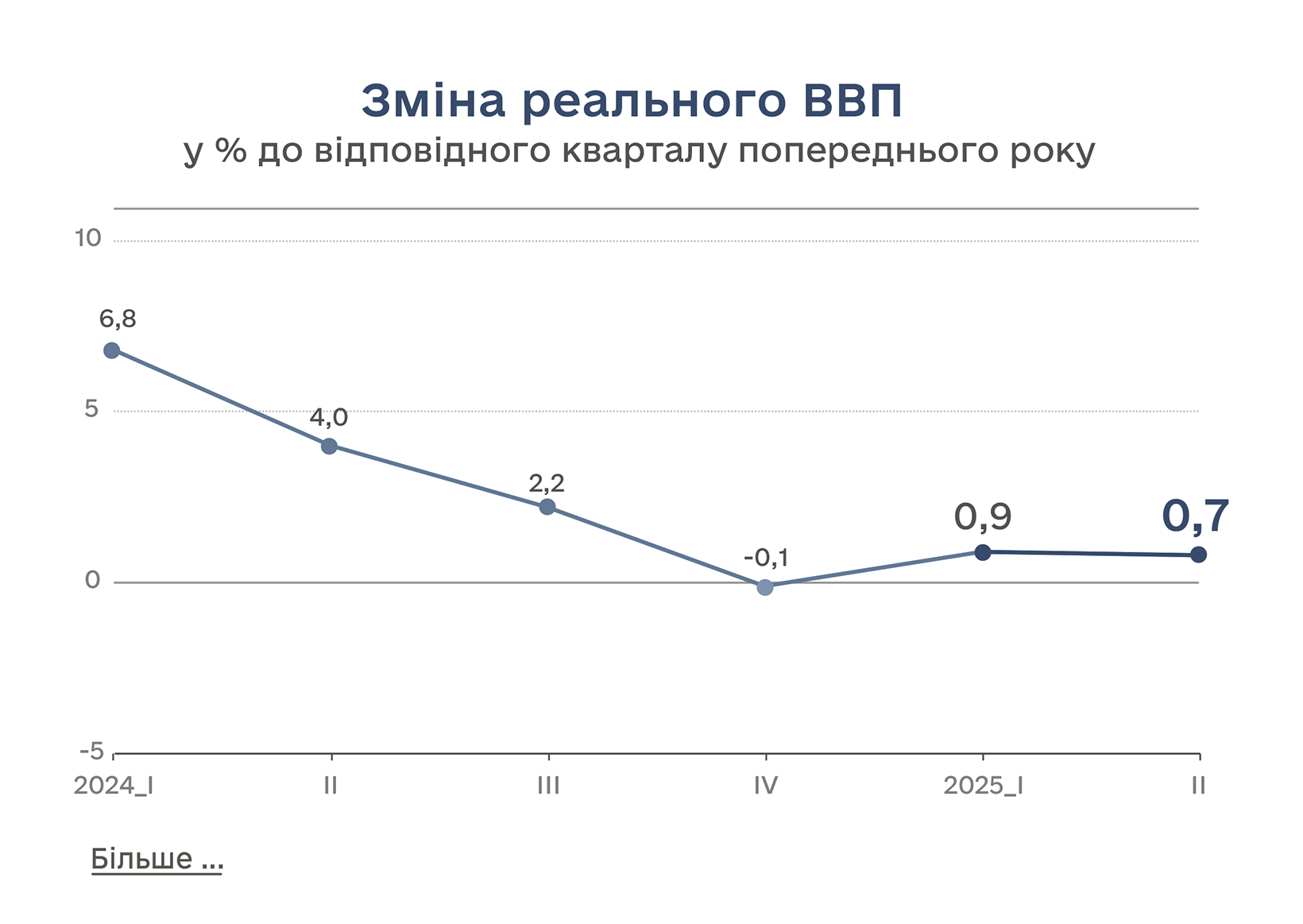
According to NBU’s estimates, economic growth picked up in Q3 2025 thanks to the intensification of early crop harvesting, sustained consumer demand, and an improved situation in the energy sector, which lasted through to the end of September.
The expected increase in budgetary spending at the end of the year will support further recovery. However, energy shortages caused by the recent destruction of infrastructure and natural gas production facilities, coupled with labor shortages, will significantly hamper businesses activity.
War remains the key risk to Ukraine’s economy
Ukraine’s central bank is concerned about an increase in the intensity of air attacks and the destruction of energy infrastructure, logistics, and production facilities. This has already affected NBU’s forecasts, increasing the risks of higher price pressures and a further decline in economic potential.
Positive factors for the economy include increased military and financial support from partners and the international community’s efforts to ensure a just and lasting peace for Ukraine, Pyshny said.
In August-October, Ukraine received about $13 billion in external financing. By the end of 2025, another $15 billion is expected to arrive.