Key Takeaways from the ISW:
- The Kremlin is attempting to leverage the visit of Russian Direct Investment Fund (RDIF) CEO Kirill Dmitriev to the United States to spread Kremlin narratives in the US information space.
- Dmitriev effectively acknowledged that Ukraine has made compromises in its negotiating position while reaffirming that Russia’s maximalist demands from 2021 and 2022 remain unchanged.
- Dmitriev attempted to appeal to what he perceives to be Trump administration interests in order to distract from Dmitriev’s statements, which demonstrate Russia’s continued unwillingness to engage in good-faith negotiations to end the war.
- Russian State Duma deputies continue to publicly state that Russia has not changed its maximalist demands — contradicting Dmitriev’s attempts to obfuscate his reiteration of unchanged Russia’s demands in his interviews with US media outlets.
- Dmitriev heavily promoted US-Russian economic cooperation while subtly alluding to Russia’s status as a nuclear power.
- The British and French-led Coalition of the Willing met on October 24 in the UK to discuss further support for Ukraine and to put pressure on Russia.
- Russian forces are making gains near Pokrovsk and Myrnohrad (directly east of Pokrovsk) that are significant but likely do not portend the imminent collapse of Ukrainian defenses in the area.
- Russian forces are employing infiltration tactics in other areas of the front line for informational effects.
- Russian forces continue attempts to leverage poor weather conditions to conduct larger mechanized assaults but continue to suffer high vehicle losses disproportionate to their gains.
- Russian aircraft may have violated Japanese airspace on October 24.
- Ukraine’s European allies continue to provide military aid to Ukraine.
- Ukrainian forces advanced near Kupyansk, Pokrovsk, and Velykomykhailivka. Russian forces advanced near Lyman, Siversk, Pokrovsk, Novopavlivka, and Velykomykhailivka.
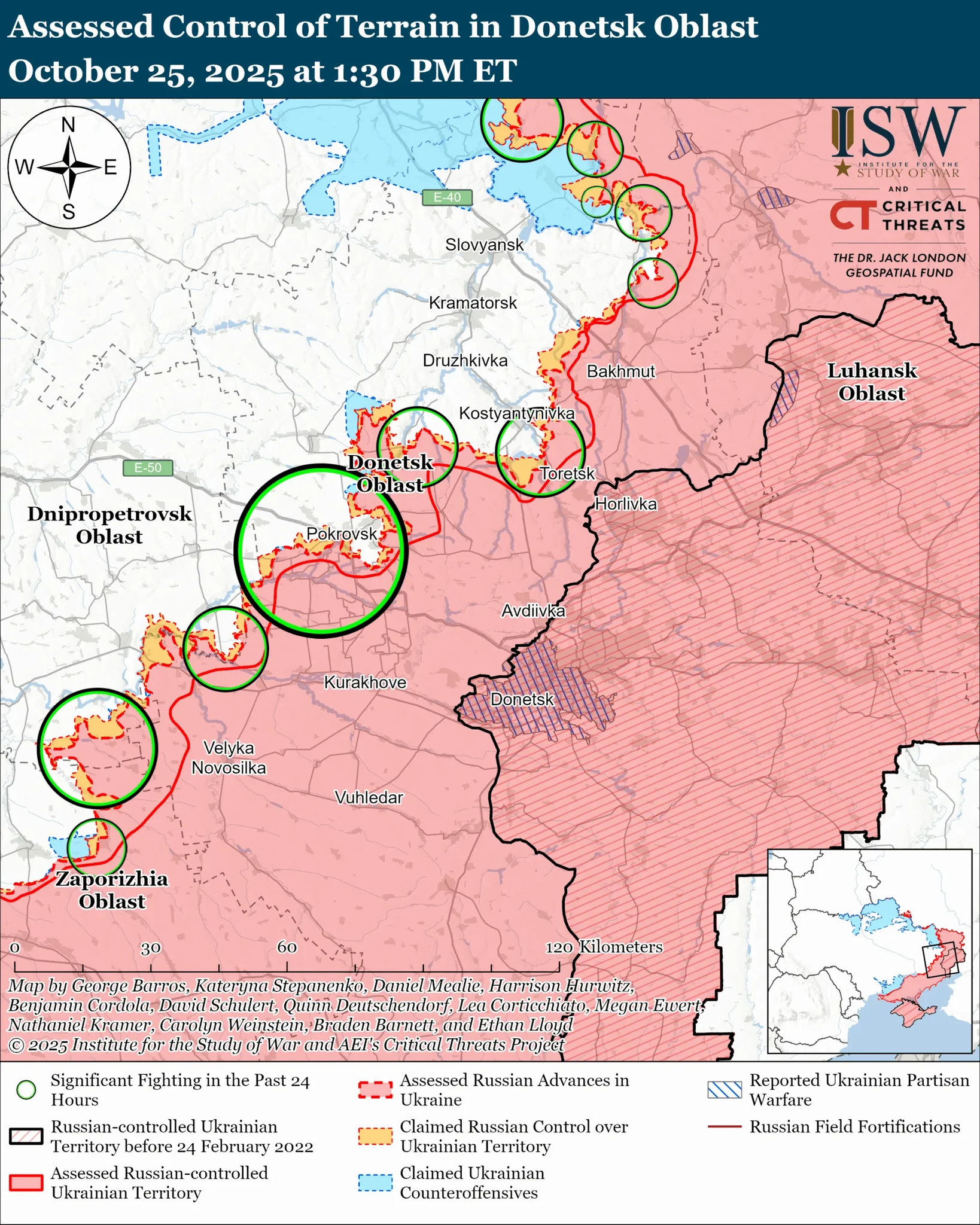
See the original here.