This week, Washington remains focused on the Asian vector of US foreign policy. After nearly a week-long tour of Asia, President Trump initiated the C5+1 summit, during which he is to meet with five leaders of Central Asian countries.
The presidents of Kazakhstan, Tajikistan, Turkmenistan, Uzbekistan, and Kyrgyzstan are expected to arrive in the United States on Thursday, Nov. 6.
Ukrainian diplomat Serhiy Korsunsky, Ukraine’s Ambassador Extraordinary and Plenipotentiary to Japan (2020–2024), told the Kyiv Post how this summit could affect the resolution of the Ukrainian issue.
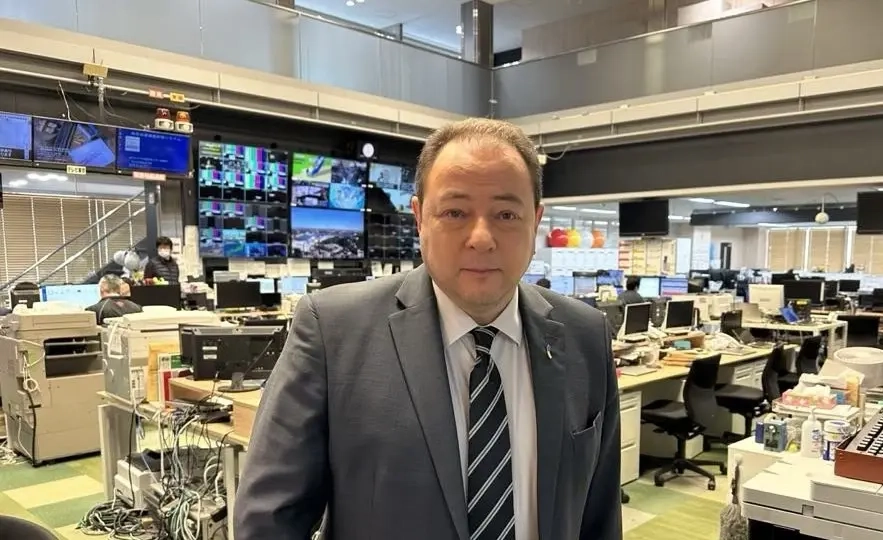
Trump’s C5+1 summit
Kyiv Post (KP): Experts emphasize that it is currently unclear how the summit with the participation of Central Asian leaders will affect the peace process in Ukraine. They suggest that the main goal is to oust Chinese influence in the region. Is this good for Ukraine?
Serhiy Korsunsky (SK): In fact, it has almost nothing to do with us. These countries have been cooperating with China for a very long time. And, obviously, Russia is also actively present there.
I think we will see Trump attempt to eliminate the tariffs on imports that he has imposed on these countries. In particular, 25% on imports from Kazakhstan. In other words, the US president will try to make the same agreements as he did with Thailand, Malaysia, and Cambodia.
Trump may suggest, “Buy more goods from us, and we will cancel the tariffs. In other words, we are ready to cooperate with you (with the countries of Central Asia — ed.). Let’s see what happens next.
I assume that China will not ignore these events either. And the influence of the East will be much stronger.
This is exactly what happened, for example, after Donald Trump toured Southeast Asia. Although, it is worth noting that this tour went very well.
While in Europe or even the Middle East, Trump “beats the table” and puts pressure on, in Asia he was extremely constructive.
But as soon as he left, Xi Jinping gave a speech at the APEC summit, proposing a shared future, cooperation, and so on.
So, everything returned to normal. Everything became the same as it was before.
And now everyone is only discussing the prospects of cooperation with Beijing and is afraid to even think about replacing Chinese partners with unpredictable Americans.
The Americans, indeed, occasionally wake up to the realization that these countries have fallen out of their field of vision. But this understanding did not come to them for the first time.
However, we do not see a systematic policy on the part of the US towards these republics. These countries are very dependent on the PRC: the US is far away, China is close. Obviously, Beijing will not leave.
KP: Will the Ukrainian issue not be discussed at all during the summit negotiations?
SK: No. However, one single aspect concerning Ukraine may be discussed.
There is a strange fact that we have known about for a long time. It concerns a situation where exports from, for example, South Korea or Germany to countries such as Kyrgyzstan are growing tenfold.
If we take the period since the start of the full-scale war, we are now seeing a peak period.
This is recorded in trade statistics.
There are serious reasons to believe that this is Russia’s “sanctioned exports.”
That is, certain things are being supplied there: Kyrgyzstan pays money and buys, for example, machine tools or electronic components. In other words, these are not weapons. Such goods do not have an end-user certificate: you can do whatever you want with them. Where do these goods go next?
KP: Can we assume that they will move to the territory of yet another country, where these elements will be used to manufacture drones that will be used to attack Ukraine?
SK: Yes, for example, for drones. In other words, these goods are going to Russia.
I remember how a couple of years ago there was a scandal about an incredible number of optical sights for rifles being exported, I think to Kazakhstan or another country in the region. They explained that it was for hunting. Although it was obvious that such optics are used by military snipers.
As for the current situation, everyone sees the statistics, but no one can do anything about it. However, American intelligence is working. It is possible that the Americans would like to shut down this channel. The only thing that may interest us is the US’s intention to control sanctions.
KP: Russia’s attempts to circumvent US sanctions may be discussed at the level of country leaders during a meeting in Washington?
SK: I hope that this can be discussed. But I cannot know whether it will be on the agenda of this Central Asian summit [C5+1, Nov. 6 – Ed.]
My assessment of this is rather skeptical. We also hoped that the Ukrainian issue would be addressed at the summit between Xi and Trump.
However, the leaders of China and the US did not touch on either the Ukrainian issue or even the Taiwanese issue.
KP: Isn’t it good for Ukraine if the US strengthens its presence and influence in the post-Soviet countries? Isn’t the attempt to increase the US presence in such countries beneficial for Ukraine?
SK: We are making up fairy tales for ourselves. The United States today is clearly pursuing one goal: “Make America Great Again.” Only what fits this goal will be implemented.
We can assume that Trump and his team are looking for the same rare earth metals in Central Asian countries. Or maybe they want uranium? They used to buy uranium from Kazakhstan, and then they imposed a 25% tariff. It is completely unclear what their intentions are.
Of course, it would be good for us if the channel of cooperation between the former USSR and Russia were blocked. Of course, it would be positive for us if the US increased its presence there. However, I do not see what resources the US would spend on this.