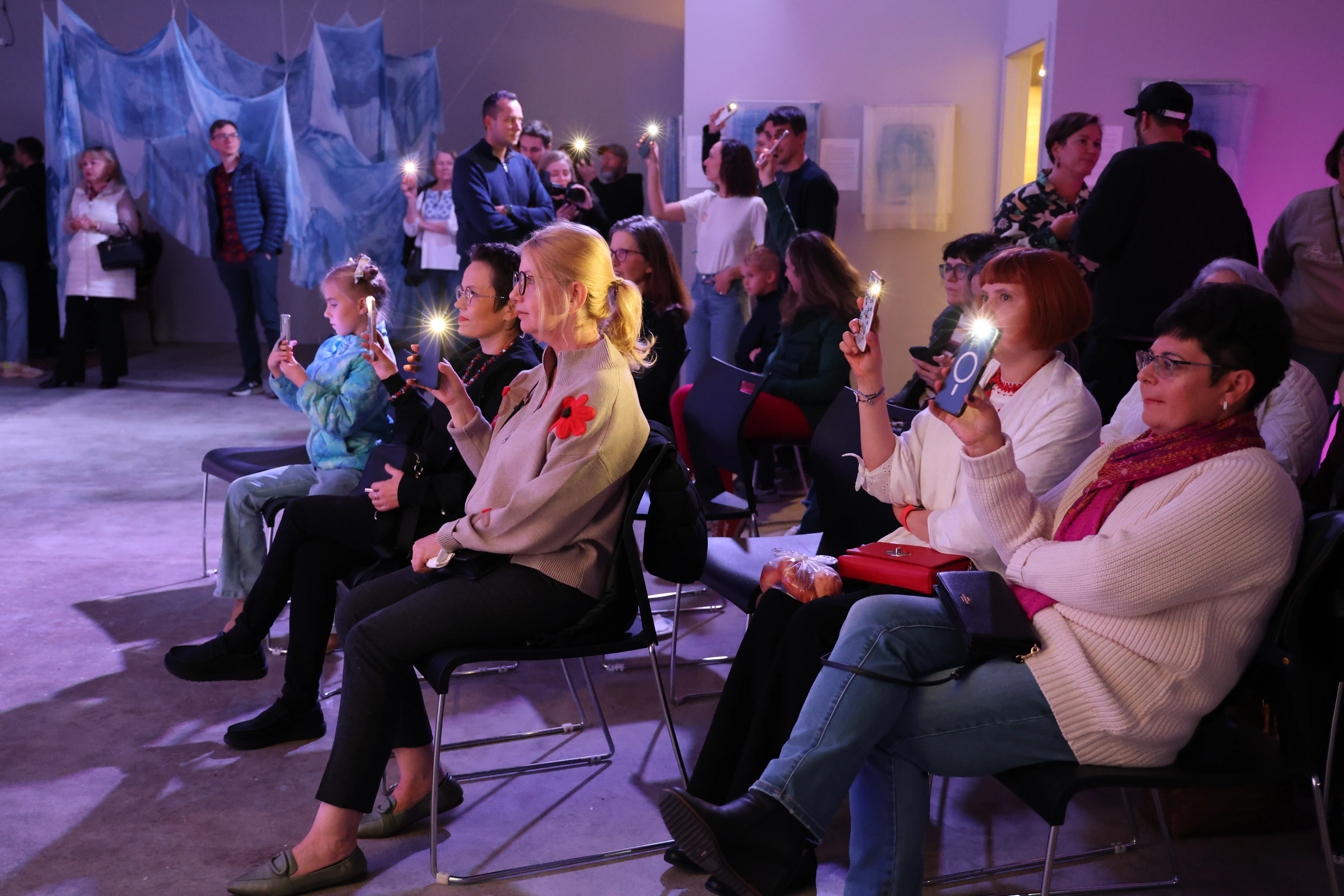
On Oct. 25 at the Ukrainian Cultural Center Toloka in Bellevue, Washington, around 100 people gathered for what organizers from the Volia Fund called the “Concert for Courage,” a fundraising event supporting Ukrainians who have survived traumatic limb amputations caused by Russia’s ongoing invasion.
The event raised over $5,000, enough to sponsor a month of wraparound physical therapy for five veterans adjusting to life with prosthetic arms and legs. But the evening’s success, according to organizers, extended beyond dollars:It was about keeping attention fixed on the war.
“Keeping people’s attention on the brutal genocidal Russian war in Ukraine and its aftermath is essential,” said Yuliia Matvieieva, vice president of medical and veteran affairs at Volia Fund’s Ukraine Abilitation Initiative, known as UAble.
“The fighting may seem distant, but the human cost continues every day. These days tens of thousands of people – civilians and military – are adapting to prosthetics, learning to walk again, and rebuilding their sense of purpose. If we stop talking about it, their struggle becomes invisible.”
All proceeds from the event went directly to Volia Fund’s rehabilitation project, an initiative dedicated to improving prosthetic and rehabilitation care for Ukrainians with limb loss. The organization provides access to advanced prosthetics, physical therapy and mental health rehabilitation – services aimed at helping survivors, as organizers put it, “stand tall (and walk) again.”
Speaking to the attendees, Matvieieva stated that “over the past two years, we’ve been able to fund more than 100 months of rehabilitation for veterans who sustained limb loss.”
She added: “Our newest sub-project focuses on creating 3D-printed upper-limb prosthetics for veterans who have lost limbs and, in many cases, their eyesight.”
The choice of venue for the event was deliberate. Toloka, the first nonreligious Ukrainian community space in Washington State, has become what Tetiana Novokhatska, Volia Fund’s co-founder, calls “a center of gravity” for the diaspora.
“Our motto says it best: Toloka is a home for all friends of Ukraine,” said Oksana Krivizuk, a community leader at the center. The space hosts language classes for children, film screenings, concerts, master classes and communal dinners.
“This is why centers like Toloka are really important,” Novokhatska said. “We try to support it as a center of gravity for the community so we have a space to have this dialogue with our donors.”
Volia Fund was founded in response to Russia’s full-scale invasion of Ukraine in 2022 by a group of concerned Ukrainian Americans working in the tech sector. The initial goal was urgent: to support Ukrainians fighting for their freedom and provide humanitarian assistance to defenders on the front lines.
In 2023, Matvieieva joined the Volia board, bringing with her the UAble project, an initiative that has significantly expanded the fund’s impact in Ukraine. UAble focuses on improving rehabilitation outcomes for soldiers and civilians, including children, who have sustained injuries due to the war.
“We were doing a lot of events in 2022 and 2023 – that was the way to bring awareness, create an audience of volunteers and supporters and establish Volia Fund brand awareness,” Novokhatska said. “In 2024 and 2025 we shifted toward offline work more, and the events we hosted were more narrowly focused.”
Matvieieva, who chose the event’s name, wanted it to reflect the extraordinary resilience required of Ukraine’s wounded.
“We chose the name ‘Concert for Courage’ to honor the incredible strength of Ukrainian veterans: from their courage to survive traumatic amputation, to endure painful rehabilitation, and to rebuild their lives from the ground up,” she said. “It’s an extremely challenging journey, to say the least, both physically and emotionally. We wanted to create a space that not only raises funds but also admiration and awareness for that kind of courage.”
The evening featured live music, homemade food and donated artwork, which were all contributed by a team of volunteers who cooked, baked, and organized. Their dedication, Matvieieva said, gave the event “its warmth and heart.”
“That’s probably what success looks like beyond the funds raised: when compassion unites people and crosses languages and nationalities,” she said.
Still, organizers acknowledge that maintaining momentum has grown harder with each passing year.
“It indeed becomes harder year over year to hurdle people around and raise funds,” Novokhatska said. “We are aiming now to build a circle of recurring donors, as the UAble project requires continuity and stability to continue creating an impact.” Even small recurring donations, she emphasized, matter enormously. The goal now is less about one-time bursts of generosity and more about sustained commitment.
For Matvieieva, the work is deeply personal. A physician who graduated from medical school in Donetsk is now currently completing a degree in clinical mental health counseling in the United States, where she practices under supervision.
Since 2022, she has traveled to Ukraine seven times – and plans to return this winter – to coordinate humanitarian missions and support multidisciplinary medical teams working on prosthetics and physical and psychological recovery. She also volunteers with Força Ukraine, a mobile group of American medics that facilitates tactical medicine training across the country, where she serves as a psychological first aid trainer.
“My goal in working with the military population is to help veterans not only survive but live fully again,” she said. “Healing after war doesn’t stop when the wounds close, it continues in the minds, hearts and within the community.”