At a Ukrainian Unmanned Ground Vehicle (UGV) operations base near the front line in north-eastern Ukraine, the ground robots are taking over.
“Our goal is to reduce to a minimum the exposure of our soldiers to the enemy, and wherever possible we replace humans with UGVs,” Armed Forces of Ukraine (AFU) Commander “Shorokh” (*) tells us during a Nov. 28 Kyiv Post visit to his unit’s repair shops, training sites and operations center.
“Right now, I think we are probably one of the most advanced units in the world in this type of warfare,” he adds.
Ukraine’s 3rd Assault Brigade, for which Shorokh and his team work, is one of the Armed Forces of Ukraine’s (AFU) most-experienced and best-financed fighting formations. According to Shorokh and industry sources, about half of the unit’s several dozen UGVs with a base model price of around $22,000 (€ 20,000) are provided through state funding, and the other half by civil society donations.
The 3rd Assault Brigade began with a few UGVs in 2023 and experimented as they went, with technical data and field feedback going back and forth between operators on the ground and manufacturers across the country. By late 2024, its UGV section was a full-fledged support unit. By 2025 Shorokh’s battalion had become possibly the very first logistics outfit in military history to supply front line units in an entire fighting brigade, in a conventional war, using only UGVs.
According to Shorokh, in a typical week of combat, his ground robots deliver ten tons of food, water, ammunition and fuel to forward positions, and up to 370 tons of military material across the brigade in a month. The 4WD triple-axle truck – NATO’s standard means of getting military supply to the front – can’t survive on the modern battlefield, soldiers interviewed by Kyiv Post explain, because on Ukraine’s battlefields, any truck out in the open would inevitably be spotted from the air and then hit with artillery, mortars or a kamikaze First Person View (FPV) drone.
But Ukrainian UGVs at war are not just about replacing legacy logistics. At the sharp edge of the fighting, in the 3rd Brigade, infantry units make assaults supported by UGVs rigged with heavy .50 caliber machine guns or automatic grenade launchers that pound Russian positions as the ground soldiers make their assaults.
Kyiv Post has confirmed the use of this tactic in several other AFU brigades. The Chinese military has (per state media) fielded similarly armed UGVs and begun training on similar tactics. In contrast, use of UGVs in the Russian army and NATO forces are only experimental, Kyiv Post research has found.
The Ukrainian defense news outlet Militarnyi on Nov. 15 reported that, in late October and early November, a 3rd Brigade UGV mounted with a Browning-designed M2A1 “Ma Deuce” .50 caliber heavy machine gun held a section of the front, on its own, for 45 days before finally being relieved. The ground drone weighed 500–600 kg and was equipped with thermal/night vision cameras, anti-jamming electronics and a Starlink satellite receiver. Shorokh confirmed the report. According to the commander, the system’s rugged build and weather-proofed electronics were key factors in the UGV’s front line survival.
Clearing the way
Severin Yurchik, 25, is a Kyiv native who first fought as an armed civilian against Russian forces when the capital’s northern Irpin suburb was attacked in February 2022. A marketing and business specialist by education, he joined the AFU and by Nov. 2025 had been promoted to vice commander of 3rd Brigade’s UGV combat engineering unit.
The missions he and his team are assigned, he says, differ from day to day and all would be extremely dangerous if carried out by humans. Large UGVs can lay mines, while small UGVs sometimes take out enemy mines by sacrificing themselves, and sometimes just by pushing the mine off a road. A big hook on the bow of a UGV can pull away barbed wire. If a bridge or a section of road needs to be destroyed, a UGV can roll up and deliver a charge, he said. ”If our people must go somewhere out in the open, we always clear the way for them,” Yurchik says. “The drones go first.”
Transporting the wounded
Sofia “Sonya” Menichuk, 25, is a lawyer from Ukraine’s western Lutsk region. At the start of the full-scale invasion, she helped out with the war effort as a volunteer. In 2023, she joined the 3rd Brigade as a combat medic, saw front line combat and survived. Her battlefield job was treating shock and stopping bleeding enough for a wounded soldier to survive the journey to the unit casualty treatment point. Transport was sometimes by Vietnam-era M-113 armored personnel carrier (APC), but more frequently by civilian car or pickup truck.
Increasing numbers of drones saturating air space above roads, trails and open fields mid 2024 made hauling a wounded soldier by human-driven vehicle almost always dangerous and sometimes suicidal.
Now promoted to commander of a company battle casualty treatment point receiving injured troops, Menichuk says UGVs fitted with stretchers can save her soldiers’ lives by re-opening evacuation routes between her stabilization team and front-line combat medics. Although not impossible to detect from the air, she explains that a ground robot raises less dust than a car or an armored personnel carrier (APC), is smaller and harder to see from the air, and is easier to camouflage with branches and thermal cloaks. Because electric power is quieter than internal combustion, engine noise doesn’t tip off the enemy that an evacuation is being attempted, Menichuk says.
Probably the most important advantage of a UGV, she explains, is that thanks to its lighter weight and better traction, it can make its way right to the entrance of practically any fighting position, no matter the terrain. A pickup truck or fighting vehicle might have to stop dozens of meters short, forcing soldiers to expose themselves to drone, mortar or artillery strikes as they carry the wounded soldier to the evacuation vehicle. “For a wounded man to survive he needs to make the trip to proper medical stabilization,” Menichuk tells us. “If we didn’t have these UGVs, more soldiers would die.”
Evacuation of the wounded is slower (typically around three hours) and more complex on the 21st century Ukrainian battlefield, than in the 20th century when a traditional ambulance or helicopter would transport wounded soldiers to hospital.
As described by Menichuk and members of the brigade operations section, an evacuation UGV trundling its way to a casualty point is always preceded by a flying drone reconnoitering the route, often with air cover flown by FPV kamikaze drones with the mission of attacking ground troops or Russian FPV drones that might try to ambush the evacuation. Sometimes the evacuation UGV is escorted by a UGV loaded with electronic jammers designed to confuse radio-controlled FPVs diving in.
Planning for the evacuation of a single soldier, Menichuk says, typically requires coordination between a half-dozen or more brigade elements like ground drones, air drones, command and operations, front line troops, rear security troops, the casualty stabilization point, the hospital and ambulances. Notwithstanding the complicated planning, Menichuk says, about 80 percent of all soldiers hit in combat in the brigade are evacuated by ground robots.
Quick thinking command and control
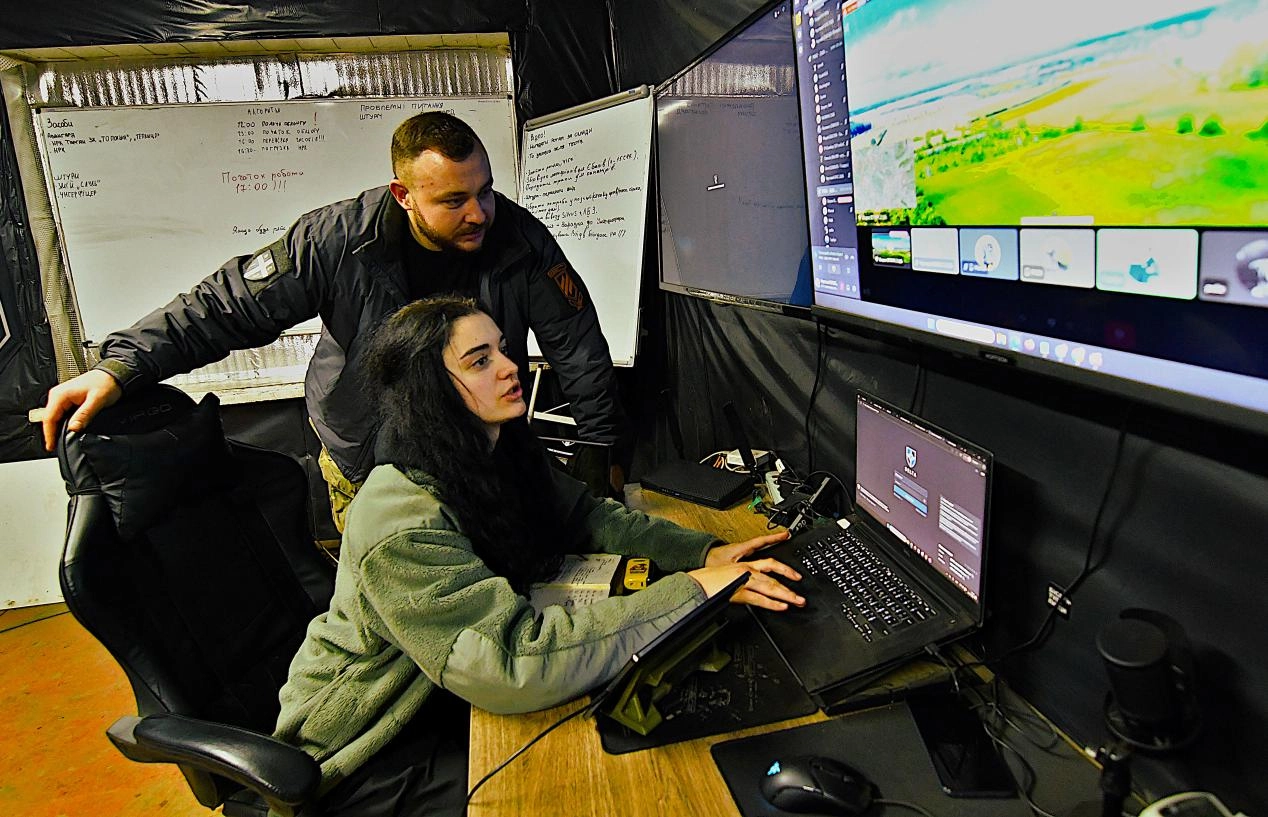
Marta Khlivnushko, 21, is a trained lawyer from the city Lviv, near Ukraine’s border with Poland, but she has never practiced law. In 2024, she joined the AFU, eventually becoming an operations center staffer in the brigade. Her main job is watching 25+ video feeds from ground and air drones covering the brigade sector to help her commander, Shorokh, understand what’s happening and might happen on the battlefield. During a casualty evacuation operation, Khlivnushko’s eyes and experience are the critical link between what all the drones’ sensors see and perceive, and the command group’s split-second decision to send a UGV or alter its direction or activity.
“There are times when this is a very high-pressure job – you have to be able to recognize things, make decisions and think fast. Whether or not the operation [with a UGV] succeeds, depends a whole lot on how we can see the situation and understand what to do about it,” Khlivnushko says.
In a battle control center visited by a Kyiv Post reporter, an operator team sits at screens giving commands to a UGV making its way along a typical Ukrainian black mud dirt road running parallel to a wood line. At one point the tracked robot gets stuck on something. From the video screens it isn’t clear what. After some frustration, ribbing between the junior and senior operator, and spinning tracks flinging chunks of black mud, they get the UGV moving again. ”Sometimes we do all this planning, the drone goes out, and then it gets hit or stuck or breaks, and it’s just out there, we’ve lost it, and you feel bad about that,” Menichuk says. “But better a UGV than a person.”
Commander Shorokh explains that the latest wave of UGV experimentation is a “mother ship” UGV that carries one or two kamikaze UGVs up to a Russian position, then the smaller ground robots that ride there trundle off the big UGV to go and blow something up. ”If the Russians are hiding in a deep bunker, a big UGV can’t get to them,” Shorokh says. “But a little one can.”
*This officer asked that his identity be concealed for security reasons – a request Kyiv Post respected. An AFU officer accompanied Kyiv Post during this reporting trip. This article was checked by the unit for possible security leaks but was not amended.