Ukraine’s Main Intelligence Directorate (HUR) on Tuesday opened a training area outside Kyiv to selected media for a presentation and – if reporters wanted – a test-drive of an Unmanned Ground Vehicle (UGV) they developed against Russian forces.
A Kyiv Post reporter took HUR up on the offer and test-drove a six-wheel medium UGV called Legit, a drone armed with a heavy machine gun in a remote-controlled turret. The drive test took place on soggy ground, but aside from light drizzle, it wasn’t raining hard.
Introduction to Ukraine’s UGV scene
HUR is one of several operators competing for resources and orders in the country’s booming but fiercely competitive UGV market. Over 200 private companies, large and small, are thought to be producing UGVs of one form or another in Ukraine.
The Ukrainian Ground Forces, the Armed Forces of Ukraine (AFU), and at least 10 combat brigades within the AFU are deeply involved in the development and fielding of UGVs.
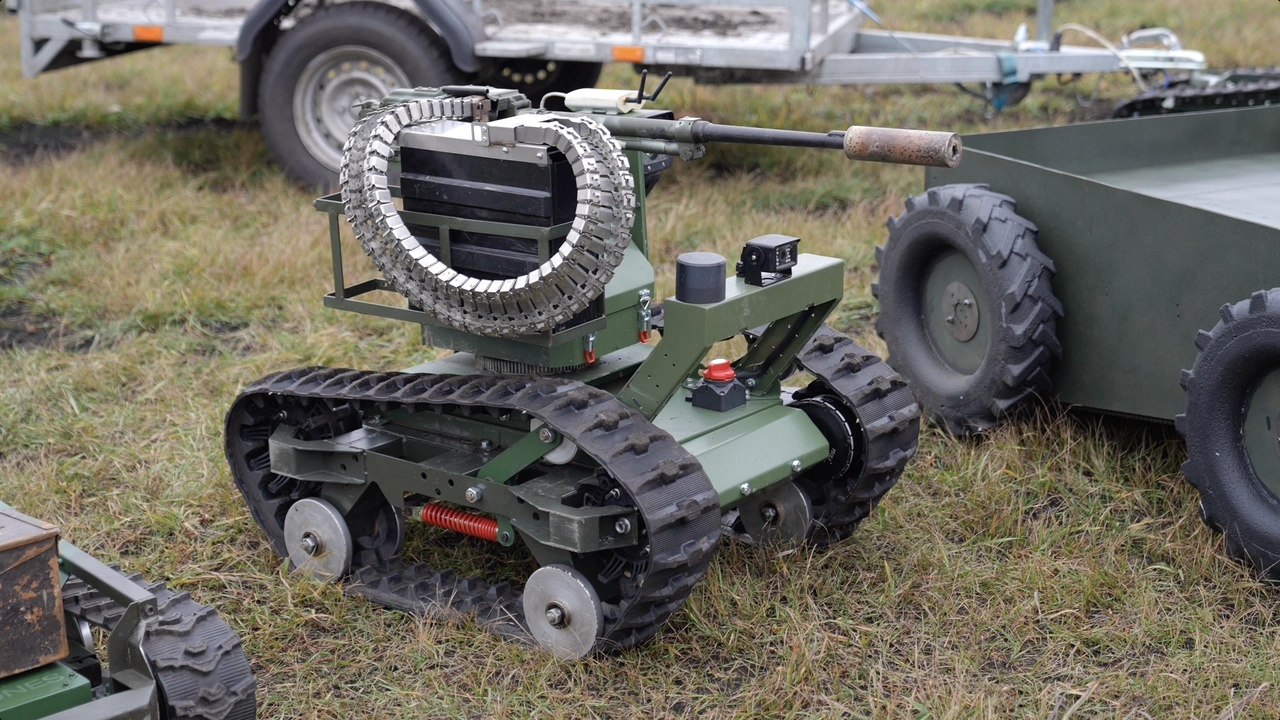
HUR’s mid-level entrant into that market, the Legit UGV platform, is a legitimate competitor but far from the only UGV available for combat operations in Ukraine. By specs and price (listed at the bottom of this review), the Legit’s performance is probably on par with competing models.
Thanks to long-term HUR experience with international suppliers, more complicated sub-systems might have an advantage if fitted to the Legit platform.
First impressions
The six-wheel Legit transporter, test-driven and operated by Kyiv Post, appeared strongly built. Milling and finishing of components were clean, and part fit seemed good to excellent throughout.
Thick, wide wheels and high clearance seemed well-suited to the deep mud often encountered in Ukraine. The .50-caliber machine gun and turret placed the weapon more than a meter above ground, protecting its sensors from flying mud.
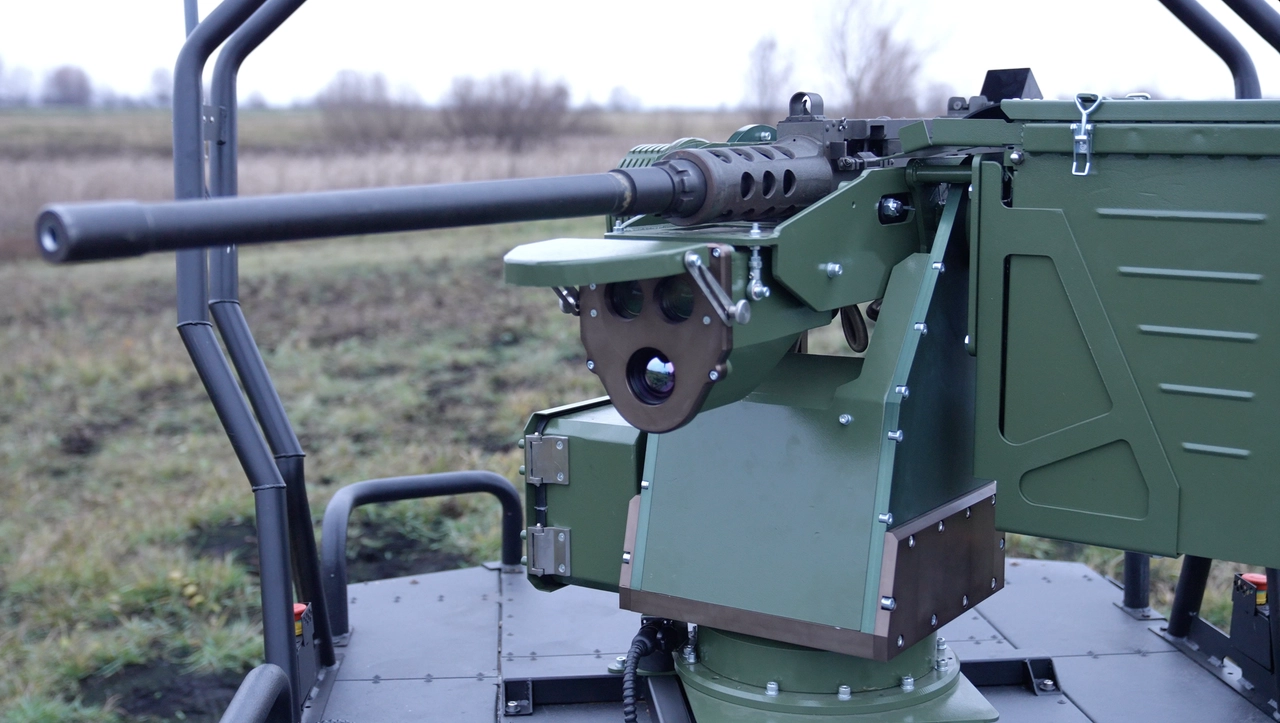
The weapon itself, mounted in a Murena (a reliable, well-known Ukrainian manufacturer) remote-control turret, is fixed to the flatbed over rubberized shock-absorbing connectors. They seemed robust, but the test drive did not include test-firing, so Kyiv Post was unable to judge how well that shock-absorption system actually works.
There is a single 50-round ammo box identical to ammo feeds in manned machine guns. To reload the weapon, the UGV would have to reach a human operator to replace the empty box and feed the new belt, or a human would have to bring the ammo box to the UGV.
The main antenna, a rectangular panel, was fitted on the top of a roll-cage structure protecting the turret. The antenna and machine gun seemed relatively unprotected from flying metal threats like shell splinters or small arms fire. Another probable backup antenna is visible on the back of the vehicle.
A HUR spokesman said that in normal battle conditions, the weapon operates from concealed positions 2 km (1.2 miles) or more from the enemy, normally does not come under direct fire, and, because of its size and relative ease of concealment, is not so easy to hit with indirect fire.
The Driving Experience: The UGV tested by Kyiv Post was driven from a desk-top computer station inside an unmarked van parked on the side of the testing ground. The driver has a main operational screen showing video feeds from the drone’s forward- and rear-ward facing sensors. The screens were easy to read and glare even with doors open was not a problem. The support van operating system allows the driver to place windows of other video feeds, for instance from an overhead drone, on his driving screen.
Control of the vehicle by keyboard was easy and intuitive using a W-A-S-D setup. Response was immediate in both forward and reverse directions, turning was intuitive and the vehicle seemed surprisingly agile considering its weight.
Other keys controlled speed. Because of reporter unfamiliarity with the UGV and UGVs and people moving about the test drive area, Kyiv Post did not attempt maximum speed. Initial acceleration was responsive and for an unfamiliar driver at least possibly too quick: it seemed like the UGV would jerk quickly from stationary to motion rather than accelerating smoothly. The HUR instructor said new operators get used to this quickly.
The general impression was that the vehicle is easy to maneuver and simpler than operating an automobile on Kyiv’s roads.
MG Operator Experience: The machine gun, a Belgium-made M2A1 “Ma Deuce” .50-caliber firing NATO-standard 12.7mm by 99mm cartridge, is pointed and aimed either by computer keyboard or by computer mouse. Kyiv Post used the mouse. A left click on the viewing screen points the weapon where the mouse clicked. Magnification is by mouse wheel or keyboard.
A video feed from all three sensors (daylight, infrared, and wide angle) was clear and windows with secondary feed could be placed on the main screen. Big jumps from wide angle to tight magnification display of the change was not instantaneous but still less than a second. In a close-in firefight this delay could be a tactical problem, but at ranges the system normally would operate it probably would not, Kyiv Post concluded.
Firing is by keyboard. Functions may be changed to new keyboard keys if the user wishes. “Practically all” combat functions could be run via a Playstation controller, a HUR advisor said.
Within the relatively narrow viewing angle of the on-board sensors the weapon seemed to slew and target quickly, in less than a second. Swinging the weapon through a larger arc is only possible by slewing the entire vehicle in a new direction, after which precise adjustments are made by the weapons operator. By display the machine gun might be elevated up to about 60 degrees and down to about -20 degrees. Due to narrow viewing field and sometimes less-than-instantaneous display of new fields, the system would not be suitable for firing on aircraft or drones.
Although theoretically a single operator can drive the UGV and operate the machine gun at the same time, HUR experience is that a two-man team with one men driving and the other operating the weapon is more efficient. Kyiv Post experience operating these systems for the first time, came to the same conclusion.
Although possibly redundant given the very flat trajectory of the NATO .50 caliber’s extremely flat trajectory out to most battle ranges, the operator can adjust the point of aim with a correction for range – this adjustment is made either by keyboard or the mouse’s middle button. A HUR advisor said the system might be fitted with a laser rangefinder but normally firing range is estimated by comparison of terrain as seen by the UGV with digital maps or overhead imagery.
In a test targeting a line of windows in an office building some 700-800 meters from the UGV (Kyiv Post estimate) the cross-hair and display was capable of zooming in sufficiently to pick out selected quadrants of an office window, or the trunk of a medium-sized tree, and lock the cross-hair on that object. An expanding/contracting digital square displayed on the screen around the cross-hair is used by an operator to estimate bullet dispersion as range varies.
Although firing on the move is possible, given ground conditions and the size and weight of a .50-caliber machine gun, this is almost never attempted, an operator said.
Early Verdict: This UGV looks promising and seems more than battle-capable, and its pricing matches market pricing, but by capacity and specs doesn’t seem surpass other UGVs fitted with machine guns operating in Ukraine.
Price and General Information: Ukraine’s military agency HUR develops and deploys several unmanned UGVs, among them the “Legit” multi-purpose ground drone. Unveiled on June 2, 2025, the remote-control transporter can be built with a six-wheel or tracked drive. A base model according to a HUR spokesperson costs between one and four million UAH ($23,622-$94,489).
Specs: 20-30 km operational radius, speed up to 45 kph (wheeled), payload 200-300 kg, GPS navigation assisted by AI, encrypted data links, shell/mortar splinter-resistant chassis and drive, a .50-caliber machine gun turret with infrared, optical and telescopic sensors, support van with two work stations, generators and communications equipment.
Probable drive-away cost: Around $80-90,000 for the UGV, similar price range for the support van.