Viktor Orbán is cornered and Ukraine has become the central weapon in his political survival strategy. With the April 12 parliamentary election less than three months away and his Fidesz party trailing Péter Magyar’s Tisza party by double digits, Hungary’s prime minister has abandoned conventional campaigning in favor of total political warfare.
On January 26, 2026, Orbán summoned Ukraine’s ambassador and alleged Kyiv was interfering in Hungary’s election.
“Our national security services have evaluated this latest Ukrainian attack and determined that what happened is part of a coordinated series of Ukrainian measures to interfere in the Hungarian elections,” he said, though he offered no evidence for his claims.
Orbán’s central claim is that Hungarians have a choice between war and peace, explicitly warning that if his opponents win, Hungarian children will be “taken to war as soldiers” to fight in Donbas.
Ukraine has become Orbán’s final survival strategy mainly because the social contract that has sustained his rule since 2010, based on prosperity, competence and moral authority, has collapsed.
A collapsing domestic foundation
For the first time since 2010, Orbán’s national‑conservative Fidesz party is trailing the main opposition Tisza party, a new centrist, anti‑corruption movement led by Péter Magyar, which a Median poll recently put at 51% against Fidesz’s 39%, a margin that would shatter Fidesz’s supermajority and potentially end Orbán’s 16-year tenure.
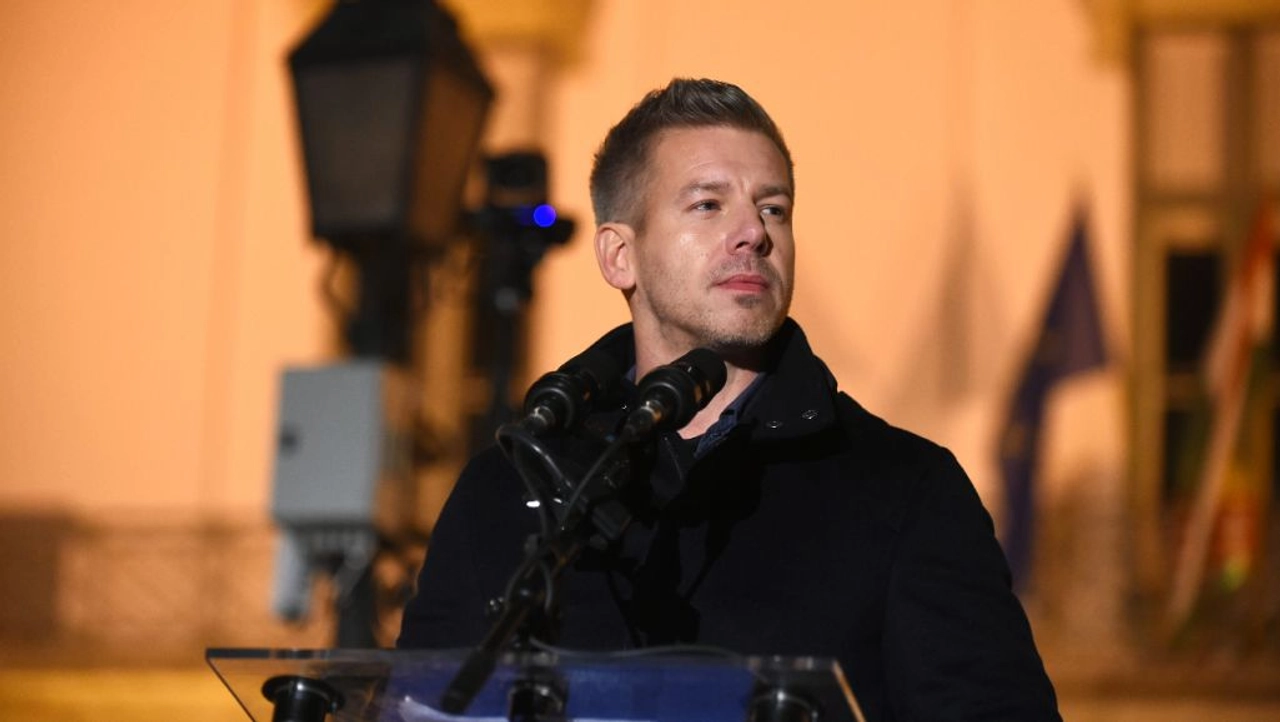
But Magyar’s rise is only part of the crisis. According to 2024-2025 Eurostat data, Hungary now has the lowest household living standards in the European Union, with actual individual consumption at just 72% of the EU average. The economy stagnated throughout 2025, with GDP growth near 0.5%.
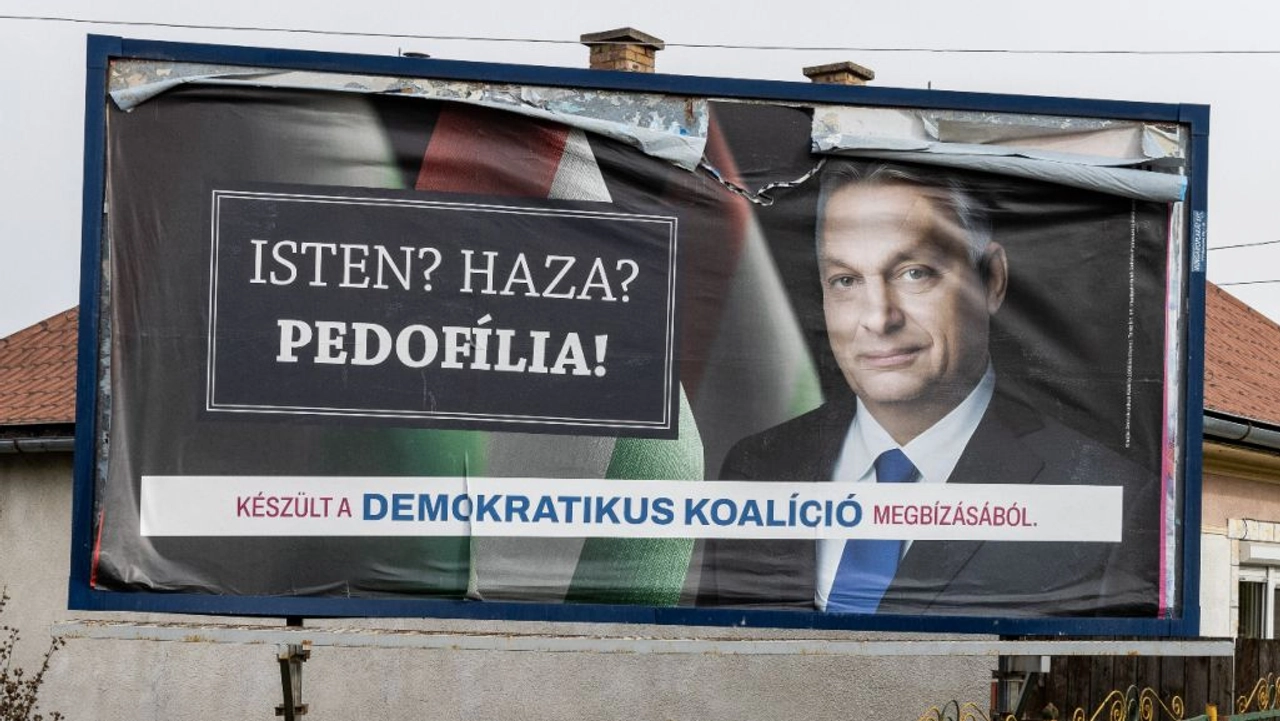
Worse still, Fidesz’s family values brand imploded amid a widening child abuse scandal centered on a child correctional facility in Budapest. The crisis began when it emerged that then Orbán-aligned President Katalin Novák had pardoned a man convicted of covering up abuse in a state‑run institution. With prosperity compromised, morality shattered and competence questioned, Ukraine is now filling the vacuum.
This election is shaping up as one of Europe’s most consequential this year, serving as a test of whether the continent’s most entrenched illiberal system can be replaced.
From EU vetoes to existential framing
Orbán’s transformation of Ukraine from a foreign policy issue into a domestic political weapon has been methodical and long-running, but it accelerated sharply in 2024 and 2025 as Péter Magyar emerged as a credible challenger. At the EU level, Orbán had already established a pattern of using Ukraine as leverage.
In December 2022, he vetoed an €18 billion EU loan package for Ukraine before lifting it days later as part of a broader deal. In December 2023, he allowed accession talks with Ukraine to open by leaving the room during the vote, while simultaneously blocking a separate €50 billion aid package.
The pattern was consistent: threaten a veto, extract concessions, then accept legal workarounds that preserved a narrative of resistance at home. What changed with Magyar’s rise was that this EU obstructionism was repurposed to mobilize the Fidesz core support. Ukraine stopped being a bargaining chip in Brussels and became a permanent campaign theme.
The anti-Ukraine shift was reinforced through repeated “national consultations,” a tool Orbán has long used to manufacture popular support. Earlier consultations framed Ukraine as a security and economic risk, while the most recent nationwide questionnaire urges voters to oppose continued EU funding for Kyiv, keeping the war permanently present in Hungarian domestic politics.
On January 23, Orbán named Ukraine as a hostile actor: “The Ukrainians will be active participants in the Hungarian campaign, because they have a vested interest in a change of government in Hungary.” A day later he went further: “The Ukrainians have gone on the offensive. They’re issuing threats and openly interfering in the Hungarian elections.” Two days after that came the summoning of the Ukrainian ambassador.
Péter Magyar as a ‘foreign proxy’
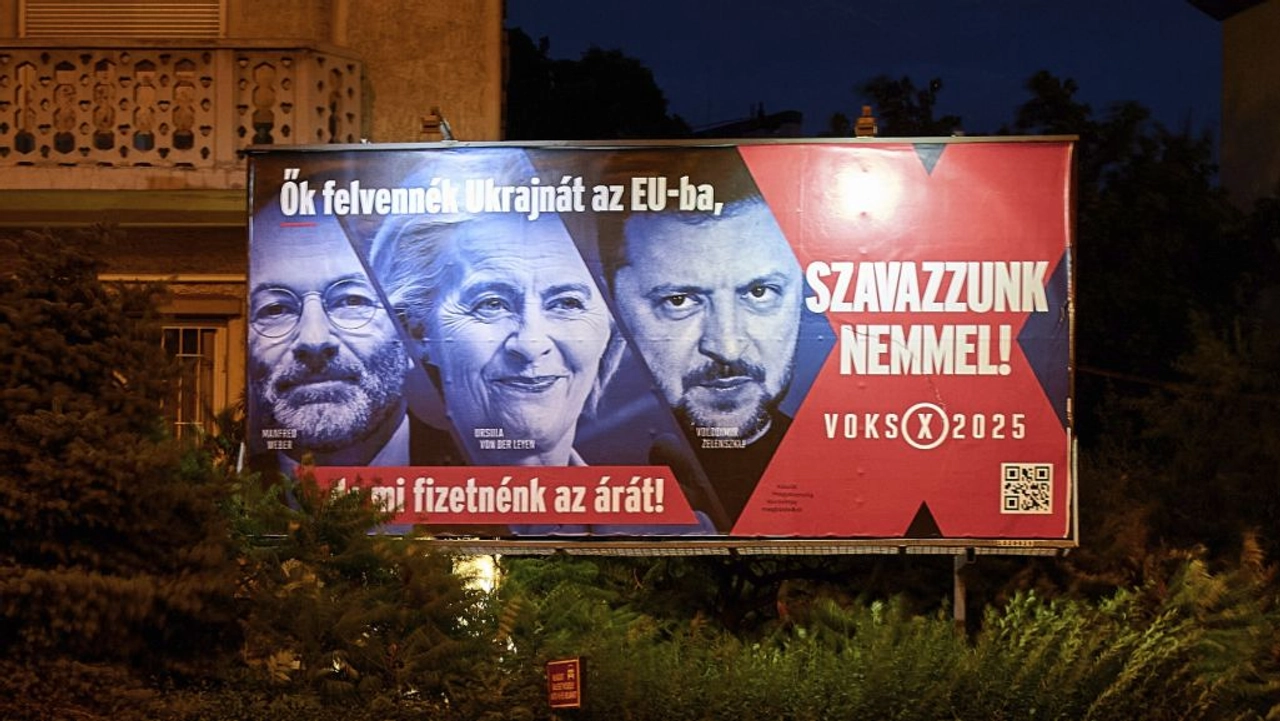
Orbán frames Péter Magyar not merely as a rival, but as a “pro‑Brussels and pro‑Ukraine” foreign proxy, using highly personalized attacks to fuse the opposition leader with the war narrative. In speeches and state-aligned media, Magyar is repeatedly described as the candidate of “Brussels and Kyiv,” accused of having a secret “pact” with Ukraine and portrayed as a politician who would “immediately open the road to war” if elected.
Government billboards and talk shows have pushed the same message, warning that a Tisza victory would mean Hungarian soldiers sent to the front and national decisions taken “on orders from abroad.” Magyar has tried to counter this by saying he supports peace and explicitly rejecting conscription, but Orbán’s media dominance, channeled through the KESMA conglomerate, ensures that the “foreign proxy” framing reaches most voters, particularly outside Budapest.
The ideology of the besieged nation
Underneath this lies Orbán’s long-standing ideology: Hungary as a besieged sovereign state fighting off “EU colonization.” He draws parallels between the Soviet tanks of 1956 and modern financial sanctions, portraying Brussels as the new Moscow. In a recent speech, he said, “In 1956 they came with tanks. Today they come with financial sanctions.”
By framing the conflict this way, Orbán taps into deep-seated historical anxieties in Hungary about national survival and external interference, positioning himself as the only leader capable of defending Hungarian “sovereignty.”
Ukraine is essential to making this story work. In January 2026, Orbán denied Ukraine any real agency, declaring that “Ukraine has ceased to be a sovereign country” and exists only because the West allows it to exist. If Ukraine is merely a Western instrument, then supporting it becomes complicity in what Orbán presents as EU imperialism and resisting it becomes an act of national self-defense.
Doubling down on polarization
Orbán’s strategy is not designed to win over the political center; it is a project to harden his base. The campaign focuses on rural areas and small towns where media dominance is most effective. By saturating these regions with the “war or peace” message, he aims to mobilize his core supporters through fear, ensuring that the election is fought on his terms rather than on the state of the economy or the collapse of the healthcare system.
Ultimately, Ukraine is not Orbán’s obsession; it is his last remaining instrument to hold onto power. If he wins the April 2026 election, this strategy of extreme escalation will be validated as a roadmap for illiberal survival. If he loses, a narrative of Ukrainian and Brussels interference will likely be used to challenge the legitimacy of the outcome.