I had the privilege of knowing Semon Gluzman, who died this week. I do not claim to have known him well. But, all the same, there was an indirect and direct connection.
I’d like to recall this as part of my tribute to this courageous individual, who initially became a symbol of independent thought and ethical professionalism and paid a price for it as a Soviet political prisoner, but who also, as a freethinker, subsequently contributed to the development of the notion of a Ukrainian political nation.
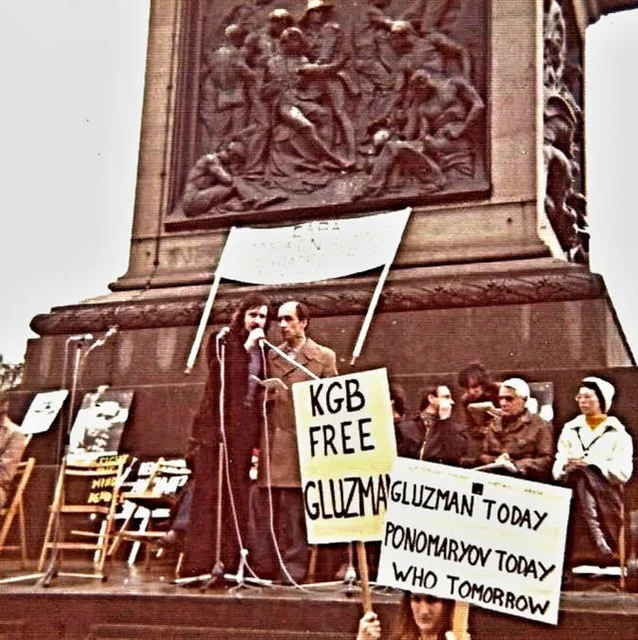
My first memories of Gluzman are from the mid-1970s. At the time, I was both a postgraduate at the London School of Economics and Political Science and already involved with those in London who were campaigning for the release of Soviet political prisoners, and especially the victims of the Soviet abuse of psychiatry for political purposes.
Gluzman, as a young psychiatrist, made his name by courageously opposing punitive psychiatry as applied by the Soviet authorities against dissenters. One of them was the Ukrainian former Soviet general, Petro Hryhorenko, who had turned against the system. Gluzman dared to refuse to recognize that this “patient” was indeed insane and made his findings public.
Born in Kyiv, he served as a psychiatrist in the notorious Dnipropetrovsk Special Psychiatric Hospital, where numerous political dissidents were held. He was probably the first Soviet psychiatrist to break ranks and expose the truth about what was happening.
He was arrested in May 1972 and subsequently sentenced to seven years in a strict-regime labor camp and three years in Siberian exile for “anti-Soviet agitation and propaganda.” While imprisoned, he continued his defiance, notably co-authoring “A Manual on Psychiatry for Dissidents” with Vladimir Bukovsky between 1973 and 1974
Following his release from exile in 1982, Gluzman remained in Ukraine, continuing his fight for human rights despite ongoing harassment. With the fall of the Soviet Union, he became a pivotal figure in reforming Ukrainian psychiatry. In 1991, he founded the Ukrainian Psychiatric Association, serving as its president and working to integrate Ukrainian psychiatry into the international professional community and establish ethical standards.
I recall taking part in large public meetings in London, especially in Trafalgar Square, when a host of well-known public figures called for the release of Soviet prisoners of conscience. They included many Ukrainians, such as the mathematician Leonid Pliushch and physician Mykola Plakhotniuk. And Gluzman’s name figured prominently.
At that time. I was not even aware as a young student that Gluzman was from Kyiv. He was depicted simply as a brave “Russian” psychiatrist who had opposed the imprisonment of dissenters in Soviet psychiatric hospitals.
It was only later that I discovered that, after he had been arrested and detained in Kyiv, not Moscow or any other large Russian city, for his courageous position in refusing to do what the Soviet authorities demanded of him, that as a Soviet Ukrainian Jew, he had undergone a transformation in his view of things.
Time as a political prisoner
While awaiting trial in a Kyiv KGB cell, he met the prominent Ukrainian poet and defender of Ukraine’s national rights, Vasyl Stus.
I was subsequently impressed to learn how the two diverse personalities with different priorities but united by their defense of human rights had interacted in the prison cell. They bonded and opened up to one another.
The Russian-speaking psychiatrist Gluzman gave Stus tips on how to act before his KGB interrogators. For his part, Stus explained to his temporary cellmate what Ukrainian patriots were struggling for, interested him in learning basic Ukrainian, and even shared some of his poems with him
So, Gluzman, preoccupied with opposing political abuses of psychiatry, was won over to the Ukrainian cause that hitherto he had not been particularly interested in.
Subsequently, in the labor camps in which he served his sentence, Gluzman felt at home with Ukrainian political prisoners. Including those national freedom fighters from the late 1940s and early 1950s that the Soviets had branded as Nazis.
After completing his sentence and Ukraine becoming independent, Gluzman returned to his psychiatric profession, eventually becoming the head of the Ukrainian Psychiatric Association, which he founded.
He maintained a very open and balanced perspective. As a former “Soviet” Jew, after his experience in the Soviet labor camps and his meetings with Ukraine’s leading national rights defenders, he developed his own views on what an independent Ukraine should be.
A former dissident and political prisoner, Gluzman did not try to capitalize on this politically. He worked and advanced within his profession and, from time to time, shared his thoughts about where Ukraine was heading.
We know that he supported the Maidan protests, or rather the Revolution of Dignity, which occurred at the end of 2013 and beginning of 2014.
But it is clear that he became very disillusioned with what followed under President Petro Poroshenko. He became increasingly critical of what he saw as the failure to uphold the principles of the Revolution of Dignity.
He also questioned, and then opposed, the approach to the reform of the country’s health care system launched under Poroshenko.
I met Gluzman several times, the last just before Russia’s full-scale assault on Ukraine. It was on a terrace on Khreshchatyk Street close to the Maidan.
We had an intense discussion about the way Ukraine was heading. He was not happy with what he was seeing. This was towards the end of the Poroshenko era, but before Zelensky emerged on the political scene and before he was elected president of the country.
Corruption, broken promises, cheap patriotic populism, and incompetence in managing reforms, especially in the health sphere - these were among issues he raised.
But he was also concerned that the project to build a new, modern, inclusive Ukraine was faltering because of what he saw as the wrong, populist, and inherently divisive motivations from the top.
I don’t know what he felt and believed subsequently, as Zelensky replaced Poroshenko, and Russia launched its full-scale war against Ukraine.
Suffice to say, he remained on the fringes and did not seek the limelight for himself.
So, in this short tribute, I want to pay my respects to a courageous psychiatrist who risked, or rather invited, imprisonment for opposing the barbaric Soviet ways of treating dissenters.
But also as a figure who embodied the movement in Ukraine towards genuine democracy and the crystallization of an authentic political nation.
Gluzman maintained his dignity and principles throughout and had the guts to express his views on the state of affairs, whether during Soviet despotism or the complex period of independent democratic statehood that followed.
We are fortunate that he was with us and did what he did. He will not be forgotten.
The views expressed in this opinion article are the author’s and not necessarily of Kyiv Post.