Vladimir Putin, dictator of a country where 20 percent of the citizens have no indoor plumbing, is driving the global political agenda today. He is the focus of every high-level discussion, every defensive strategy, every fear and wish. Putin has the initiative, and all the world’s powerful states and media are watching him and reacting to what he does. In effect, they are being led by Putin.
He defines the game and the rules. And while the Western world reels from the shock of his crimes, defense ministries collect data, speculate about his next moves and, anxious about his reactions, drag their feet.
Western governments have long been merely voyeurs. Thirty years ago, they limited themselves to launching mainly missiles of moral opprobrium, as the armies of another European dictator rampaged through a neighboring country, defiling, looting, raping and slitting throats, their barbarity driven by ruthless media incitement and a revanchist sense of entitlement and ethnic superiority. Like Putin, Slobodan Milosevic played the victim, invoking Nazi crimes while mimicking their methods as he waged a war of aggression ideologically endorsed by regime intellectuals in the Serbian Academy of Sciences, and blessed by some Christian Orthodox leaders.
Historical sympathies led to divisions among Europeans as to how to deal with the destruction and death taking place only a few hundred kilometers from the borders of the European Union. NATO had no normal legal mandate to intervene. Serbia’s patrons on the UN Security Council paralyzed the UN. Appeasement in the form of ethnic partition was promoted by leading Western politicians and think-tankers. Why shouldn’t political borders be altered to reflect the boundaries of ethnic communities? The Dayton Agreement endorsed the formation of ethnic entities, it ended the war, but it did not bring political stability. Today, encouraged by Russia, ethno-political tension is again rising in Bosnia-Herzegovina.
Putin is similar to Milosevic in his demonstration of a willingness to slaughter innocent civilians and to ostentatiously lie without shame, in his contempt for the truth, and his betrayal of every convention of civilized leadership. In doing so, he has, paradoxically, morally disarmed the Western world. Our condemnation has been rendered impotent, and indeed it confirms Putin’s evil charisma. For Putin is the incarnation of Friedrich Nietzsche’s Übermensch – a superman, “beyond good and evil,” driven only by the will of inhuman power because it is immune from humanity’s moral constraints. Putin has nullified any semblance of democratic or legal oversight; he answers to no one. In doing to, he has made himself not only the center of Russian, but also international politics. We don’t even think about members of the Duma. It is as if the Russian legislative body does not exist. Many Russians have bravely objected to the war. But by and large, Russian society, while composed of individuals, each with reason, conscience and agency, has been forged into a unitary organism, an instrument of Putin’s will.
Putin undoubtedly ordered his conscripted troops to leave plenty of civilian bodies behind in their tactical retreat. It is a signal to Ukraine and to the world that Putin, and the nation he has swallowed, is ready to confront even God in his putative defense of Mother Russia. Perhaps the soldiers had seen media propaganda dehumanizing the Ukrainian people. An op ed in Novosti stated that the “majority” of Ukrainians are “passive Nazis, accomplices of Nazism,” and that forced labor, the death penalty and imprisonment would be used as punishment against the “accomplices of the Nazi regime.” The war crimes going on in Ukraine are a tactic to terrify the population into submission. But they are also a tactic to terrify NATO and the international community with evidence that they are dealing with a will and a power greater than their own, a power willing to stop at nothing, whereas Western officials operate in a framework of moral reasoning and democratic legitimacy.
The siege of Sarajevo lasted almost four years, and resulted in about 5,500 civilian deaths. Children were shot in a way to cause a slow death while mothers helplessly watched. Then, as now, leaders of the victims pleaded for help. After Serbian artillery killed 68 civilians on Feb. 6 1994, the UN Secretary General asked NATO to intervene, and a series of air strikes eventually brought the siege to an end. Russian officials have never forgiven NATO for bombing Serbia in 1999, stopping what would likely have been a mass killing of Kosovar Albanians. The action had no endorsement by the UN Security Council.
No-one expects such a response to Russia’s racialist imperialism in Ukraine, however, because Russia is successfully blackmailing the civilized world with the threat of its nuclear weapons. Only confidence and courage greater than Putin’s will bring this carnage to an end. But, led by the United States, a misguided complacency still prevails, expressed in Secretary of State Anthony Blinken’s assurances that Russia has now suffered a “strategic defeat.” Ukraine needs heavy weaponry.
But if Ukraine’s friends want to be effective, they must come up with more than military materiel. They must impose a complete boycott of Russian energy. Perhaps most importantly, they must adjust their mentality in order to better understand and respond to the threat faced by Ukraine and all of Europe.
The views expressed in this article are the author’s and not necessarily those of the Kyiv Post.
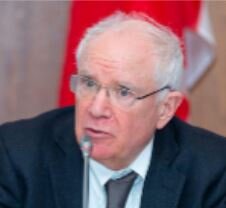
Aaron Rhodes is Senior Fellow in the Common Sense Society, and president of the Forum for Religious Freedom-Europe. He was Executive Director of the International Helsinki Federation for Human Rights 1993-2007.