The high-tech industry is an important contributor to the state budget; it pays $600 million a year in taxes alone. But it also brings other benefits to the economy as a whole.
The IT industry ranks third in terms of export volumes in Ukraine, behind metallurgy and the food industry. Since it is mostly an export-oriented business, it has become one of the country’s main sources of incoming foreign currency.
And as the international demand for IT services prompts tech sectors to grow, so do tax revenues for Ukraine.
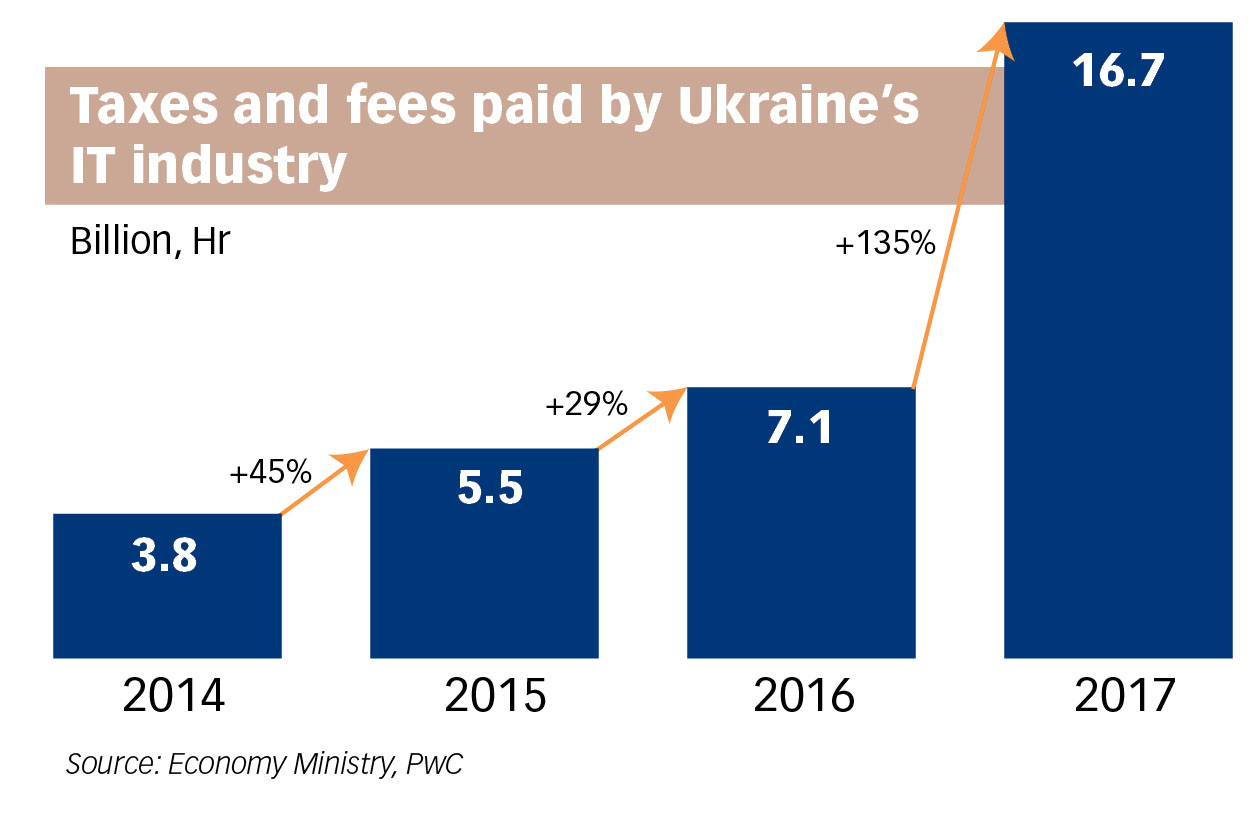
The taxes and fees paid by the tech sector increased by 88 percent in 2016, compared to 2014, and amounted to Hr 7.1 billion, or $255 million. The figure more than doubled in 2017, reaching Hr 16.7 billion, or approximately $600 million.
According to research conducted by the Ukraine IT Association and auditor PwC, most of the taxes were paid on income, while corporate taxes (corporate income tax and value-added tax) accounted for a much smaller share.
Paying for brains
Labor is the main cost for software development companies, and thus labor payment is the main expense item. About 70 percent of tech companies’ earnings go towards paying for labor, according to the Economy Ministry.
Ukraine has about 1,650 tech companies, with the five largest ones hiring more than 2,000 employees each while the next five have about 1,000 employees each. The 25 largest tech companies employ about a third of the total number of the sector’s workforce, although this share is decreasing.
The sector currently employs 116,000 specialists, while PwC experts expect the industry to employ 240,000 tech people by 2025.
In accordance with the labor law, the Ukrainian companies have to pay personal income tax, military fees and a unified tax that covers mandatory state social insurance for every employee.
Combining these taxes, the total tax burden per worker is about 36.6 percent of their salary. Therefore, on a Hr 10,000 gross monthly salary, an employer would have to pay Hr 3,660 in taxes.
Given that the average after-tax wage of a tech specialist in Ukraine is Hr 43,700 ($1,670), the employers’ average tax bill per worker should be Hr 19,800, according to PwC’s research.
In traditional sectors, employee payments make up a small share of expenses, and therefore income tax policy has less influence on them than in the IT market. In the export of ferrous and non-ferrous metals, for instance, employee payments rarely exceed 10 percent of the company’s income, so an enterprise operating in the commodities sector might spend only about 2.9 percent of its income on taxes related to employee payments.
Meanwhile, with the expenses of a software development company in paying all of its employees obligatory fees accounting for about 70 percent of its earnings, that means it has to pay to the budget around 18.8 percent of its total income on taxes and fees related to employee payments.
‘Optimizing’ taxes
As a result, companies operating in the software development market are particularly sensitive to the tax burden on labor payments. So the most widespread legal form of work in the software development market is basically to outsource business contracts to IT specialists, who are registered as individual entrepreneurs and pay taxes themselves under the simplified tax system.
This significantly reduces the tax burden on companies: Individual entrepreneurs pay a tax of 5 percent of their income, and a $29-per-month unified tax for mandatory state social insurance.
In fact, the Economy Ministry reports that most of the taxes raised from Ukraine’s tech sector come from people registered as entrepreneurs.
Future prospects
Analysts from PwC expect the tech sector in Ukraine to continue growing. According to them, if the Ukrainian government retains its current taxation policy, doesn’t introduce new regulatory obstacles, develops IT education, and actively promotes Ukraine’s brand on the international arena, the sector will continue to grow, and pay about Hr 46 billion – more than $1.6 billion at today’s exchange rate — in taxes by 2025.
The Ukraine IT Association, in turn, predicts Ukraine’s IT exports to grow by 25 percent in 2018, reaching $4.5 billion. In 2017, growth was 20 percent, bringing $3.6 billion, the association says.