The Ukrainian government and the country’s civil society are united in their opposition to the election of Russian Alexander Prokopchuk to the presidency of Interpol, officials and rights defenders said at a Nov. 20 press conference in Kyiv.
Prokopchuk, a former major general in Russia’s Interior Ministry, currently serves as the international police organization’s vice-president for Europe — and he could be elected its president as early as Nov. 21.
That possibility has sparked fears in Ukraine that the organization will be used to persecute Moscow’s political opponents across the border.
“If we let this go and Prokopchuk takes over Interpol without (us) resisting, then in a few years it will be dangerous for our citizens — especially (politically) active ones — to visit other countries,” Borys Zakharov, a program officer at the Kharkiv Human Rights Group, told the Kyiv Post.
Red notice
At the core of the issue, say human rights activists, is the fact that Russia has used the Interpol system of “red notices” — the closest thing in existence to an international arrest warrant — to take aim at its critics abroad.
That isn’t a uniquely Russian practice. A number of countries — including China, Turkey, and Azerbaijan — are known for regularly abusing the red notice system. And that didn’t stop China’s Meng Hongwei from assuming the Interpol presidency in 2016.
The current succession controversy emerged after Hongwei was detained in China on vague and likely politically motivated corruption charges and submitted a letter of resignation to Interpol.
Prokopchuk has a specifically negative history. He took charge of Russia’s National Central Bureau, which connects the Russian police with Interpol, in 2011 before assuming the vice-president role at the organization in 2016. This likely gave him a direct hand in several politically motivated usages of Interpol, including attempts to arrest Bill Browder, a hedge fund manager and the driving force behind the Magnitsky Act.
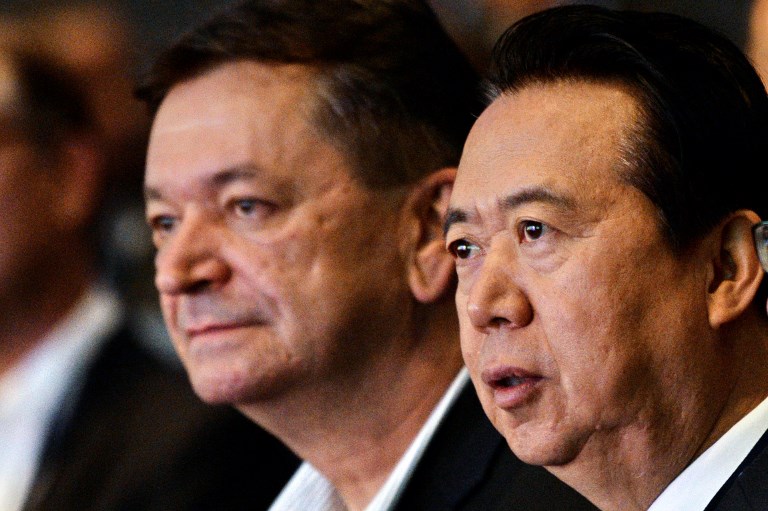
Interpol vice-president Alexander Prokopchuk (L) and and president Meng Hongwei attend the opening of the Interpol World Congress in Singapore on July 4, 2017. (AFP)
However, for Ukraine, a Russian Interpol president is particularly frightening because of the degree to which Russia has used arrests of Ukrainians to exert political pressure on Kyiv.
In certain cases, the Ukrainians arrested in Russia appear to have been “chosen for the role of victim not because of their personal (political) positions, but in an attempt to create a connection with the highest rungs of the Ukrainian leadership,” said Oleksandra Matviychuk, chairman of the Center for Civil Liberties, an organization that helps individuals imprisoned in Russia and occupied Crimea.
Matviychuk cites the so-called “Chechen case” in which Stanislav Klykh and Mykola Karpiuk — two Ukrainians who were arrested separately on Russian territory in 2014 — were convicted of fighting against Russian forces during the First Chechen War in 1994-95. In May 2016, both were sentenced to 20 years in prison. Both Klykh and Karpiuk deny even visiting Chechnya.
While neither man was arrested through a red notice, their cases carried political significance, says Matviychuk. The 2015 indictment against the two men suggests that they fought in Chechnya alongside Arseniy Yatsenyuk, then Ukraine’s prime-minister. Additionally, earlier this year, Klykh’s mother told the Ukrainska Pravda news site that her son was tortured in order to force him to testify that he had seen Yatsenyuk and Oleh Tyahnybok, head of the nationalist Svoboda party, in Chechnya.
A month before Klykh and Karpiuk were indicted, Alexander Bastrykin, the head of Russia’s Investigative Committee, claimed that Yatsenyuk had fought alongside Chechen separatists against Moscow.
The image of the slim, bespectacled prime minister taking part in bloody insurgency in the north Caucasus provoked much laughter online, but Russia appears to have been serious about the accusation.
In March 2017, Russia issued a warrant for Yatsenyuk’s arrest on charges of participating in the Chechen War. Two months later, Interpol officially denied Russia’s request to add Yatsenyuk to the international wanted list.
Rights activists worry that, with Prokopchuk at the head of Interpol, Russia would gain control over the wanted list.
The Kharkiv Human Rights Group’s Zakharov believes that Moscow would be able to add its political opponents and those of its allies to the wanted list and issue Interpol travel documents to “Russian agents.”
“If a Russian becomes the president, they will get this database under their control and they can give protection to Russian international crime en masse,” he said.
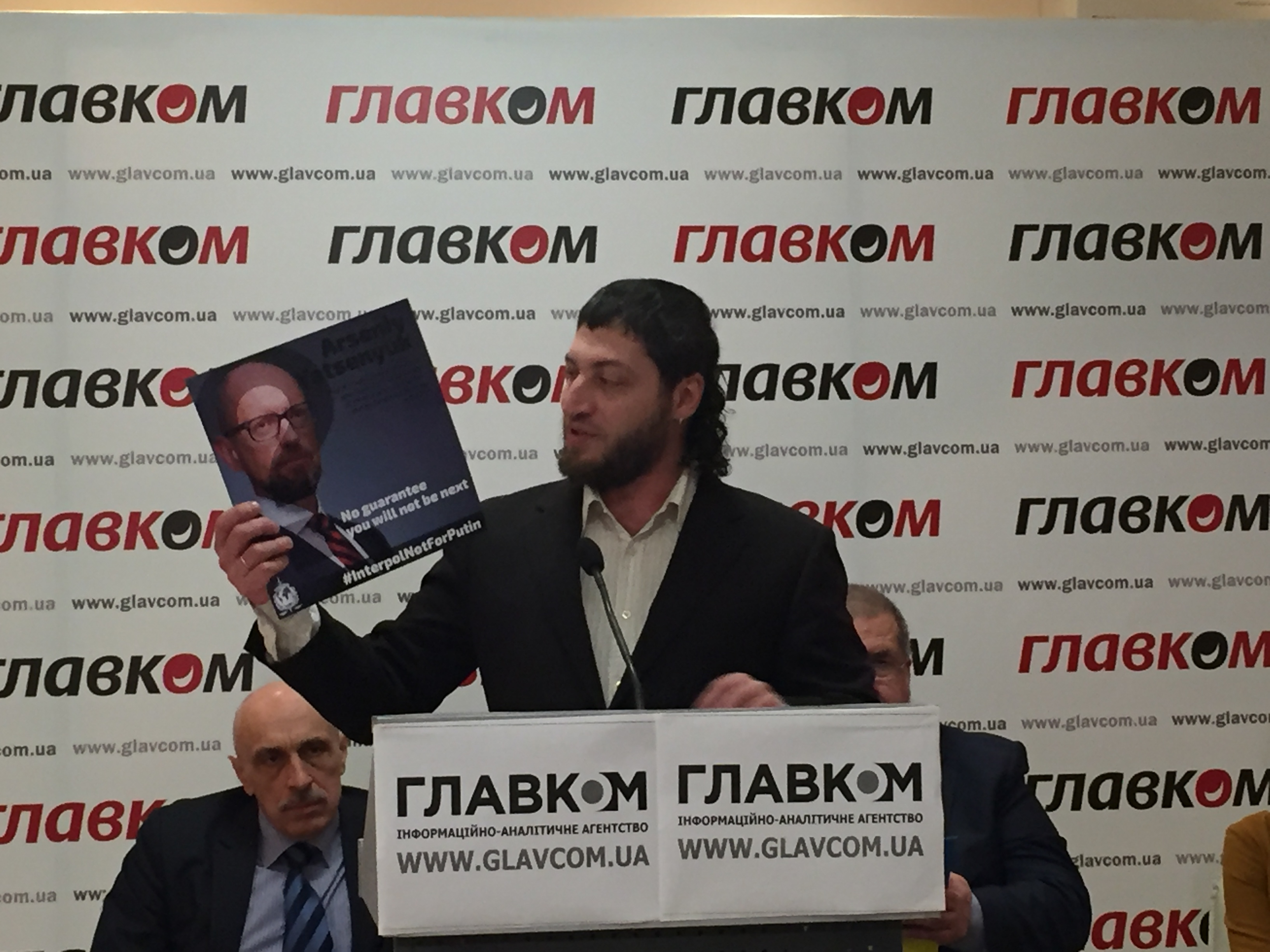
Borys Zakharov, a program officer at the Kharkiv Human Rights Group, holds up a poster featuring former Ukrainian Prime Minister Arseny Yatsenyuk, one of several Ukrainians Russia attempted to target with an Interpol “red notice,” during a Nov. 20 press conference. (Matthew Kupfer)
Artem Shevchenko, the press secretary of Ukraine’s Interior Ministry, noted that, in 2016, Russia took aim at Ukraine’s top military commanders with Interpol.
“In 2016, the attempt to add the highest leadership of our army and national guard to the wanted list failed because it was discovered in time,” he said at the press conference.
But he is concerned that, should Prokopchuk come to power, Russia could target lower-ranking military leaders who could face detention if they leave the country.
Brothers across the barricades
The impending election of Prokopchuk has also sparked controversy for another reason: the Russian Interpol official is a native of Ukraine and has a brother who is a Ukrainian diplomat.
On Nov. 20, the Dzerkalo Tyzhnya news site reported that Ihor Prokopchuk — Alexander Prokopchuk’s younger brother — has served as Ukraine’s permanent representative to the Organization for Security and Cooperation in Europe, or OSCE, in Vienna for over eight years.
Both brothers grew up in Ukraine’s Zhytomyr Oblast and graduated from Taras Shevchenko National University of Kyiv.
Ihor Prokopchuk’s colleagues characterize him as a knowledgeable and disciplined professional diplomat who commands respect both at the OSCE and in the Foreign Ministry, Dzerkalo Tyzhnya reported.
That respect was on display when Ukraine’s Foreign Ministry came to the younger Prokopchuk’s defense after news of his family ties to the Russian Interpol vice-president broke.
“This war has scattered friends, loved ones, and relatives across the front line,” the ministry said in a statement to Ukrainska Pravda. “For many, this has become a true personal tragedy.”
However, since the start of Russia’s war with Ukraine, “there have been no actions that compromise the Permanent Representative of Ukraine to the OSCE, Ihor Prokopchuk, or harm the national interests of Ukraine,” the ministry added.
Refat Chubarov, a Ukrainian lawmaker and leader of the country’s Crimean Tatar minority, characterized the Ukrainian Prokopchuk, whom he knows personally, as a “high-class diplomat of Ukraine.”
However, Ukrainian law must be prepared for situations like this, he says, noting there are cases when certain individuals working in state agencies or being hired there come with certain “risks.”
Chubarov stressed that “the harshest resolutions in relation to Russia were passed” when Ihor Prokopchuk was Ukraine’s representative in the OSCE.
The MP also criticized publications that covered Ihor Prokopchuk’s connection to the Russian Interpol official with “irony” and “disapproval,” comparing this to Russia’s method of hybrid warfare.
What’s next?
With Alexander Prokopchuk’s election highly likely, the question for many is what comes next.
Not everyone views a Russian president of Interpol as a doomsday scenario for the organization. Mark Galeotti, an expert on the Russian security agencies, believes the reaction to Prokopchuk’s candidacy has been “far too much alarmism.”
“Did Beijing have unfettered access to the databases and the right to have anyone it wanted arrested when the previous director was in charge?” he wrote in a message to the Kyiv Post. “It’s certainly not a step forward for reform of Interpol, and it will give Moscow a little more leverage, but it is not the apocalypse.”
Additionally, Radio Free Europe/Radio Liberty interviewed several experts on the organization’s inner workings. They believed that Prokopchuk’s influence on Interpol’s daily operations would be minimal and he could hardly overcome the organization’s checks and balances and turn it into an instrument of the Russian state.
On Nov. 19, a bipartisan group of senators called on U.S. President Donald Trump to oppose Prokopchuk’s candidacy for Interpol president. Kremlin spokesperson Dmitry Peskov characterized this statement as “electoral process of an international organization.”
Rebecca Harms, a member of the European Parliament, wrote on Twitter that European Union member states would have to leave Interpol if Prokopchuk becomes its president.
And, on Nov. 20, the Lithuanian parliament passed a resolution calling for “Lithuania and other democratic countries to rapidly consider the possibility of leaving the organization” if Prokopchuk is elected president.
That outcome is likely easier said than done. Still, it has its appeal to Ukrainian rights activists like the Kharkiv Human Rights Group’s Zakharov.
“If the democratic countries all leave (Interpol), then it will only be dangerous to visit those countries that remain,” he said.