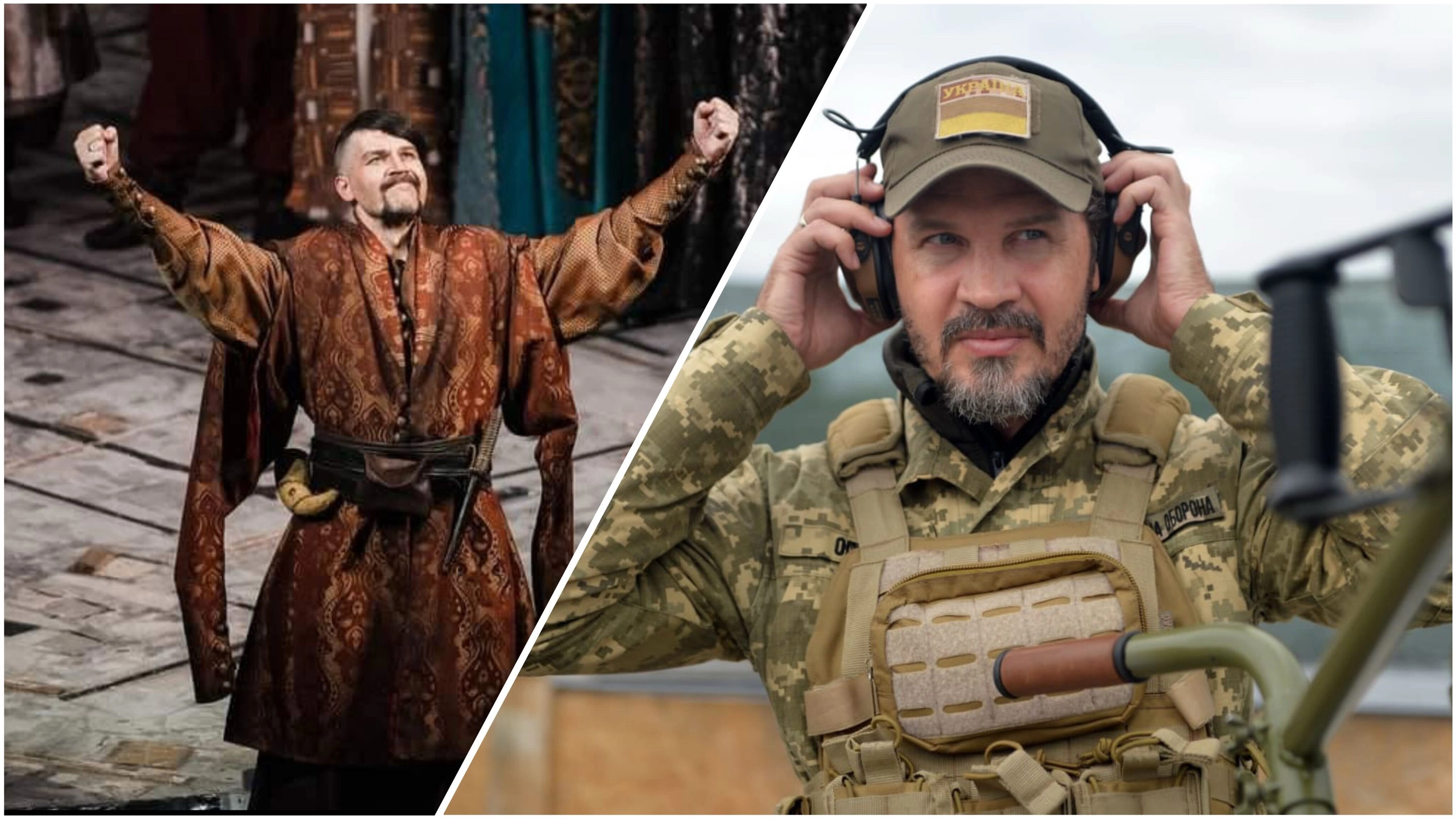
Taras Berezhanskyi, an opera singer and Honored Artist of Ukraine whose successful international career spans renowned opera houses across four continents—including the Sydney Opera House, the Chilean National Opera, and the Deutsche Oper Berlin, and who is a soloist of the Lviv National Opera and the National Philharmonic of Ukraine—has for three years balanced his artistic work with service in the “Mriya” volunteer Territorial Defense unit, which protects the capital during missile and drone attacks.
Kyiv Post spoke with Berezhanskyi during a short break after a night shift, just before he went on stage.
JOIN US ON TELEGRAM
Follow our coverage of the war on the @Kyivpost_official.
Kyiv Post (KP): Taras, most interviews with you now begin with a question about your service in the Territorial Defense. Let me first thank you for helping defend Kyiv’s skies. What was decisive in making this choice?
Taras Berezhanskyi (TB): Indeed, many conversations start this way today—that’s the reality of war. (Smiles.) The decision to join the Territorial Defense was not spontaneous. It matured under the impact of the full-scale invasion and an inner sense of responsibility. Especially after reports of war crimes, there was a strong desire to take an active part in defending the country.
From the very beginning of the war, I was looking for a format that would allow me to combine service with my profession. Many years have been invested in my career—study, work in Ukrainian and international theaters. The Territorial Defense volunteer unit became a way to be useful to the state without crossing out my professional path. I’m convinced I can serve Ukraine on different levels—defense, culture, and the international stage.
News of the deaths of people I knew, including musicians, became a powerful emotional trigger. When the war reaches your professional community, it stops being abstract. That only strengthened my resolve to act rather than remain a bystander.
KP: You have mentioned the unique composition of the “Mriya” unit you serve in. Has it changed over the years?
TB: Overall, the structure has remained stable since 2022. Our company has two platoons. One is largely made up of judges, lawyers, and legal professionals. The second is more diverse—that’s where I serve. Over time, some fighters have joined the Armed Forces of Ukraine, including units working with unmanned systems. This is a natural process seen in many volunteer formations.
There are also symbolic stories. Recently, on my way to a rehearsal at the Franko Theater, a man approached me—he heads the theater’s legal department. He recognized me and said he also serves in “Mriya,” just in a different role. The world is truly small—you can meet your brothers-in-arms right on the street. Moments like this remind you how many different people have united around a common cause.
KP: You once described your rhythm of life as: “In my free time from service, I sing; in my free time from work, I serve.” What helps you maintain this balance?
TB: Constant work keeps you in professional shape. After a shift, you have limited time to recover and immediately return to rehearsals. The stage doesn’t care how your night went or how tired you are—everything must be flawless: sound, form, emotion. The balance rests on discipline and an awareness of responsibility in each of these roles.
KP: You’ve worked in leading theaters in Ukraine and abroad. What is Ukrainian theater like today, despite the war?
TB: When I first went abroad, I relied solely on the experience gained at the Conservatory. Returning after international contracts—particularly from Australia—I brought back a different vision, a different school and approach. Today, this exchange works both ways. Ukrainian theater actively integrates global experience while shaping its own language. We are gradually shedding the inferiority complex while preserving a deep understanding of our culture.
Even with limited mobility, we have free access to contemporary productions, masterclasses, and the global context via the internet—and this allows constant professional growth. This is especially evident at the Lviv Opera, where there is active collaboration with Ukrainian and foreign directors and conductors. Such creative exchange and the strengthening of the troupe with talented artists significantly raise both the quality of work and internal thinking.
The opera productions of Ivan Uryvskyi offer an entirely new directorial vision of Ukrainian opera—for example, Borys Liatoshynskyi’s The Golden Hoop. Or collaborations with Germans Andreas Weirich and Anna Schöttl on Ukrainian material such as Yevhen Stankovych’s opera A Terrible Vengeance. All this shows how national music and history can resonate in a European context. A new generation of directors has emerged, cultivating a European style and bringing a distinctly European vibe to our stages.
KP: Which of your wartime performances abroad stands out the most?
TB: The most symbolic was my first performance after the full-scale invasion—in October 2022 at the Sydney Opera House, in a revival of Verdi’s Attila. The opera gained special relevance: Attila is a conqueror, a negative character. Back in February 2022, I wrote to the Sydney Opera’s director that my stage Attila turned out to be far more “honest” than Putin.
After the premiere, I took my bows holding a Ukrainian flag. The reaction was powerful—long ovations and wide media coverage. Although political gestures are usually avoided in Western opera circles, I consciously took that responsibility. Support came not only from the audience but from the entire company.
KP: Global events provoke a reassessment of values. What has changed for you?
TB: Family has always come first—my wife, daughter, parents. The war has only intensified this feeling. I worry more about my daughter as she grows up, and about our parents and relatives: my parents live in Pavlohrad, my wife’s parents in Odesa, my sister in Dnipro. All these cities are under constant threat.
Things like sleep, water, and electricity used to matter; now you get used to shortages—stock up, charge power banks. Service can be tough, but I know what it’s like for those who live in this state 24/7. So there’s nothing to complain about—you mobilize your strength and work.
KP: What are your plans for 2026?
TB: Among the key ones is performing Beethoven’s Ninth Symphony on a prestigious stage in Denmark in October. As a Ukrainian, I will sing the EU anthem, sending a message: Ukraine is a peace-loving nation, but we are defending ourselves and will not give up what is ours.
I also have a busy schedule at home. In late February–early March, there will be the premiere of Don Giovanni at the Kyiv Operetta Theatre. On Feb. 20, on the eve of the fourth anniversary of the full-scale invasion, the Franko Theater will host Mozart’s Requiem staged by Yevhen Lavrenchuk—an already sold-out project first presented late last year. In April, the National Philharmonic of Ukraine will host an unusual symphonic concert featuring Rammstein’s music in a new orchestral arrangement with a soloist, conducted by a German maestro. And in June, the Lviv National Opera plans the premiere of Gounod’s Faust—a new production with compelling direction and a strong creative team.
You can also highlight the text and press Ctrl + Enter