A senior Iranian military official has announced that any prospective peace agreement with the US hinges on the White House authorizing the release of $24 billion in frozen Iranian financial assets. The statement places the responsibility for breaking the current diplomatic gridlock directly on US President Donald Trump.
The terms were outlined by Mohsen Rezaei, military adviser to Iranian Supreme Leader Ayatollah Mojtaba Khamenei, during an interview with CNN in Tehran on Friday, June 5.
JOIN US ON TELEGRAM
Follow our coverage of the war on the @Kyivpost_official.
A phased financial ultimatum
Rezaei confirmed that Iran’s strategic leadership has structured the financial demand into a two-tiered release mechanism linked to the progression of diplomatic talks. Under this framework, Tehran requires the immediate unfreezing of $12 billion as soon as an interim peace agreement is signed by both nations. The remaining $12 billion would then be released during a subsequent phase of the process.
The Iranian leadership has framed the multibillion-dollar demand as a prerequisite for any further diplomatic normalization between the two countries.
“The negotiations are at a deadlock and Trump must break this deadlock,” Rezaei stated during the broadcast. “The ball is in Trump’s court. If he wants to reach an agreement with Iran, this $24 billion is a test of trust that Iran wants to have with Trump – this is a test that America must pass and the path will be opened.”
US officials have expressed concern regarding the proposal, noting that unfreezing substantial financial reserves at this stage of negotiations would eliminate a primary point of diplomatic leverage over the Iranian government. Furthermore, when questioned about a potential direct meeting between Trump and Supreme Leader Khamenei to resolve the dispute, Rezaei rejected the possibility, stating that such a summit will not occur while negotiations remain at a standstill.
Infantry Up Close, More and Better Bombardment, Helping America ‘Win’
Threats of expanded maritime warfare
The financial ultimatum arrives amid warnings of severe military escalation if diplomatic channels fail. Rezaei cautioned that a breakdown in talks followed by a resumption of hostilities by the United States would cause Washington to “enter into a dark corridor.”
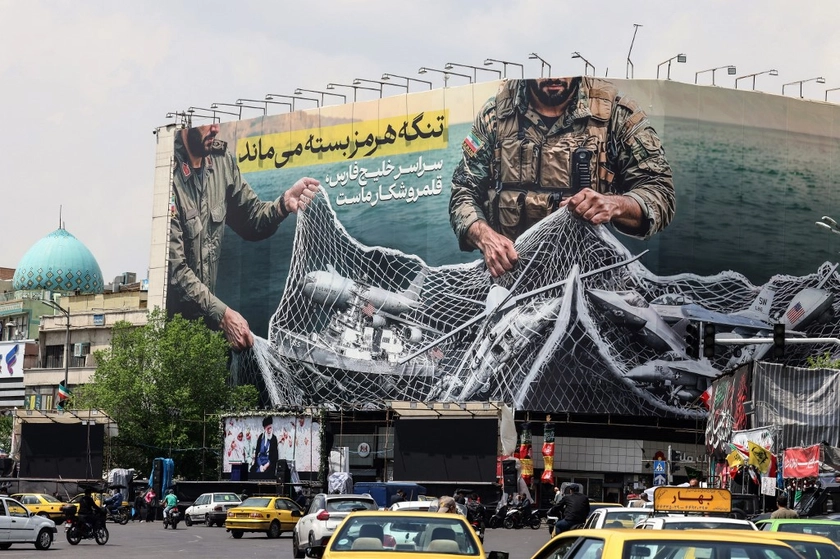
According to the military adviser, Iran has developed operational plans to systematically draw the conflict far beyond the geographic boundaries of the Persian Gulf. In the event of renewed fighting, Rezaei stated that Tehran would expand its kinetic operations from the strategic Strait of Hormuz into the Indian Ocean, the Bab al-Mandab Strait, the Red Sea, and the Mediterranean Sea.
He emphasized that Iranian forces would achieve this wider operational dimension by launching targeted strikes against additional American military installations across these maritime sectors.
Regional Tensions and Covert Infrastructure
The gridlock in asset negotiations unfolds against a backdrop of complex regional alignments established during the recent hostilities. Parallel intelligence disclosures indicate that Israel had previously established a network of covert military and surveillance sites throughout the Middle East to counter Iranian operations.
These included secret deployments of special operations forces and intelligence gathering infrastructure in southern Azerbaijan – positioned within 60 miles of the Iranian city of Tabriz – as well as logistical facilities in Somaliland and air defense deployments in the United Arab Emirates.
While countries like Azerbaijan have officially denied the utilization of their territory for foreign military operations, the extensive preparation of regional intelligence infrastructure in early 2026 underscored widespread international skepticism regarding the durability of US-Iran diplomacy.
With Iran now threatening to expand its strike radius across multiple global shipping lanes if financial concessions are not met, the onus remains on the Trump administration to determine whether to release the frozen funds or brace for a broader theater of regional attrition.
You can also highlight the text and press Ctrl + Enter