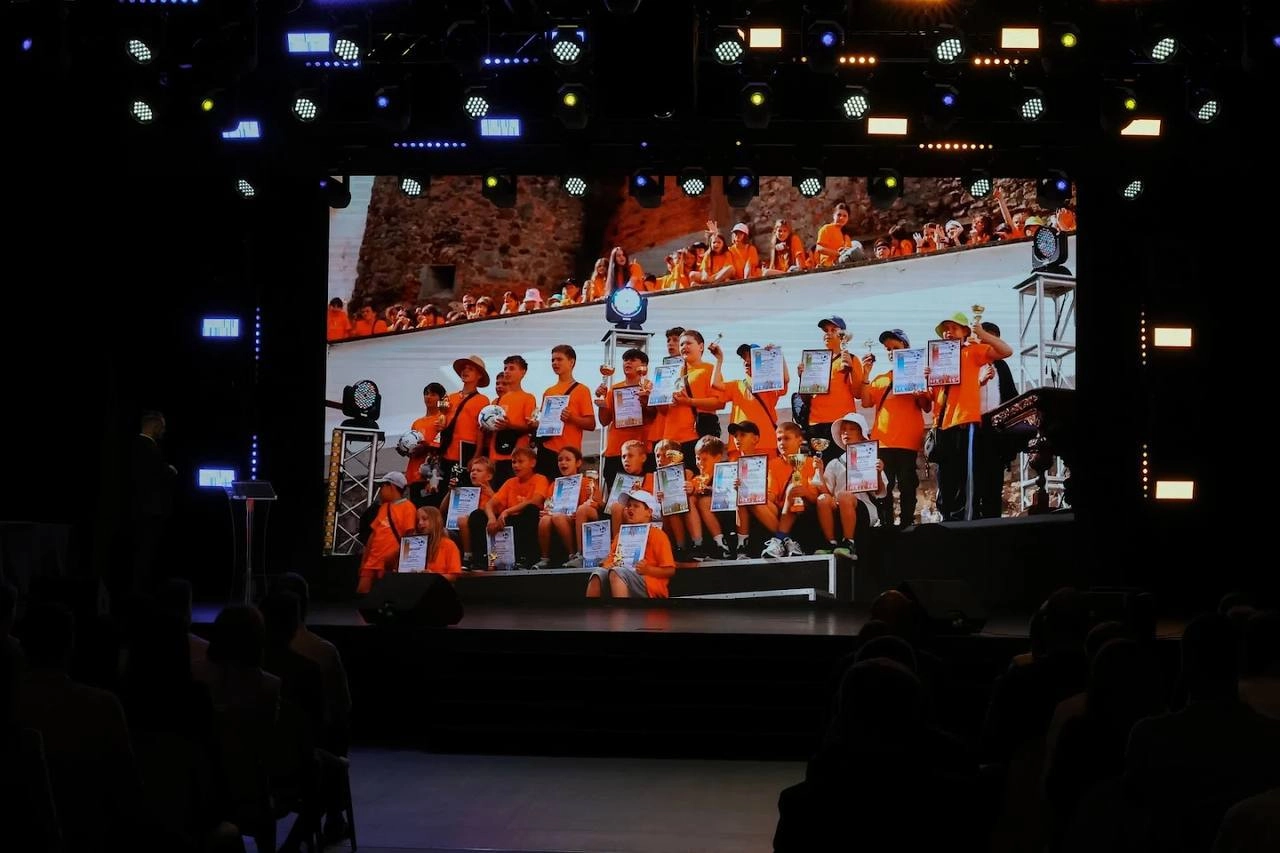
Two hundred children of servicemen, police officers and rescuers from the Kharkiv region, took part in this year’s “Carpathian Change” recovery project, aimed to ease trauma from living on the front line.
Oleh Syniehubov, head of the Kharkiv Regional State Administration reported a meeting with the Deputy Head of the Office of the President of Ukraine Viktor Mykyta, regional state administration authorities, and representatives of the Ukrainian Association of Football to review the project’s results and discuss its future development.
JOIN US ON TELEGRAM
Follow our coverage of the war on the @Kyivpost_official.
“‘Carpathian Change’ was initiated by President Volodymyr Zelensky to help children from frontline regions recover in a safe environment, combining rest, psychological support, and sports,” Syniehubov said, adding that two projects were organized in the Lviv region.
Two recovery shifts in Lviv region
Children from the Kharkiv region took part in two separate rest and recovery projects organized in the Lviv region this year, combining cultural activities with physical and psychological recovery designed to give children a break from the realities of war.
Activities included excursions, football tournaments, multi-sport competitions, and creative workshops, according to organizers. Children also met well-known Ukrainian athletes, including the Ukrainian Association of Football president Andriy Shevchenko.
“For children growing up amid war, such projects hold special significance,” Syniehubov said, adding that “interaction with peers, team sports, psychological support, and new experiences help restore their emotional state.”
Results show improved wellbeing – but what about prolonged war trauma?
More than 70% of children participating in the program reported having a calmer mood and an improved emotional state, according to results cited by Syniehubov.
However, due to their innate vulnerability, children remain among the easiest targets of both political propaganda and forced assimilation.
Citing Joshi and O’Donnell (2003), the War Childhood Museum explains that mental health problems are a “normal reaction to abnormal events,” framing children not as passive victims, but as active participants in society who “develop their own ways to cope and survive.”
Children in war-torn areas can face long-term consequences to their psyche from ongoing bombardment, including risk of anxiety disorders, post traumatic stress disorder (PTSD), depression, dissociative disorders (such as depersonalization and emotional numbing), behavioral disorders – especially aggression and violent criminal behaviour – and higher rates of alcohol and substance abuse than their counterparts in safer environments.
Russia’s “family values”
While Moscow continuously frames itself as a defender of traditional family values, its own war record tells a different story.
Since the beginning of Russia’s full-scale invasion of Ukraine, hundreds of Ukrainian children have been killed, with thousands more kidnapped and forcibly transferred to Russia, where they are stripped of their identity, and in many cases placed with families who show little regard for their Ukrainian heritage.
This contradiction extends to Russia’s own domestic rhetoric, with ordinary Russian men being conscripted and forcibly taken to fight wars involuntarily, even as authorities urge its youth to have at least 3 children by 35 amid steepest birth rate decline in decades.
Profiles of children taken from a Kherson orphanage surfaced on a Russian state adoption portal in April – a move condemned by both Ukraine’s human rights authorities and the EU. Ukraine’s human rights ombudsman Dmytro Lubinets said the listings “completely lack any mention of Ukraine or their true origin,” calling it a deliberate effort to erase the children’s identity.
You can also highlight the text and press Ctrl + Enter