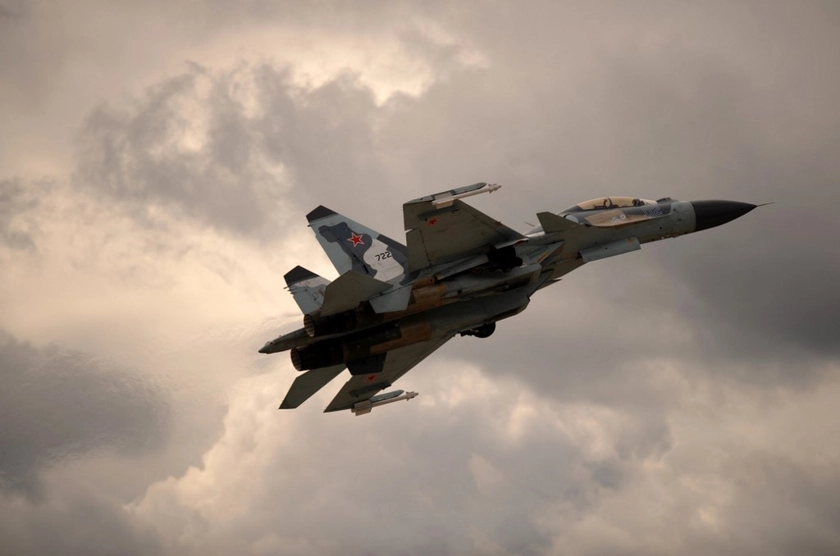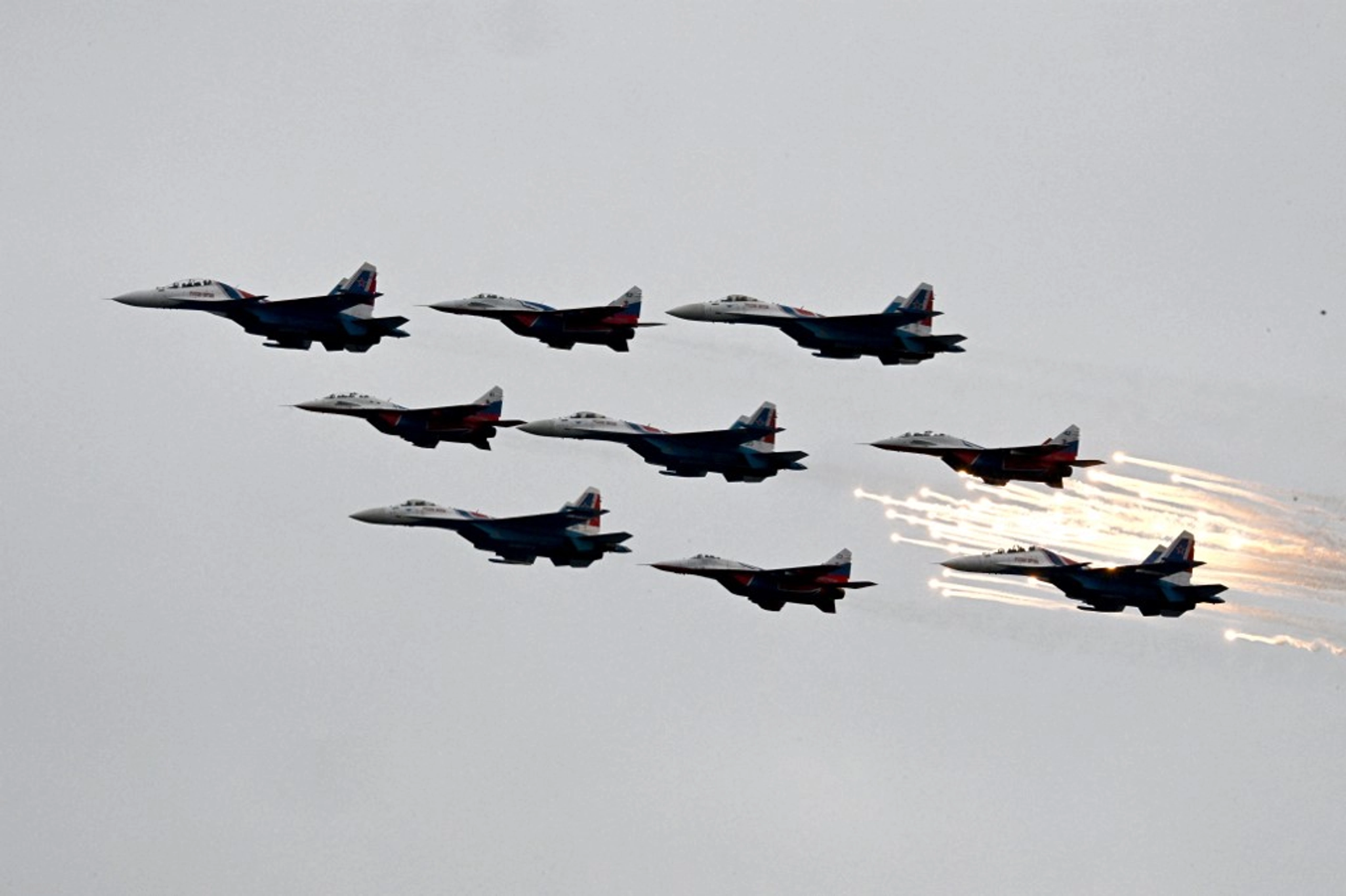
Russia has reportedly completed production of the first batch of 20 Su-35 fighters ordered by Iran, marking a major step in Tehran’s effort to modernize its aging air force.
According to Military Watch Magazine, the aircraft were built at Russia’s Komsomolsk-on-Amur Aviation Plant, with Iran’s Defense Ministry currently covering maintenance and sustainment costs while the jets remain in Russia ahead of transfer.
JOIN US ON TELEGRAM
Follow our coverage of the war on the @Kyivpost_official.
The development follows leaked Russian military-industrial correspondence from late 2025 indicating that 16 Su-35s were already in production for Iran at the time.
With a combat radius of nearly 1,600 kilometers (1,000 miles), the Sukhoi Su-35 (NATO: Flanker-M, or “Super Flanker”) can strike targets deep inside enemy territory. Its ability to operate from short or improvised airfields also makes it less dependent on major airbases and harder to neutralize.
While less advanced than aircraft such as the Lockheed Martin F-35 Lightning II or China’s Shenyang J-16, the Su-35 remains one of the world’s most battle-tested modern fighters and has been steadily upgraded with newer air-to-air missile systems, the report added.
Russia has historically produced Su-35s at a relatively modest pace of around 14 aircraft per year, though officials said production capacity was being expanded.
In May 2025, Vadim Badekha, general director of United Aircraft Corporation, confirmed that efforts were underway to increase output. The ramp-up is expected to reduce deliveries of Su-35s to Russia’s own aerospace forces over the next two to three years as Iranian orders are prioritized.
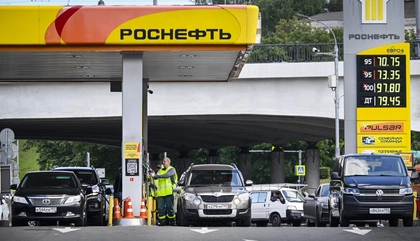
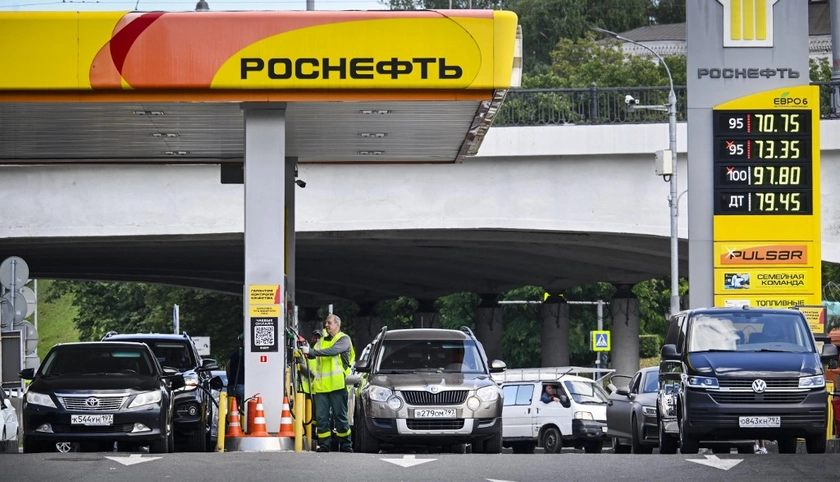
Russian Officials Receive Priority at Gas Stations Amid Nationwide Fuel Crisis
Leaked Russian government documents published in late 2025 suggested Iran had ordered 48 Su-35 fighters in total, confirming earlier statements by Iranian officials that an unspecified number of the aircraft had been purchased.
Russia reached a defense deal with Iran in 2023. The agreement marked Iran’s first fighter jet purchase since the 1990s and included Su-35 fighters, Mil Mi-28 attack helicopters, and Yakovlev Yak-130 jet trainers.
Interest in the Su-35 from other countries has been limited, with concerns over outdated avionics and potential sanctions discouraging many potential buyers.
As per the report, Iran has already begun preparing pilots for the new fleet. Deliveries of Yakovlev Yak-130 trainer aircraft to Iran began in September 2023, widely seen as part of a broader pilot training program for future Su-35 operations.
According to the report, Su-35 deliveries to Iran could begin in 2026, although some sources say infrastructure damage at Hamadan Air Base may be delaying deployment. Engineering teams are reportedly working to restore the facility, and advanced flight simulators are expected to arrive before the fighters themselves.
Iran’s military procurement from Russia appears to extend beyond the Su-35 program. Russian sources reportedly said in June that Tehran had also ordered 12 Su-30SM2 fighters, with deliveries expected to begin in mid-2027 using aircraft transferred from active Russian units.
The Sukhoi Su-30SM2, a less complex derivative of the Sukhoi Su-35, is considered cheaper and easier to maintain while remaining effective in strike missions and pilot training.
There have also been reports that Iran may seek to acquire the Sukhoi Su-57, Russia’s fifth-generation stealth fighter, though production backlogs could delay any deliveries until around 2030.
Iran’s acquisition of its first post-Cold War fighters is especially significant given the continued use of its aging Cold War-era fleet, including the Grumman F-14A Tomcat, McDonnell Douglas F-4D/E Phantom II, and Northrop F-5E/F Tiger II.
Iran’s air force has long relied on aging Western-made aircraft acquired before the 1979 revolution, many of which have become increasingly difficult to maintain. Its last major fighter acquisition came in the 1990s with the purchase of Mikoyan MiG-29 jets from Russia.
Although Iran has developed one of the region’s strongest missile arsenals, its domestic aviation capabilities remain comparatively weak.
However, despite their age, Iranian aircraft were able to carry out strike missions during recent hostilities involving the US and its regional partners, while largely avoiding destruction on the ground.
Analysts say the arrival of Sukhoi Su-35 fighters could significantly strengthen Iran’s air power and expand its ability to conduct long-range operations across the Middle East.
Su-35 – a fighter Russia uses for ground attack and air superiority
The Sukhoi Su-35 is Russia’s most advanced operational 4+ generation fighter, second only to the limited-number Sukhoi Su-57 supposed stealth airplane.
Developed from the Sukhoi Su-27, the Su-35 features enhanced maneuverability, thrust-vectoring engines, improved radar, and multirole capabilities for both air-to-air and air-to-ground missions.
The fighter entered service with the Russian Aerospace Forces in 2014 and is produced by United Aircraft Corporation (UAC). While highly maneuverable, analysts note its avionics and radar remain less advanced than those of many modern Western fighters equipped with AESA radar systems.
Russia has actively used Su-35s in the war against Ukraine for air combat, missile launches, and guided bomb attacks against frontline positions. Ukraine does not operate Su-35 aircraft.
Russia keeps building despite sanctions
In April 2026, UAC delivered a new batch of Su-35 fighters to Russia’s Aerospace Forces, marking the jet’s first publicly announced delivery of the year.
UAC said on April 17 that the aircraft had completed factory testing and were transferred to their operational airfields.
The previous public delivery was announced in December 2025. Defense outlet Militarnyi reported that at least two Su-35S aircraft were visible in UAC’s promotional footage from the company’s production plant in Komsomolsk-on-Amur.
Russian aviation sources estimate UAC delivered more than 20 Su-35S jets in 2025, compared with 15 aircraft in 2024.
The fighter has also drawn attention in sanctions-related investigations. A 2025 report by International Partnership for Human Rights and National Anti-Corruption Action Center found that downed Russian Su-34 and Su-35 aircraft contained large amounts of foreign-made electronics essential for targeting, navigation, and communications.
Researchers traced 889 foreign components in the Su-35 alone, mostly originating from US companies, suggesting Russia continues to bypass sanctions through intermediary shell companies.
You can also highlight the text and press Ctrl + Enter