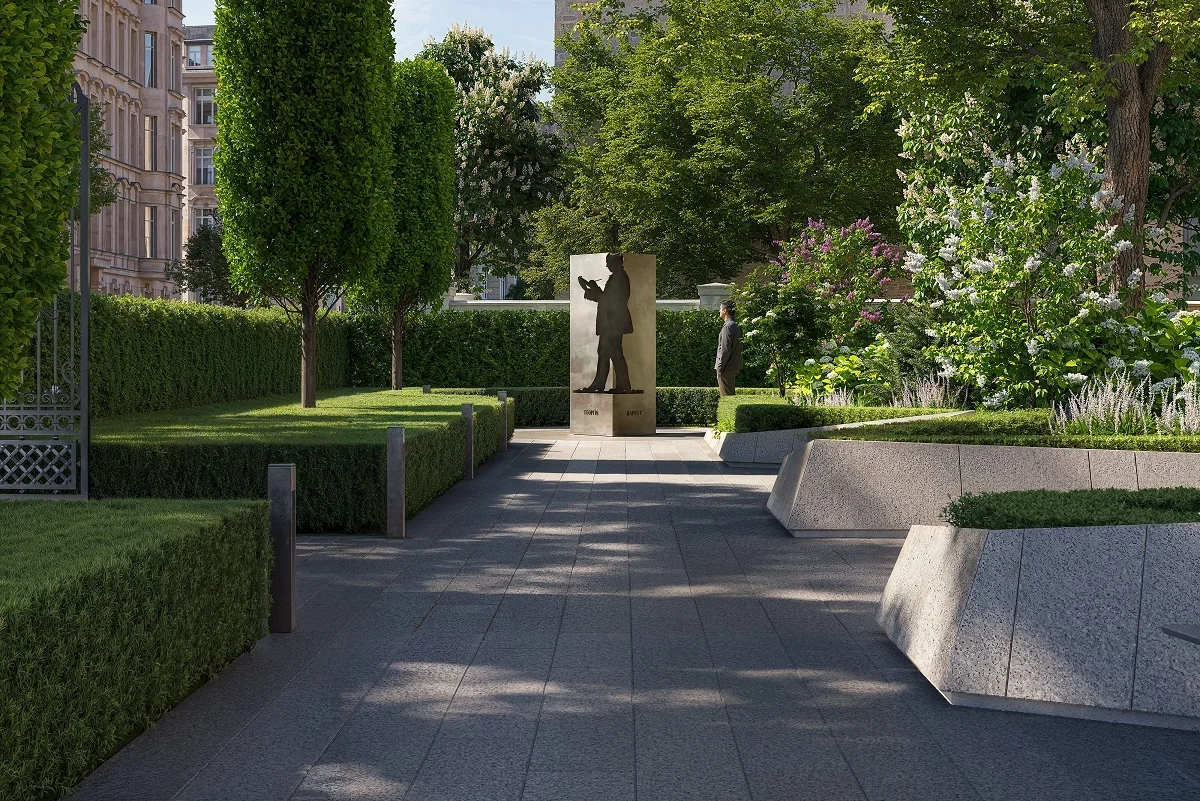
On a quiet corner of Reitarska Street in central Kyiv, an overgrown public square is about to take on new life as a “meta-garden” dedicated to Heorhiy Narbut – the artist who, more than a century ago, gave Ukraine its first visual identity.
Narbut, often called the father of modern Ukrainian graphic design, was rector of the Kyiv Academy of Arts and played a central role in shaping the country’s visual identity during its short-lived independence after World War I.
JOIN US ON TELEGRAM
Follow our coverage of the war on the @Kyivpost_official.
He created the banknotes and postage stamps of the short-lived Ukrainian People’s Republic (UNR). His bold, elegant style drew on folklore, medieval manuscripts, and Art Nouveau, leaving an enduring imprint on Ukrainian book illustration and state symbolism. Today, his name is little known outside art circles, yet his imagery defined a generation.
The transformation of the site brings together sculptor Nazar Bilyk, known for his public works in Kyiv, and local architects and landscape designers. At the heart of the project will stand Bilyk’s sculptural interpretation of Narbut – not a portrait, but what the artist calls “a silhouette of his life, passions, and precise hand.”
Unlike many urban makeovers, the Reitarska initiative is deeply tied to the community. Designers pledged to preserve existing trees, avoid artificial landscaping, and introduce plants that bloom year-round – echoing Kyiv’s long tradition as a city of gardens.

Russia Bombs Ukraine’s Sacred Monastery | Eastern Express
The square also carries symbolic weight: Narbut once worked just a street away.
“To create a memorial for the man who designed Ukraine’s visual brand is a challenge,” Bilyk told journalists at the presentation.
“The goal was not likeness but essence.”
A broader redevelopment effort of nearby 19th-century buildings has already been recognized by the International Property Awards in London. But organizers insist the meta-garden is not about prestige. Instead, they describe it as a cultural dialogue across generations – a reminder that even in wartime Kyiv, the seeds of memory and identity are being planted for the future.
“We are preserving every brick, restoring the authentic color of Kyiv’s 19th-century facades. We conducted thorough archival research to give Kyiv’s modernism a second life,” says project manager Oleksandr Shovkalyuk.
The project was presented this month with the support of Dovgiy Family Office, which is leading the wider revitalization of nearby historic buildings and the square itself. The project will take about three years to complete.
You can also highlight the text and press Ctrl + Enter

Fire Erupts at Kyiv Lavra in Overnight Russian Barrage
Russia Unleashes 681 Aerial Weapons on Ukraine, Killing 10, Including Rescuers