
What started as a temporary crisis response for foreign citizens in Ukraine has now hardened into a permanent and strict legal reality.
Back in 2022, thousands of international consultants, tech specialists, investors, and aid workers rushed into the country to support emergency efforts. Most arrived with suitcases packed for short-term crisis-response missions.
JOIN US ON TELEGRAM
Follow our coverage of the war on the @Kyivpost_official.
Fast forward to 2026, and the situation looks very different. Many of those individuals never left. They built lives, rented apartments, launched startups, and managed humanitarian projects from within the country.
This prolonged stay makes understanding NGO tax residency Ukraine rules and general expat tax status a matter of immediate survival for international operations and individuals alike. What used to be “emergency hubbing” is now, in the eyes of the law, a stable residency.
The 183-Day Threshold and the Myth of Overseas Compensation
Ukrainian tax status depends on a simple, objective headcount of days, not on where your boss sits or where your bank is located. A common trap for foreign entrepreneurs and remote developers is the belief that getting a salary into a US or EU account keeps them off the local tax grid.
In reality, the law is quite blunt. If you spend more than 183 days inside Ukraine within a single calendar year, the government views you as a local tax resident.
Valentyna Georgitsa, points out that this rule cuts across all categories. “It does not matter if you hold a volunteer visa, work for a global charity, or run a high-growth IT business from a laptop in Kyiv,” she notes.
When local authorities check your status, they don’t just count days; they look at the “Center of Vital Interests.” This involves checking:
- Your Residential Base: Having a long-term lease or owning property is a major red flag for residency. If your family moved to Ukraine with you, the case for residency becomes almost impossible to argue against.
- Local Economic Footprint: This includes doing freelance work while physically sitting in a Ukrainian co-working space, using local cards for daily expenses, or running a business through a Ukrainian desk.
- The Worldwide Income Rule: The moment you become a resident, Ukraine expects you to pay tax on everything you earn globally. This means foreign wages, rental yields from properties abroad and even realized gains from stock options in a home country are all part of the taxable base.
The Emergence of CRS and Enhanced Banking Compliance
The challenge of maintaining foreign workers compliance Ukraine standards has intensified because the Common Reporting Standard (CRS) is now fully operational. With more than 120 countries sharing financial data automatically, the era of keeping offshore accounts under the radar is officially over.
Ukrainian tax authorities now receive automatic data packages from foreign banks every year. These reports include account balances, interest, dividends, and corporate payouts linked to people living in Ukraine.
If you are an expat receiving a foreign salary via Wise, Revolut, PayPal, or Payoneer, the Ukrainian State Tax Service likely already has access to those figures through this global exchange network.
- Financial Flow Monitoring: Money moving through Wise, Revolut, and PayPal accounts is now highly transparent.
- Brokerage Transparency: Annual activity and balances on Interactive Brokers or Freedom Finance are shared with local regulators.
- Crypto and Web3: Large transfers on Binance, Bybit, or through decentralized wallets are increasingly being flagged by automated AML (Anti-Money Laundering) systems.
At the same time, local banks have significantly toughened their internal compliance. Foreigners in Ukraine now face blocked transfers almost daily as banks struggle to verify the origin of cross-border flows. To unlock these funds, individuals must pass tough source of funds checks by providing certified paperwork and proof of tax clearance.
Employment Structures: Navigating the Volunteer vs. Employee Split
International charities, tech firms, and foreign brands cannot afford to ignore their local contract structures anymore. The biggest legal risk in the 2026 market is misclassifying people who actually work for you full-time.
When evaluating volunteer vs employee NGO setups, auditors from the State Labor Service look at daily habits, not the fancy title on your business card.
If an international consultant or field coordinator works a set 40-hour week, manages a local team, and gets a steady monthly wire transfer, the government will almost certainly reclassify them as a standard employee.
The consequences of this reclassification are severe. If a volunteer is found to be a staff member, the organization must pay all backdated payroll taxes, plus heavy fines. For international brands, this doesn’t just mean a financial hit; it means bad press that can scare off global donors and corporate partners.
2026 Fiscal Rates and the “Foreign Tax Credit”
Expats who trigger local tax residency must file their annual returns based on standard Ukrainian tax rates.
However, the goal is often to avoid paying twice on the same dollar earned abroad. This is where double taxation treaties (DTTs) become your most important tool.
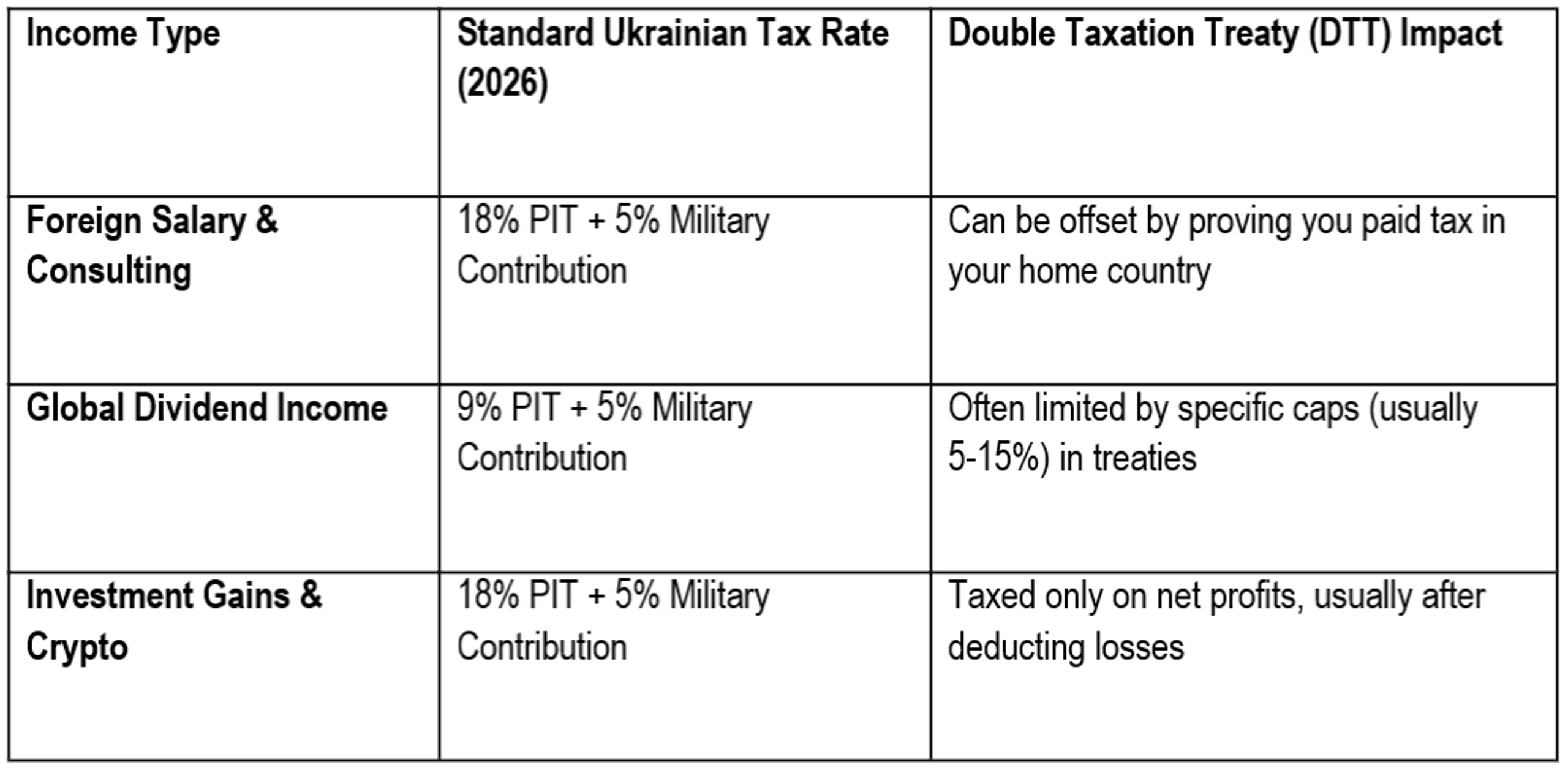
The “Military Contribution” is a unique part of the Ukrainian system, designed to support defense efforts, and it applies to almost all types of income. To stop you from being double-taxed, you can use a foreign tax credit.
But this isn’t a simple check box. You must provide official, paper certificates stamped by your home country’s revenue service (like the IRS or HMRC) to prove you already settled your bill there.
Digital Compliance: ID Numbers and the KEP System
Ukraine has significantly expanded its digital public services in recent years. While foreign citizens still face a number of administrative requirements, many tax and compliance procedures can now be completed online through banking and government electronic systems.
To stay on the right side of the law, every foreign resident needs three basic things:
- Tax ID Number (RNOKPP): This is the foundation of your financial life here. You need it to open a bank account, rent an office, or sign a contract. It requires a passport and a certified local notarized translation.
- Electronic Signature (KEP): This is a cryptographic file that acts as your legal signature for all government websites. Most expats generate this through their local bank account in a few clicks.
- The Electronic Cabinet: This is the main online tax portal. It’s where you upload your annual filings, monitor your tax balance, and pay your bills directly using a card or bank transfer.
Mandatory Documentation for Global Transparency
If you want the Ukrainian tax office to accept that you’ve already paid taxes in Washington, London, or Berlin, you need institution-backed proof. Digital PDFs from consumer banking apps or simple Excel spreadsheets will be rejected immediately during a compliance review.
For expats in Ukraine, the risk isn’t just about paying more tax – it’s about losing access to your banking and your ability to operate globally due to compliance freezes. As more foreign professionals, investors, and entrepreneurs continue building their lives in Ukraine, tax residency is becoming a practical consideration rather than a theoretical one.
Understanding where you are considered a tax resident, how your global income is treated, and what reporting obligations may apply is increasingly important for anyone planning a long-term presence in Ukraine.
You can also highlight the text and press Ctrl + Enter

Russia Hit by 660-Drone Overnight Barrage Targeting Moscow, Crimea and Key Military Sites