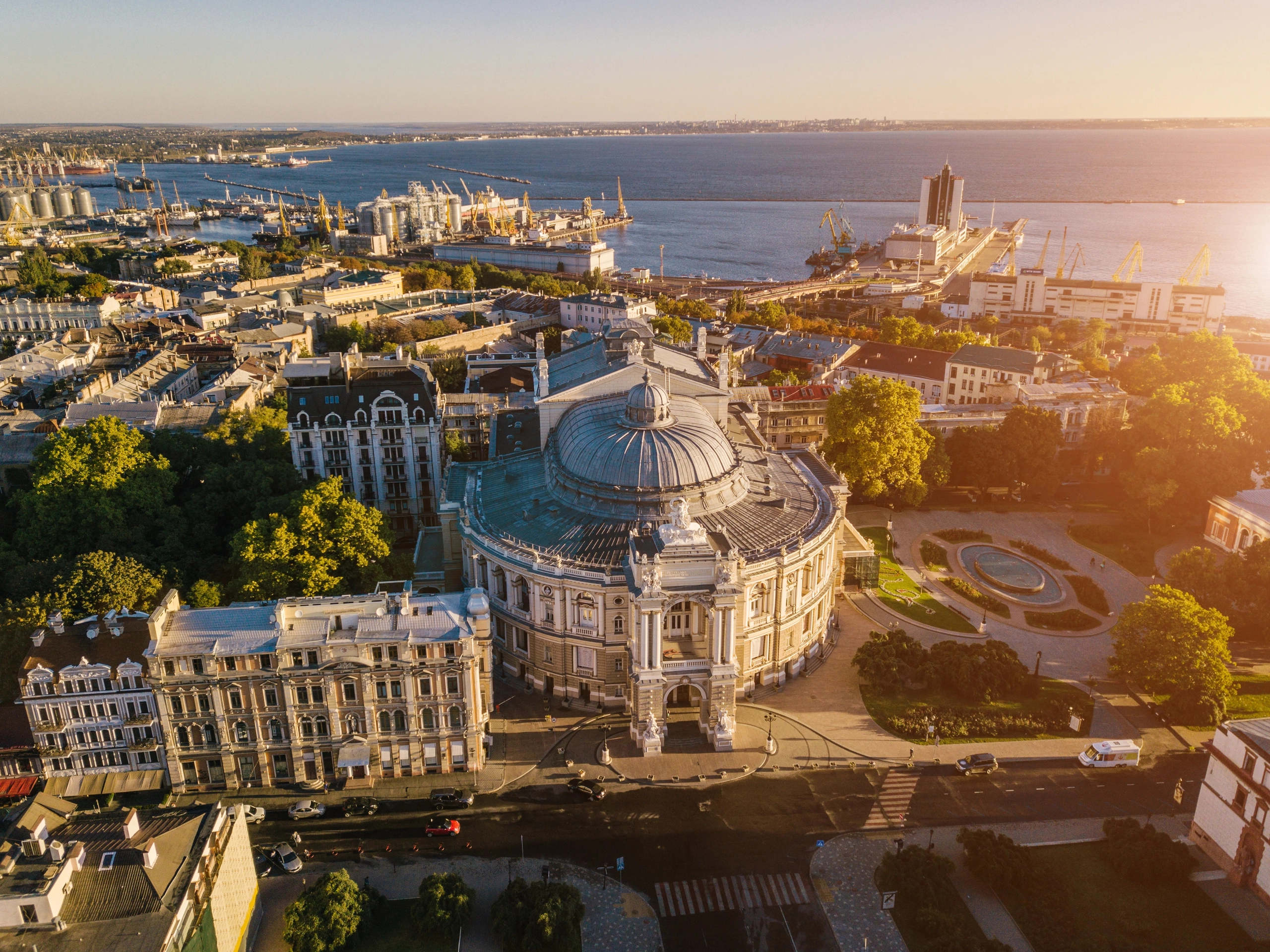
In the shade of the sycamores lining Odesa’s Palais-Royale Sq., every café table seems to carry the echo of a negotiation. Over coffee recently, I met Gennady Nechaevsky, who once directed the Department of City’s Municipal Bond and Infrastructure Projects from 2005 till 2011.
I had seen him last in 2017, ten years after he successfully implemented the Odesa municipal bonds denominated in Swiss francs. At that time, I worked at the Ministry of Finance of Ukraine and was responsible for the Ukrainian sovereign, sub-sovereign and municipal borrowing. Nechaevsky smiled with the quiet satisfaction of a man who had convinced Swiss bankers to lend millions to a Ukrainian port city better known for its humor than its credit history.
That conversation recalled a remarkable – and largely forgotten – chapter of municipal finance, in which Odesa, the “pearl of the Black Sea,” repeatedly reinvented itself as a pioneer of public borrowing, from the 19th century to the eve of the 2008 financial crisis.
Founded in 1794, Odesa wasted no time establishing itself as a commercial hub. By 1796, it already boasted a functioning commodity exchange – the first in the southern reaches of the Russian Empire. “Odesa was always a financial center and the southern capital of the Empire, and later of Ukraine,” Nechaevsky noted. “By 1900, its population rivaled Milan, Marseille, and Leipzig.”
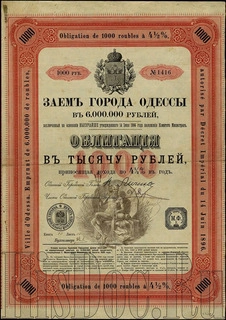
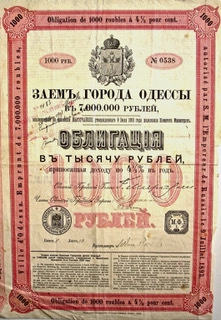
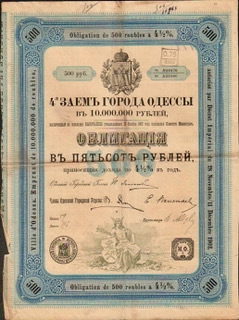
At the turn of the 20th century, the city issued its first municipal bonds – 7 million rubles (then equivalent to $5.4 million) in 1893, followed by additional placements in 1896 and 1902. The debut issue carried a 4.25% coupon and a 52-year maturity, terms enviably long by modern standards. According to period accounts, these securities circulated well into the 1920s in Britain and until 1941 in France. At the time, Odesa’s creditworthiness was mentioned in the same breath as Paris, London, Berlin, and Rome – an extraordinary position for a city less than a century old.
The first municipal bonds in the Russian Empire were issued in St. Petersburg in 1875 with a coupon of 5.00% and a tenor of 48.5 years.
According to various sources, Odesa municipal bonds issued in 1893, 1896, 1902 remained in circulation until 1928 in Great Britain and until 1941 in France. In those years, Odesa’s financial credibility was comparable with Paris, London, Berlin and Rome.
After the Soviet collapse, Odesa reclaimed its flair for financial experimentation. In 1997, it became the first Ukrainian city – and only the second in the former Soviet Union – to issue municipal bonds. The offering, worth Hr.60 million (approximately $32 million), carried a staggering 50% annual interest rate and a 12-month maturity.
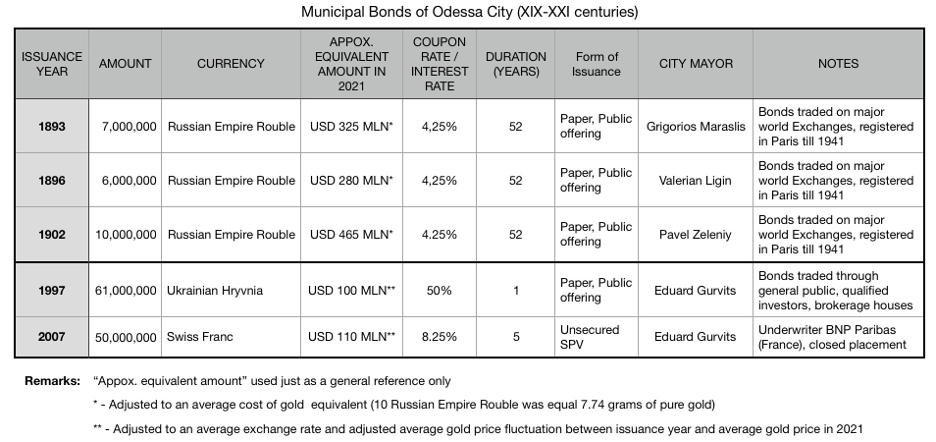
Such terms, viewed through today’s lens, border on the absurd. But, as Nechaevsky explained: “Few people remember that the effective bank rate at that time was 60-70% per annum. The economy was volatile, but there was enormous investor appetite. Roughly 90% of the bonds were snapped up by international funds. A property boom followed, and for a brief moment Odesa looked like a regional success story – until politics intervened. In 1998, the newly elected mayor, Rouslan Bodelan, declared default, despite the city having sufficient funds. The debt was only repaid after another administration came to power in 2005. The episode left a lasting scar on the city’s financial reputation.”
The 1997 default illustrates critical governance risk factors in emerging market municipal finance – specifically, political transition risk independent of underlying fiscal capacity. This sovereign-level risk premium would subsequently impact the city’s cost of capital for nearly a decade.
Odesa municipal bonds 1997 were genuinely unique for many reasons. The first Ukrainian hryvnia was printed in 1992 at Canadian Bank Note Company and was stored there before going into circulation only in 1996. Not many people know that Odesa Municipal Bond certificates 1997 were printed at the same Mint in Canada, where Canadian dollars are printed. A local legend exists that Odesa’s bond certificate paper had 22 counterfeit security protection features, exceeding the Canadian dollar and other banknotes. Another myth existed that the Canadian Bank Note Company delayed printing Canadian dollar notes for one day to print Odesa Bond Certificates.

Fueling the construction boom
It is important to understand that in 1996-97 a construction boom began in Odesa, and in terms of apartment price growth, Odesa had surpassed almost all cities in Ukraine at that time. The City Council decided to issue a short-term municipal bond and use the proceeds to create infrastructure for new multistory municipal parking lots, as well as to prepare the plots for urban construction. The city could not fulfill such projects alone, so it envisaged joint ventures with private investors (the structural predecessor of Public-Private Partnership). At that time, international investment funds, which believed in the investment program of the city, willingly bought out about 90% of the entire bond issuance, with the general public purchasing the rest.
Many people familiar with basic finance would be surprised by the economics of the Odesa municipal loan in 1997 in the amount of Hr.60 million (the equivalent of $32 million) at 50% per annum with repayment in 12 months. Few people know that in 1997-98, Ukraine carried out three external borrowings for a total of $722 million with one-year maturity, so a short repayment period was instead more the norm for Ukraine rather than an exception to the rule.
The coupon rate was so high because in 1997 the average annual dollar exchange rate was only Hr.1.8. In 1998 the dollar rose to Hr.3.4. Having borrowed Hr.61 million ($34 million) in 1997, in 1998 it was necessary to return, together with interest, Hr.91.5 million (about $27 million). Few people remember that the effective bank rate reached 60-70% per annum in those years.
The main reason why Odesa did not pay off its debt obligations was the Mayor Rouslan Bodelan’s re-election. To the surprise of the banking community, private investors, and local citizens, the newly elected mayor unexpectedly decided to not pay off the city’s financial obligations, even though there were more than enough funds in the city’s accounts. As a result, Odesa fully paid off the 1997-1998 bonds only after the next mayoral elections in 2005, paving the way for the possibility to implement a new successful bond issuance a few years later.
After the default of 1997 bonds, the Ukrainian Ministry of Finance did not trust Odesa.
If the 1997 bonds were a misstep, the 2007 issuance was an act of redemption. I recall very well when Gennady Nechaevsky appeared at the Ministry of Finance in 2006 and stunned me with the idea of potential international borrowing for Odesa and asked for advice. The fact is that then, and today, the only city that has issued municipal loans in foreign currency was Kyiv, the capital of Ukraine. Many cities of Ukraine, such as Kharkiv, Dnipro and Lviv, tried to issue international municipal bonds, but did not succeed for various objective and subjective reasons. And here was Odesa, which became infamous for its default in 1998. In 2003, the Ministry of Finance developed – and the Cabinet of Ministers approved – the procedure for municipal borrowing to avoid default situations that happened in Odesa five years earlier.
The Ministry of Finance was very skeptical about the idea of a new borrowing from Odesa, but Nechaevsky had persuaded Standard & Poor’s and Fitch Ratings to assign Odesa credit ratings – a first for any Ukrainian city. “By 2007, Odesa had one of the best ratings in the country,” he recalled. “It helped attract serious institutions – Morgan Stanley, Deutsche Bank, Royal Bank of Scotland, Nomura Bank, and BNP Paribas.”
However, the brilliant idea was to borrow Swiss francs. “All brilliant ideas are simple,” Erich Maria Remarque wrote in “The Promised Land” (Das Gelobte Land). The best option was to borrow then in Swiss francs, since historically borrowing in CHF has a lower interest rate compared with US dollars and euros.
In Odesa, where even the cats seem to walk with a swagger, finance too must have character – and perhaps, still, a faint Swiss accent.
Then Odesa thoroughly compared and evaluated the offered terms from the banks. BNP Paribas (France) won the competition, and the Odesa, together with the law firms Magister & Partners, started working on a fairly complicated SPV (special purpose vehicle) loan agreement. After three months of hard work of financiers, bankers and lawyers, the contract was accepted by all parties.
The official signing between the Odesa and BNP Paribas was scheduled for Dec. 20, 2007, just before Christmas. Unfortunately, on the evening of December 19, an Austrian bank that participated with BNP Paribas in a syndicated loan asked for major amendments to the Loan Agreement after the “pre-default” announcement of Leman Brothers known at this time only to inside specialists, which occurred just a few days earlier. “It was Christmas week, with offices in London, Vienna, and Kyiv all preparing to close,” Nechaevsky remembered. “Late in the evening, Dominique Menu (BNP Paribas) and I had to mobilize legal teams in London, Vienna and Kyiv to pursue them to amend the agreement overnight. It typically takes at least several weeks, but it was done by 7 a.m. the next morning.”
As a result, the Municipal Loan Agreement was signed after incredible events and adventures the same night and 50 million Swiss francs reached the city’s treasury account in the week before the New Year, which was also impossible considering numerous inter-banking transactions between four European countries and four currencies (euros/dollars/Swiss francs/hryvnia) during the Christmas holidays.
Months later, the global financial system began to unravel with the collapse of Lehman Brothers. Odesa had, unknowingly, beaten the clock.
The Swiss franc denomination strategy demonstrated sophisticated currency risk management, capitalizing on favorable interest rate differentials while accessing deeper liquidity pools in European capital markets. The timing – immediately preceding the 2008 global financial crisis – represented optimal market conditions that would not return for emerging market issuers for nearly a decade.
In Odesa, where even the cats seem to walk with swagger, finance too must have character – and perhaps, still, a faint Swiss accent.
Odesa’s bond history, stretching from imperial rubles to Swiss francs, offers a case study in both ambition and resilience. It is also a reminder of how cities – not just nations – can shape investor confidence and access international capital markets.
Without the well-coordinated, professional cooperation of many people, Odesa’s municipal bonds issuance would not take place in 2007. Among them it is worth mentioning Eduard Gurvits (Mayor of Odesa in 1994-98/2005-10), Dominique Menu (BNP Paribas), Olga Khoroshilova (Law Firm Magister & Partners), Michael Kharenko (Law Firm Saenko & Kharenko), Eka Beradze (the Ministry of Finance), Alexander Ginsburg (Special Advisor to the Prime Minister).
Today, as Ukraine works to restore its financial credibility amid the devastation of war, that legacy of innovation carries renewed relevance. Municipal finance may again become a tool for rebuilding trust and infrastructure alike – leveraging decentralized funding mechanisms to accelerate reconstruction while building institutional capacity at the local level.
“I am confident that true professionals will restore the credibility of Ukraine soon,” Nechaevsky reflected at the end of our conversation.
You can also highlight the text and press Ctrl + Enter

Russia Hit by 660-Drone Overnight Barrage Targeting Moscow, Crimea and Key Military Sites