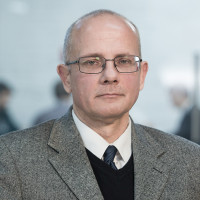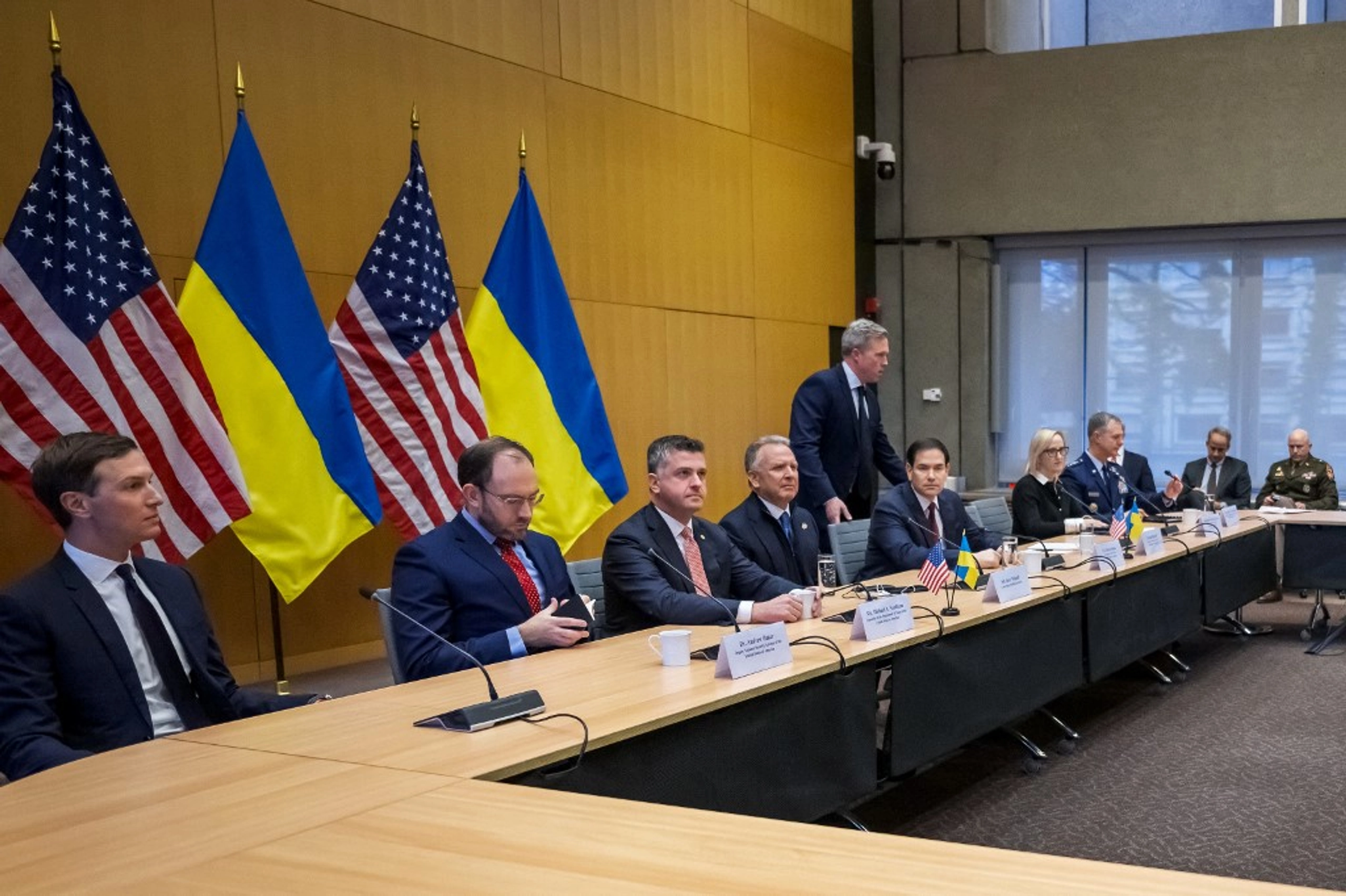
Der Tagesspiegel: Mr. Umland, following a meeting with Ukrainians and other Europeans in Geneva over the weekend, the US has announced changes to its heavily criticized 28-point plan to end Russia’s war of aggression. Is this a success?
Andreas Umland: Yes, you could say that. However, this cannot undo the fact that this 28-point plan in its original form ever appeared in the first place – and that is worrying. At the moment, there are indications that this supposedly American-Russian position, which the paper was seemingly reflected, was in fact a document that originated in Moscow and was at least partially adopted in Washington. For a moment, it looked dangerous.
JOIN US ON TELEGRAM
Follow our coverage of the war on the @Kyivpost_official.
In your opinion, which parts of the plan bear the Russian signature most clearly?
Above all, the demands that are clearly contrary to international law. For example, the request that Kyiv cede control over certain Ukrainian territories, that Moscow’s conquered areas are recognized as Russian, or that the Ukrainian army be reduced to 600,000 soldiers without consulting Kyiv. These are profound infringements on the territorial integrity and national sovereignty of a state – not to mention the fact that some points would be impossible to implement.
What do you mean?
Point 26 of the plan, for example, states that all parties to the conflict will receive “full amnesty” for their actions. I wonder how such a formulation can even appear in such a document. The International Criminal Court has issued an arrest warrant for Vladimir Putin. The Council of Europe has decided to set up a special tribunal to investigate Russian war crimes. Both are autonomous institutions that cannot simply be restrained by a bi- or trilateral agreement.
Alaska Deal or No Deal? US, Russia Clash Over Secret Trump-Putin Talks
Or take NATO membership, which Ukraine should renounce according to the 28-point plan: There is the 2008 NATO declaration stating that Ukraine will one day become a member of the Western military alliance. It is unclear how this decision can be reversed. Not to mention that it would take a two-thirds majority in the parliament in Kyiv to remove the NATO accession goal from the national Constitution. Here, too, I find it hard to believe that this would ever be possible.
After all, the plan also mentions “reliable security guarantees” for Ukraine to protect it from another Russian attack. Is that worth nothing?
It would be – if it were meant seriously. But US President Donald Trump has made it clear on several occasions in the past that American troops are not available for peacekeeping in Ukraine.
Putin will not agree to a new American-Ukrainian draft.
That leaves the Europeans.
There are still many unanswered questions among the Europeans as well. Suppose a European troop contingent is stationed in Ukraine and this contingent is then fired upon by the Russians: how would the European troops respond? If the European soldiers do not defend themselves, their mission makes little sense and would become a strategic problem. But if they did respond, the European countries which have sent them could become embroiled in the Russo-Ukrainian War – and I have serious doubts that they would be prepared to do so.
In this respect, I consider the discussion about Western troop contingents to be counterproductive at this point in time, because it distracts from more realistic and important aid measures.
Namely?
The primary task now is to find a common position with the Ukrainians and Americans that fully takes Kyiv’s interests into account and to present this as an alternative to the 28-point plan.
But Putin will surely reject such an alternative, won’t he?
Indeed, Putin will not agree to a new American-Ukrainian draft. To keep the Americans happy, Putin will probably say that everything is wonderful, but that some corrections are needed – and then turn the entire plan on its head.
At this point, the West will have to take a stand – for example, by imposing new sanctions on Russia and/or expanding arms deliveries to Ukraine. The US and Europe must show that there are consequences for Russia repeatedly allowing the peace negotiations to come to nothing. If these consequences are harsh enough, there may be a chance that Putin will ultimately give in and a compromise can be found that Ukraine can also accept.
What might that look like?
It would probably boil down to wording that reflects Russian claims to some extent – for example, on the territories already occupied – but does not make any irrevocable statements. For example, it could be agreed to accept the current status quo on the front line while avoiding definitive statements about the fate of the occupied territories or Ukrainian NATO membership. Realistically, that is all that can be achieved at present.
But even that would require a resolute stance by the US toward Russia. Haven’t the past few days shown that this is not to be expected?
Indeed, the big question is how Trump will behave going forward. My hope is that public opinion in the US will play a role here. Because there we see – at least so far – an astonishing stability in the rather pro-Ukrainian and Russia-critical mood, even among Republican voters.
Trump himself would probably have no objection to sacrificing Ukraine in exchange for good Russian-American relations. But since that is not popular in his country and party, I would not give up hope that the majority opinion will ultimately be reflected in his foreign policy behavior.
The views expressed in this opinion article are the author’s and not necessarily those of Kyiv Post.
You can also highlight the text and press Ctrl + Enter