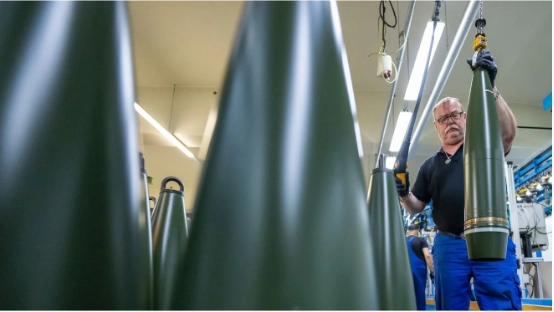
Artillery shell output at a state-of-the-art Rheinmetall factory will be almost twice initial corporate targets and, thanks to near-bottomless demand for munitions driven by the Russo-Ukraine War, production and profits for Germany’s biggest arms manufacturer will accelerate, CEO Armin Papperger said in Thursday comments to industry media.
A brand-new Rheinmetall artillery shell production facility in the Lower-Saxony village Unterlüß, coming on line in 2026, will be able to produce up to 350,000 155mm shells per year instead of the planned 200,000, Papperger told the major German business publication Handelsblatt in an interview.
JOIN US ON TELEGRAM
Follow our coverage of the war on the @Kyivpost_official.
Rheinmetall broke ground on the $341 million (€300) Unterlüß facility in February 2024. Besides artillery ammunition – especially the war-critical 155mm howitzer shell – the factory will employ 500 workers producing 1,900 tonnes of RDX explosive and, optionally, other components for producing ammunition charges. In addition, production of rocket engines and possibly warheads could take place here, a corporate statement said.
Unterlüß will become Europe’s second-largest artillery plant after a Rheinmetall-owned factory in Spain, where 450,000 shells a year will be produced annually, Papperberger said.
After first-person-view (FPV) drones, the most effective weapon used by both sides of the Russo-Ukraine War is artillery. Thanks to on-off US arms deliveries and slow European government orders to companies like Rheinmetall, Ukraine’s army, in more than three years of conventional combat against Russia, has faced multiple crippling shell shortages, most severely in the latter half of 2022 and in the first five months of 2024.
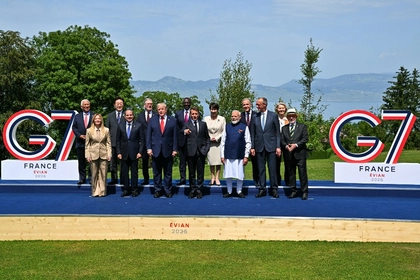
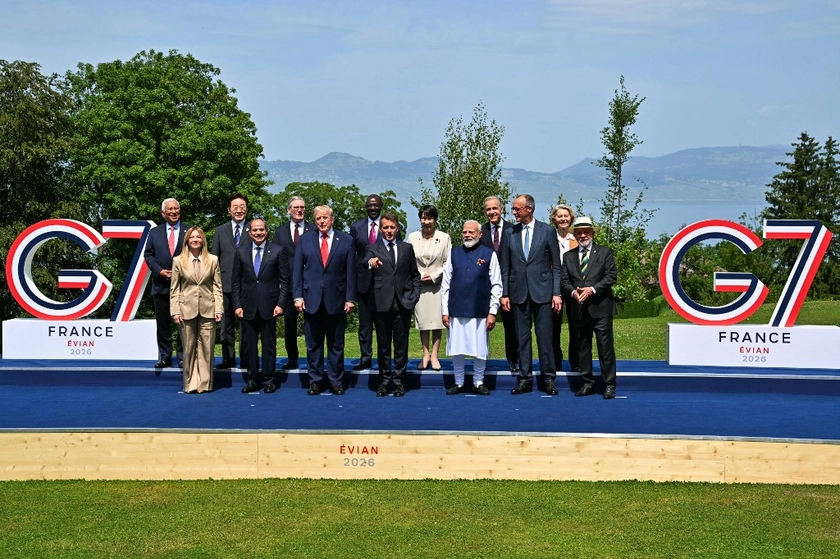
G7 Members Back on the Same Page?
Russian shell output is greater than Europe’s and since January 2024, Russia’s ally, North Korea, has sent Moscow an additional four million artillery shells, enabling Russian army artillery to heavily outgun the Armed Forces of Ukraine (AFU) throughout most of the war.
The Ukrainian military research group Defense Express on Thursday reported that Rheinmetall’s world-wide annual production capacity of 750,000 artillery shells is the single most important agency, by any state or corporation, in helping the AFU redress that Russian advantage.
A Rheinmetall production graphic published by Handelsblatt put the total number of artillery shells manufactured by the company in 2022 at 70,000 rounds, and the projected number in 2027 at 1.1 million rounds. Some military media have reported the figure might rise to 1.5-1.7 shells if in-place plans to accelerate production succeed.
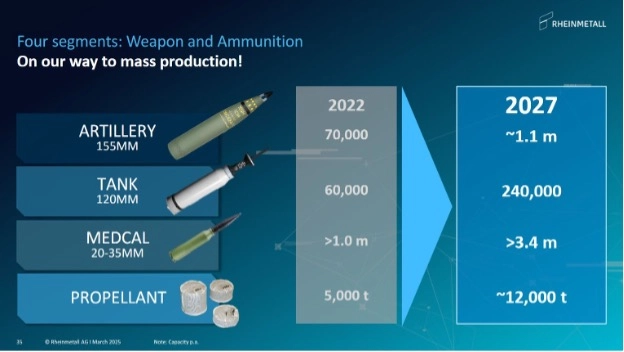
This Rheinmetall graphic shows corporate 2022 completed and 2027 planned manufacturing volumes production levels of key products.
Rheinmetall mainly manufactures artillery shells in Germany and Spain and is investing in expanding production capacity there, but, the company also is building new plants in Lithuania, Latvia, Estonia, Denmark, and Ukraine; and is negotiating with Poland and Romania, Defense Express said.
The Ukrainian plant will deliver “significantly more” than the originally planned 150,000 155mm shells per year and production will start in 2026, Papperberger said.
Rheinmetall’s sales by end of 2024 rose by 36% to $1.1 billion (€9.75 billion), operating profit grew by 61% to $1.68 billion (€1.48 billion), an order backlog of $62.5 billion (€55 billion), and sales in 2025 projected to grow 35-40%, Handelsblatt reported.
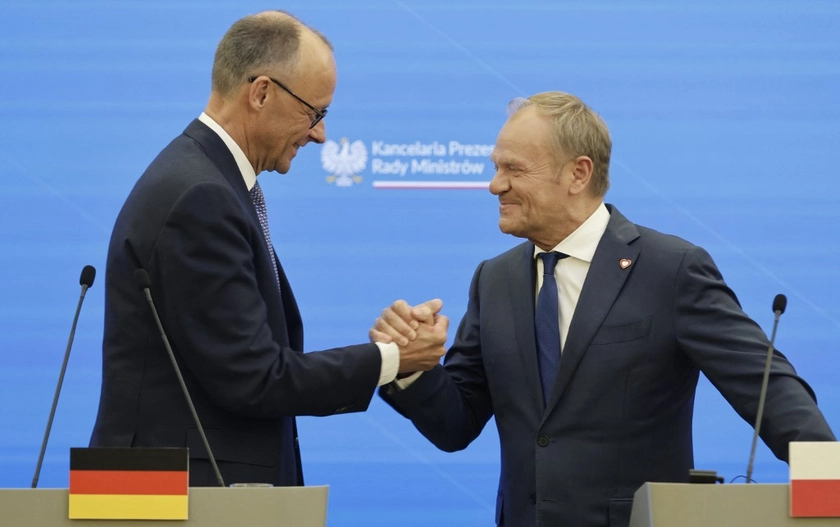
Papperberger’s upbeat comments to Handelsblatt came in the wake of statements by incoming German Chancellor Friedrich Merz that Berlin’s new CDU-SPD government intends to launch a major re-armament program for the national army, the Bundeswehr, and that widened German arms deliveries to Ukraine will be a top foreign policy priority.
In an April 13 interview on ARD television, Merz said that continued Russian targeting of Ukrainian civilians makes necessary Germany’s transfer of precision-guided Taurus cruise missiles to Kyiv, so that that Ukraine might attack Russian supply routes carrying the munitions used by Moscow’s forces to hit Ukrainian cities.
“Putin…must be told, if he does not stop bombing the civilian population in Ukraine in 24 hours, then Taurus cruise missiles must be delivered to Ukraine, in order to destroy the supply chains that this regime is using,” Merz said. “I am not convinced that Putin will react positively to weakness and peace offers. He will, he must at some point realize the hopelessness of this war, which means that we must also help Ukraine.”
Merz went on to suggest Taurus missiles might target the Kerch bridge connecting the Russian mainland to the Russia-occupied Crimea peninsula, a main supply base for Russian forces operating in southern Ukraine.
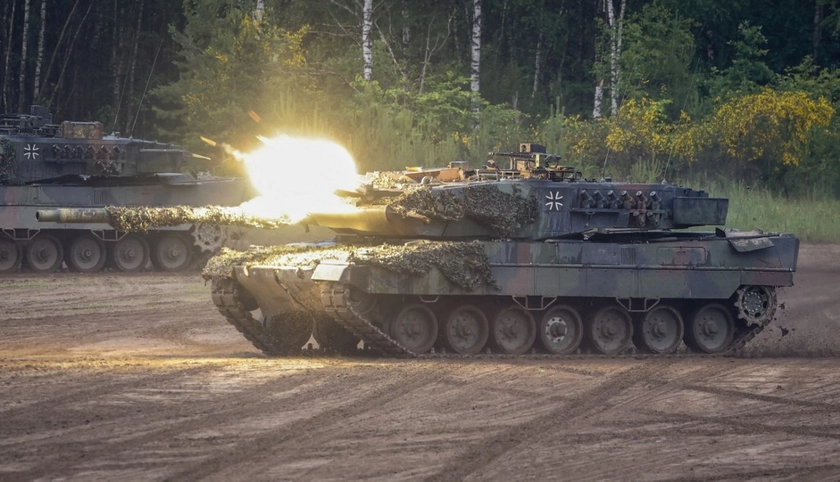
Germany is Ukraine’s second-biggest arms supplier after the United States. Among the most critical German arms and munitions supplied to Ukraine have been hundreds of thousands of artillery shells, advanced anti-aircraft missile systems, air defense cannon, air defense radars, and more recently, reconnaissance and strike drones. Limited numbers of German tanks, artillery and infantry fighting vehicles also are in use by the AFU.
Prior to the takeover of the White House by populist President Donald J. Trump, America had, like Europe, been a major supplier of artillery shells, but had expanded production more slowly than Rheinmetall did. Rheinmetall is a publicly traded corporation. US shell manufacturing is largely state-owned. Trump, since coming to office has mostly allowed previously contracted US shell deliveries to go to Ukraine but stated repeatedly that his administration opposes sending Kyiv more US arms and munitions.
The US-based Defense and Security Monitor (DSM) in a Wednesday report said that US artillery shell production volumes were almost certain to stay stagnant, and likely to fall because Trump-enacted tariffs on imported goods to the United States had driven up per-shell production costs in the country.
Imported intermediate materials needed by US factories to produce artillery shells include steel, iron, aluminum, copper – all of which have been hit by sector-specific tariffs, the report said, making steel casings, brass parts, lead cores and milling machines needed by American manufacturers more expensive.
The short-term result has been a 25% spike in the cost of producing a finished artillery shell in the US and cost overruns for the government factories doing the work, DSM reported.
The Kremlin reacted furiously to Merz’s suggestion that high-tech, precision-guided German Taurus cruise missiles should reach Ukraine’s battlefields.
“Any attack with cruise missiles on Russian targets would mean direct German involvement,” in the war, a Thursday Russian Foreign Ministry statement said.
Russian Presidential spokesperson Dmitry Peskov told Moscow media on Wednesday even the transfer of Taurus missiles to Ukraine will be “an inevitable escalation.”
Dmitriy Medvedev, a former Russian President and current Russian Security Council Deputy Chair, fumed in an “X” comment: “Chancellor candidate Fritz [Friedrich] Merz is haunted by the memory of his father, who served in Hitler’s Wehrmacht. Now Merz has suggested a strike on the Crimean [Kerch] Bridge. Think twice, Nazi!”
You can also highlight the text and press Ctrl + Enter

Poland, Germany Clash Over €6.6B in EU Funds for Ukraine
Germany Warns of Russian Orbital Nuclear Threat