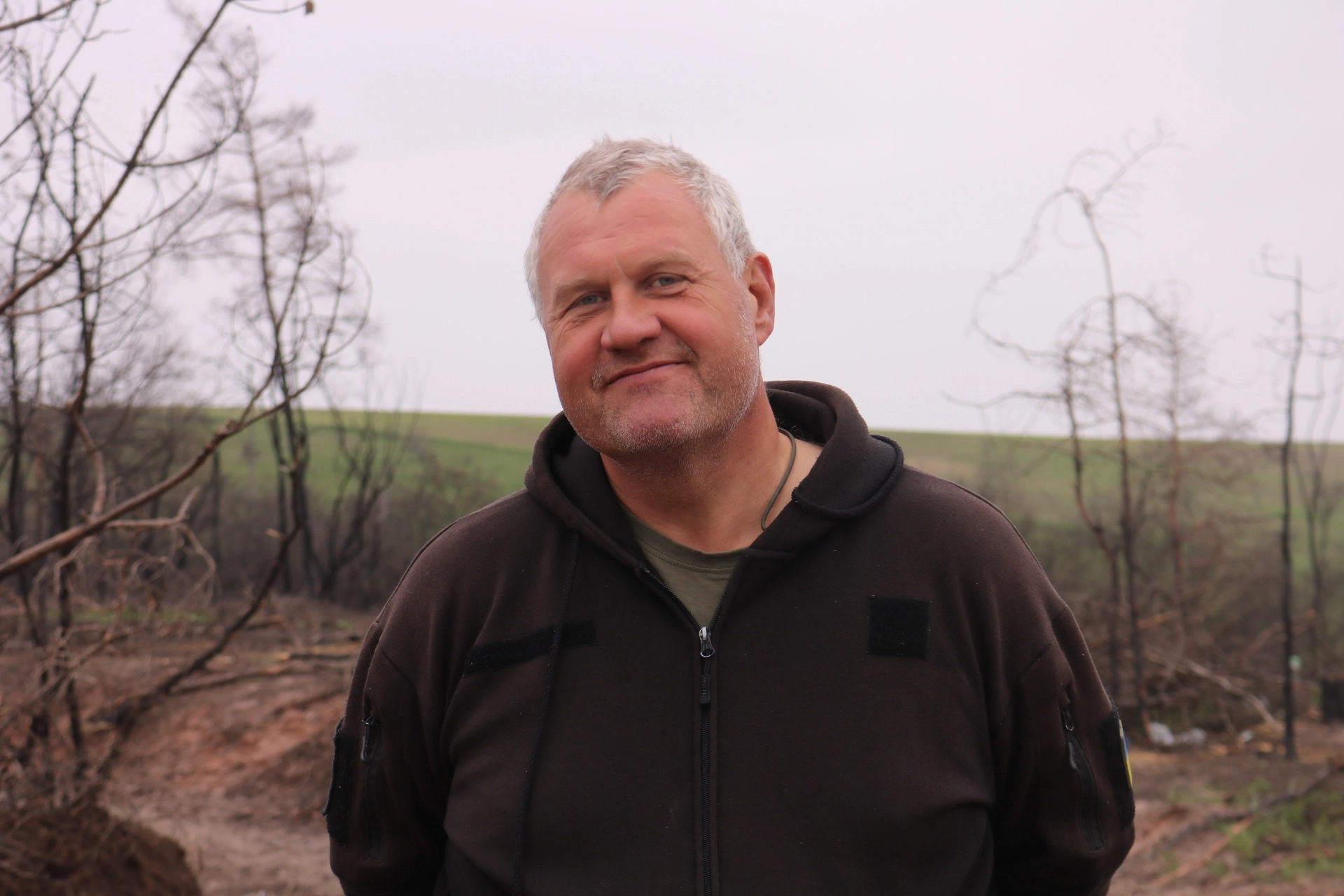
Swedish military instructor Magnus Ek likens military training to phenomena in physics.
“Military training is like rings on the water. We provide a little bit of knowledge here and there on the huge front line, and it spreads after.
JOIN US ON TELEGRAM
Follow our coverage of the war on the @Kyivpost_official.
Of course, we as instructors are not some angels coming here. The defenders on the front line are witty and intelligent. They adapt to the situation and learn fast by doing things in the battle. They are making a lot of smart and unique discoveries. So it is a self-building system. You have to learn how to fight in the circumstances that are on the front line, otherwise you cease to exist,” says Ek, who came to Ukraine to help at the beginning of the full-scale invasion, in February 2022.
In physics, the “Magnus effect,” studied by the German scientist Heinrich Gustav Magnus, describes a phenomenon explaining how lift force acts on a spinning object, causing a deflection that is absent when the object is not spinning. The change is explained by the difference in pressure of the fluid/gas on opposite sides of an item in motion.
Ek redefines the “Magnus effect” in his own humanitarian way. The “Swedish Magnus effect” is about spinning and turning, in order to train more defenders, make a difference, and save lives. And in this case, the lift force is his eagerness to support Ukraine.
Syrsky: Russian Maps Show False Advances to Please Top Command
Ek is a veteran, originally from the West of Stockholm (SE). He rushed to set up three ambulances with nurses from their medical company in Sweden when the full-scale invasion of Ukraine shook the country.
While his team didn’t get funded by his home country, still willing to assist, Ek decided to rely on the call of his spirit and his calling in the military.
Given that he worked with different types of weapons, many of which are sent to Ukraine as aid, he decided to talk to the embassy and ended up as an instructor for Ukrainian soldiers.
“Why am I doing this? I feel that the Ukrainian population has a big obstacle to overcome; it is all hands on deck for the peace in Ukraine and in Europe. I was thinking about the ways I could help. And I am glad to have an opportunity to be here as a person and a military instructor,” Ek said.
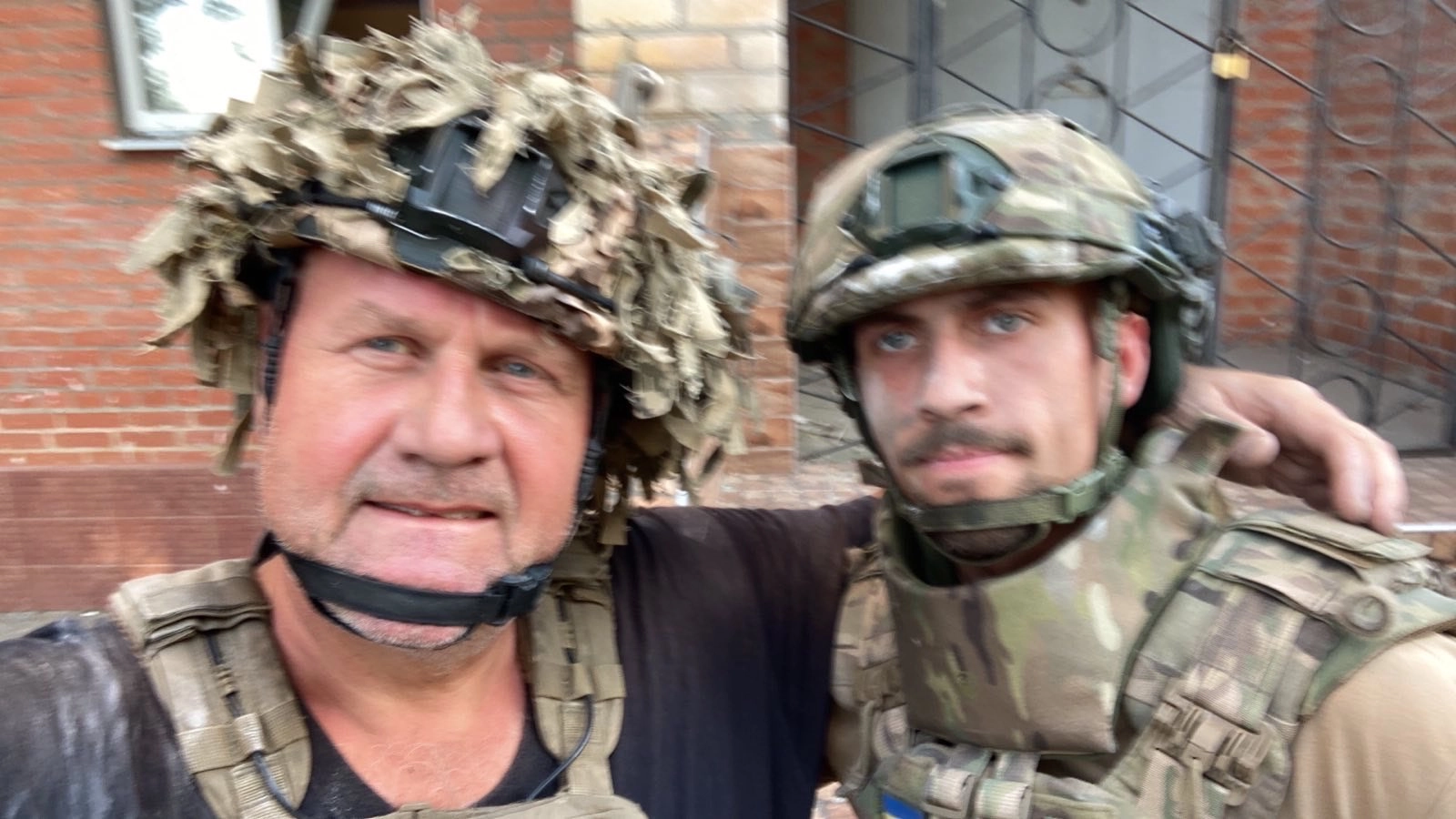
Journey of sharing knowledge
Ek was in the army in the ‘90s. First, he did his conscript time for 15 months, and then got recruited, and became an officer. And being an officer was the same as being an instructor in the ‘90s since there wasn’t a non-commissioned officer option (NCO).
As the Swedish volunteer explained: “Training, training, training. Every day,” was and still is like a motto for him.
Having arrived in Ukraine, Ek was glad to discover that the level of training they have and give in Sweden proved to be very helpful for both soldiers and their commanders in the Ukrainian army. And that’s what the Swedish instructor is trying to contribute here, though he admits that the Ukrainian defenders face truly unprecedented challenges – hard to even describe or imagine.
Ek is certain that the story of the Ukrainian fight for freedom will be something to create books and films about – including both the spiritual and the practical side of this struggle:
“The type of warfare that is happening here is not known to the world. Everyone who was in a similar situation in the Second World War is gone. Truly special knowledge is being made and collected here. All the military manuals will be rewritten after this war. I am sure,” he said.
When asked about fear or anxiety because of being in the war zone, Ek explains he doesn’t let the emotions take over and accepts the reality around him for what it is. Managing time and finding better conditions to train the soldiers worry him much more:
“There is this constant stress and nagging of not doing enough or not being sufficient, and wishing to do more. We should work 18 hours instead of the few hours we have during the daylight. As for the shellings, every person handles them differently. I am trying to be as careful as possible,” he said.
People develop a sharp sense of whether the shellings are nearby or farther away. Still, any sense of control is limited – it’s all relative, and uncertainty remains a constant.
You can be a super-trained soldier, really good at moving on the battlefield, shooting, reading, and sensing what is going on – but regarding missiles, there isn’t much you can do.
Ek considers honing crucial military basics a must for ensuring the success of the mission and safety of the Ukrainian defenders.
He says there should be much more focus on training. Because it is not just putting on the uniform, flag, helmet, and a lot of patches, grabbing a gun and fighting. There is a lot behind it. The defenders need to know the core soldier skills – handling the weapon, how to shoot and move in the trench, and how to fight, Ek says.
His experience and knowledge are shared from a place of wishing to support, that is why the Swedish instructor emphasizes that all the things he says are never orders or commands but rather essentials and recommendations to equip the Ukrainian soldiers with, so that can be taken into account or adjusted in one way or another.
The provided information sets things in motion, and the rest is masterfully adapted and implemented by the defenders, as Ek clarifies:
“I am not a Ukrainian, I am a civilian person working here, so I can’t just come and tell soldiers and commanders, ‘Well, THIS is what you should do!’ Never. I can only show them the ways of fighting different from the ones they may be used to. We have individual ways and our own backgrounds. So I am here to add tools in the toolbox that the units can apply in the situations they face on the battlefield,” he says.
Ek is happy about the levels and layers of his training sessions. There are so many defenders who need to be trained, so the instructors do their best to assist everyone: the soldiers that are recently mobilized, and those recruited some time ago. The newcomers can get the training and be ready for the battle. And those who come from the front line, are provided with some additional practice and continue with more skills afterward.
Cherishing every moment to grow
It is a true joy for Ek to work with the soldiers, and he appreciates every minute of it. Literally.
The time given for the training is short due to many factors, particularly, because the war sets the pace for how things are done here, he says. Even with the little time given, the basic skills should be practised to the point of becoming second nature, which is not a whim but a necessity to save lives:
“The reason why you should be trained as a soldier is that a lot of soldiers’ skills are supposed to be muscle memory. When you are in a situation where you are shelled, you are scared, there are explosions. There is blood and all these awful things going on around. So your body should know how to handle the machine gun or do other things without your brain involved. Training the muscle memory takes time. Time is sadly scarce here,” he said.
Ek manages to find a solution to time constraints. And it has more to do with something timeless – empathy and understanding of the context. The Swedish instructor adapts and filters down the soldier training to absolute essentials and focuses on that. And it works in the current circumstances quite well, he says.
Ek shares a few ways how the effectiveness of the training can be increased. In his opinion, there should be more instructors from Western countries in Ukraine to help like himself and his colleagues do. It concerns frontline training. Secondly, more time with each soldier for training would be another major benefit. Because it means an opportunity to check the details, coach, and correct.
Thirdly, Ek says that if certain countries have sent weapons here, it is also relevant that the soldiers get good training on those weapons instead of trying many times to figure out how to work with them by themselves.
Another thing Ek names is the importance of changing the techniques not from the bottom but at the top of the military hierarchy, from the commanders of the units:
“If we teach a soldier to do some new moves, unit leaders should also know more about this. But they are extremely busy because they are running a big war, so I understand the complications of this. Every change takes time. And we just need to continue training soldiers in the most effective way possible,” he says.
A Swede joins the Ukrainian family
Ek had a basic knowledge of Ukraine before the full-scale invasion, and even was planning a visit to explore the country better.
He is doing it now, but in a drastically different context, capacity, and depth.
Ek has been to Lviv and has been driving around, traveling a lot back and forth around the east and south. He calls Ukraine a big and beautiful country but jokes about slightly slow trains. Hopefully, it allows him to enjoy the beauty of Ukraine longer, with serene air rare these days.
According to Ek, the most magical thing about his experience is how great and friendly Ukrainians are, seemingly in every way, shape, or form.
“The hospitality is amazing. My team and I can be out in the field training, then knock on someone’s door very late at night saying, ‘Hey, can we sleep here? We got stuck here for the night.’ We enter and expect to sleep on the floor in the garage, max. But kind Ukrainians make the beds for us and cook a lot of delicious food. Their dogs wag tails at us, making us feel even more welcomed. It is wonderful,” he says.
Ek is making friends with kind-hearted people all over Ukraine, and people from all walks of life. But there is also an angelic furry dog that the Swedish instructor rescued from the zone close to the front line.
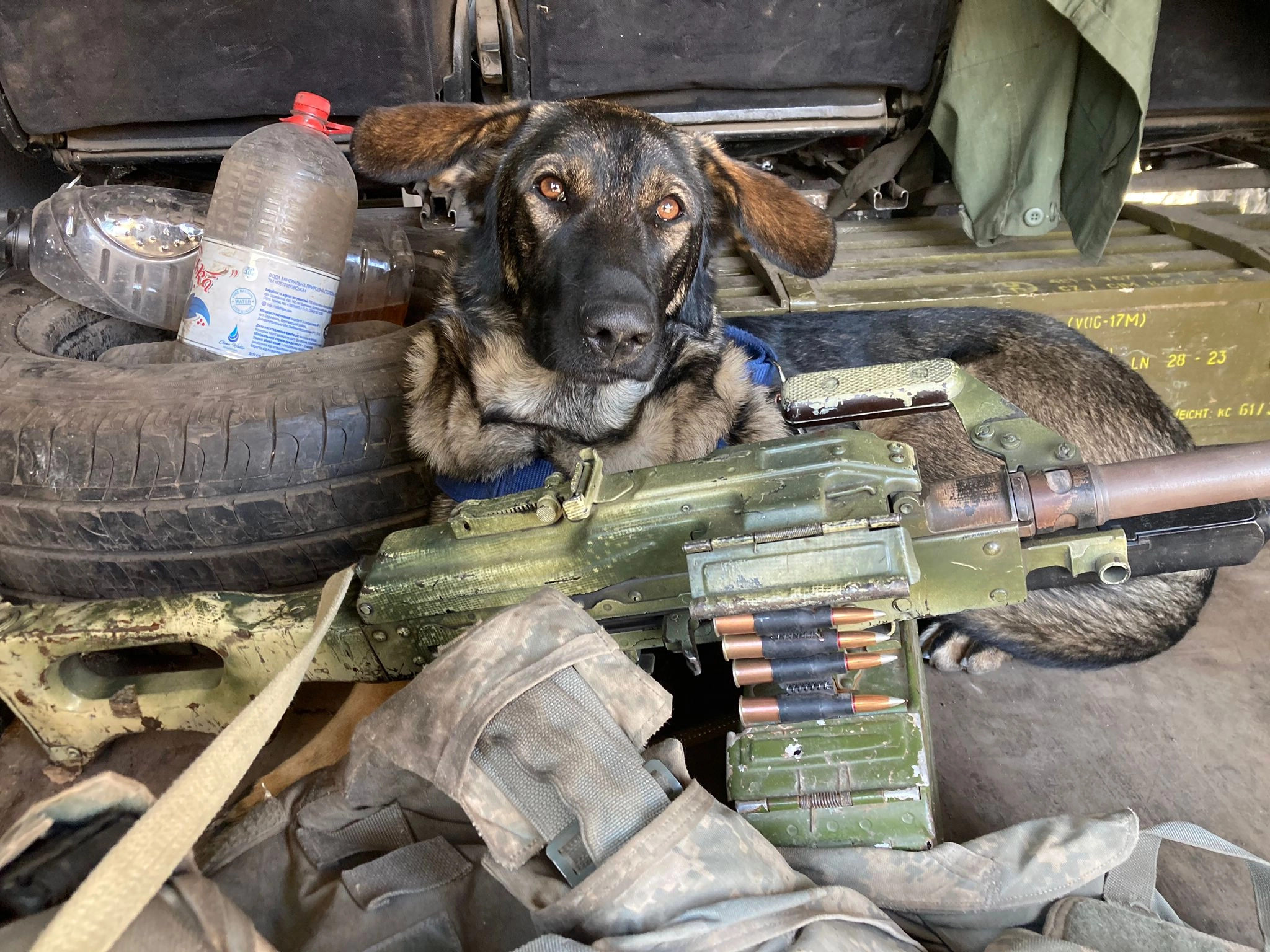
The dog’s eyes illuminate universes of love. Her name, “Soledar,” a mirror of her challenging life path, alludes to Ukraine’s fight for freedom. Also, one of Ek’s volunteer friends has a dog named “Bakhmut,” so together these pets are like a double reminder of the bravery of the Ukrainian Heroes.
Ek found Soledar when he was driving west of Sloviansk with his teammate Shannon Taylor, a combat nurse and medical instructor from New Zealand. Soledar was limping, her foot in horrible condition. The decision to adopt her came to Ek naturally. Soledar was fed and taken to the vet. The care and the warmth of a new home cured her foot and gave her hope. Things seemingly impossible in the middle of the warzone. Yet only seemingly. Soledar now has a pet passport, so she can travel to Sweden or anywhere else with her new family to remind everyone about the invincible Ukrainian spirit and Swedish kindness combined. But until then, she loyally accompanies Ek as a supporter and talisman at every training and shows no fear at the sound of the explosions.
Balancing hope, optimism, and realism
Ek remembers the day when the war started in February 2022. Like others, he was at home in Sweden watching the news and couldn’t believe that such a huge invasion in the middle of Europe was really happening. Even after coming to Ukraine, training in the south, working in the east, also up in the north and around Kharkiv, the Swedish instructor still can’t believe it’s happening or predict how exactly things might play out, even though now he is here training soldiers, being exposed to shellings, seeing different units moving around.
“Being in Ukraine for a while doesn’t make the situation more comprehensible to me. It is so hard to predict. So instead of speculating on all possible developments on the front lines, I decided to focus on the training instead. I have no clue, how, where, and why this is going to end because you can ruminate about it forever. And there are so many people doing that. Sometimes they are right, sometimes they aren’t,” he says.
Ek also strives to inform people in Sweden about the situation in Ukraine, having noticed people’s attention gradually fading. According to Ek, this can be explained by the problems people are facing – high energy prices, inflation, and rising payments causing some even to abandon their homes. Everyone has their own reality, he says.
Raising awareness about the developments in Ukraine to people in Sweden is crucial for Ek, but sending the message from there is also important. The situation is tense, and when the time comes, world leaders need to be prudent and fast in their decisions:
“It is very dangerous for everybody, particularly, for people living here close to the front line. It is such a volatile, uncontrollable situation. If it spreads to another country, society needs to act immediately, and swift decisions can be wrong. I hope with every cell in my body that war in Ukraine will be over and soon. And that it won’t escalate further into the country or even to Europe,” Ek says.
Ek shares that some things make his stay here a bit more complicated. One is that there is still a lack of instructors. All of them are mostly volunteers who come here and live out of their own pockets. And when the money is out, they have to return home.
Ek never regrets being here to help, but it is challenging to pay for the apartment, food, diesel, new tires, and maintenance of the car that often breaks down. Eventually, he will run out of money, he says.
Ek hopes that at some point there will be a certain system settled in Ukraine to get a more long-term relationship with instructors instead of people just coming, being here briefly, and then leaving.
Ek is staying in Ukraine, and despite some general fatigue, he continues to hope for Ukraine’s triumph and that hope is unshakable because every day he trains, he meet another one of the faces of victory:
“The strength here is really amazing to me. It is so impressive to witness the spirit of the Ukrainian defenders who grab their guns, practice for a short time, go and fight hard. So strong. My heart is burning for the heroes who we are training to save lives. When we were moving around, one defender came up to me, and I didn’t even remember his face, but he said, ‘Hey, Magnus, your training saved my life!’ So it is like a receipt, proof that the training sessions and instructions are really effective and change something for better. Always.”
You can also highlight the text and press Ctrl + Enter
Russia Hit by 660-Drone Overnight Barrage Targeting Moscow, Crimea and Key Military Sites