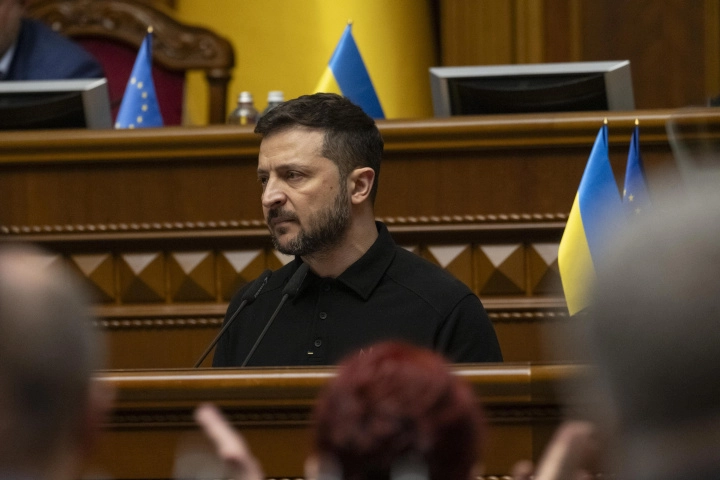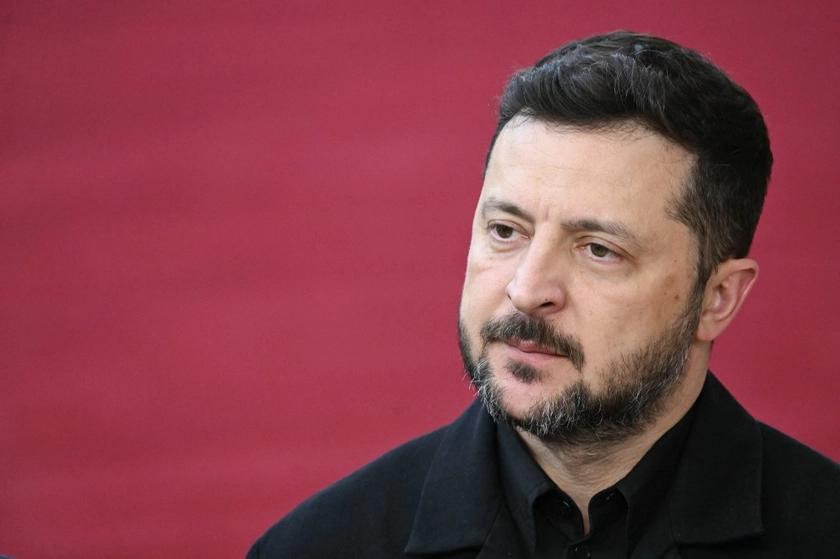
Ukrainian President Volodymyr Zelensky is resetting the government.
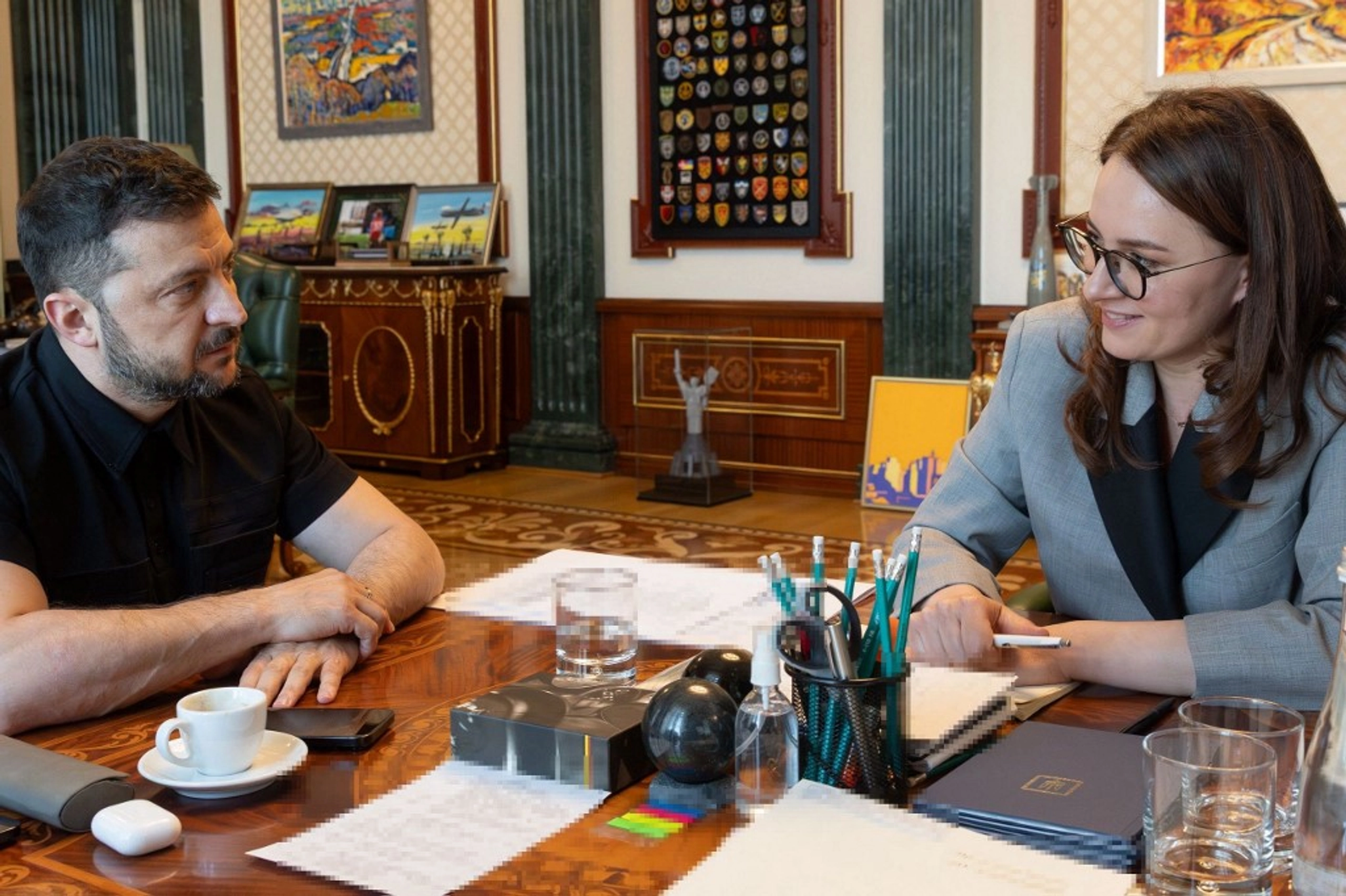
Today, he wrote on his Facebook that he offered the post of Prime Minister to the current Minister of Economy and Deputy Prime Minister, Yulia Svyrydenko. Kyiv Post has compiled everything we know about the government reset and the new Prime Minister.
JOIN US ON TELEGRAM
Follow our coverage of the war on the @Kyivpost_official.
New government – old ministers?
In what has been referred to as a “reset” of the Cabinet in the corridors, rather than a new government, Zelensky announced new appointments of top officials today.
According to several sources, this is not about dismissing all ministers and dismantling the government, but rather about shifting certain ministers from one position to another and shaking up the leadership.
The former (now) Head of Government Denys Shmyhal, who has headed the Cabinet of Ministers longer than any other Ukrainian Prime Minister – more than 5 years – is likely to be appointed Minister of Defense, according to sources who spoke with the Kyiv Post.
Several other ministers are also expected to be dismissed in the near future. Among them is the Minister of Health, Viktor Liashko, who has held his post for quite a long time, since the COVID pandemic in 2020.
And the position of Head of Government will be taken by Deputy Prime Minister and Minister of Economy Yulia Svyrydenko.
Part of the opposition criticized this move, claiming that it is unconstitutional during wartime. Furthermore, the announcement marks the collapse of the opposition’s hopes for a “government of national unity” in which they had aspirations to participate in power-sharing.
Infantry Up Close, More and Better Bombardment, Helping America ‘Win’
However, not everyone is critical of these moves. First-class civil servant, lawyer, and former deputy head of the Central Election Commission Andriy Mahera, says the reappointment of the Prime Minister and ministers is perfectly legal.
“Can the Cabinet be changed during martial law? Absolutely. First, this is an appointed, not an elected (by voters) body of the highest state authority. And second, no one can restrict the Verkhovna Rada of Ukraine and the President from exercising their constitutional powers, particularly regarding personnel issues,” he noted.
The exact composition of the new government remains unknown. Svyrydenko, who accepted Zelensky’s invitation, wrote on her Facebook page that she would present personnel proposals later.
The new Yulia
Yulia Svyrydenko is only the second woman to serve as Prime Minister of Ukraine, and shares a name with the first: the ambitious and active Yulia Tymoshenko who was Prime Minister in 2005, and again from 2007-2010.
However, unlike Tymoshenko, who took over 10 years to reach the premiership, found her own political party, and even became a victim of political persecution, Svyrydenko’s path to high office has been much quicker.
She is 39 years old and hails from the historic city of Chernihiv, one of Ukraine’s cultural heritage centers. Chernihiv was once the second most important city in the medieval kingdom of Kyivan Rus, after Kyiv.
After receiving her education in economics in Kyiv, she worked in various positions until 2011, when she was appointed head of the Permanent Representative of Chernihiv in the city of Ürümqi in China, the only representative of a Ukrainian city in the PRC. In her role as a representative, she helped attract investment Chinese investment and business to the economy of Chernihiv and Chernihiv region, leading to the construction of a polyester fiber manufacturing plant and the creation of the company “Eco-Vtor.”
This was during the Yanukovych years, when Ukrainian cities were politically dependent on the central government and could not manage their own budgets, so attracting foreign investment was a huge success for any mayor’s team.
Kyiv Post’s sources in Chernihiv believe that these accomplishments helped launch Svyrydenko’s political rise, after which her career steadily progressed, though for a long time it stayed at the regional level.
Ukrainian media write that agro-businessman Valeriy Kulich, whom Svyrydenko worked for at some point (and who later, after 2014, headed the Chernihiv Regional Administration), played an important role in her political rise.
However, Kyiv Post’s sources in Chernihiv say – it’s not that simple. Without talent and persistence, it would have been hard for Svyrydenko to thrive in such a bureaucratic structure.
Since May 2015, while aged 30, she was appointed as an advisor to the head of the Chernihiv Regional Administration, Kulich. The Chernihiv region – akin to a “state” – is not the largest in Ukraine, but it is the closest to Kyiv, has a population of one million, and borders Russia and Belarus. These factors give Chernihiv strategic defense and logistical importance.
From August 2015, Svyrydenko was head of the Regional Economic Development Department. Already by 2017, she had become Deputy Governor, and in 2018, she was acting Governor for half a year.
“She was very easy to work with. Minimal bureaucracy. Business saw her as one of their own,” one Chernihiv city council deputy told the Kyiv Post.
“As a manager, she had no ‘crown’, as they say. She listened to the more experienced, supported the young, and handled staffing shifts skillfully,” says one administration employee who worked with Svyrydenko.
Others say Svyrydenko cared deeply about her reputation – she never lobbied for her close associates and, according to Kyiv Post sources, always reacted sensitively to any media attacks.
After the 2019 elections, the new Zelensky administration began forming a new team, scouting for young, talented people from the regions.
This was how Svyrydenko got the post of Deputy Minister of Economy. However, at the time, the minister still had more than five deputies, making the post seem less significant than the title would imply.
Still, in Chernihiv, it was perceived as a natural and well-deserved promotion for her– after Svyrydenko had served as deputy head of the regional administration and had effectively headed the region for months without getting caught in any corruption scandals.
Svyrydenko’s political career really took off in the fall of 2020 when she was invited to the President’s Office as Deputy Head of the Office for Economic Affairs. Ukrainian analysts write that her work ethic and readiness to take on various tasks were especially valued.
Incidentally, other Office heads were selected similarly.
Later, others who passed through the “crucible of the Office” would occupy ministerial posts – among them, for example, the current Minister of Infrastructure, Oleksiy Kuleba.
In the fall of 2021, Svyrydenko returned to the Cabinet after a year in the President’s Office. After the start of the full-scale invasion, her personal qualities, work ethic, and ability to manage stress proved her value as an effective manager.
For example, since its independence, Ukraine has historically been heavily dependent on Russian energy and fuel. During the fuel crisis in the spring and summer of 2022, Ukraine nearly ran out of fuel following Russia’s full-scale invasion and complete severing of trade and economic ties.
But thanks to the efforts of traders, gas station networks, and the ministry’s international work under Svyrydenko, the entire fuel market was effectively reoriented towards Europe in just a few quick months. Representatives of the fuel industry call this a “fuel miracle.”
Later, Svyrydenko became heavily involved in international work in negotiating and meeting counterparts to establish new trade and business deals.
In 2025, it was Svyrydenko who signed the famous “Resource Agreement” for Ukrainian minerals with U.S. Treasury Secretary Bessent.
For a Ukrainian official, Svyrydenko is also quite open to civil society organizations and the media.
Her ministry is always quick to respond to requests and comments, and civic activists note that she is approachable for presenting this or that project.
How independent is she?
All sources agree that Svyrydenko is a very capable and hardworking executive who can implement almost any idea or handle any problem with dignity.
Some have warned that Svyrydenko is very focused on following the President’s orders, which is perfectly reasonable under a state of emergency.
Still, the opposition has voiced criticism.“To replace the 300% loyal Shmyhal, who will be blamed for everything, they will appoint their 500% loyal one, ‘Miss Whatever You Wish’ Svyrydenko… This will not change anything in economic policy,” Iryna Herashchenko, head of the opposition “European Solidarity” faction, said in a post on Facebook.
Following Zelensky’s proposal to appoint Svyrydenko as Prime Minister, she wrote a Facebook post in which she did not mention any of her own projects or ideas but instead described the tasks already outlined for her by Zelensky.
“The Head of State defined the priority tasks he sees for the renewed Government:
- strengthening Ukraine’s economic potential;
- expanding support programs for Ukrainians;
- scaling up domestic arms production. These tasks can be fulfilled through noticeable deregulation, the elimination of any bureaucratic obstacles, reduction of non-critical state expenditures and duplication of government functions, protection of entrepreneurship, and full concentration of state resources for the defense of Ukraine and recovery after hostilities.”
Judging from the experience of Denys Shmyhal’s tenure, it is clear that the authorities are primarily interested in a Prime Minister who would handle a large amount of operational work to manage the state and maintain its resilience.
This role of Prime Minister is somewhat akin to that of the Grand Viziers in the Ottoman Empire, who were, above all, diligent executors maintaining the state through day-to-day governance.
And perhaps that is exactly the kind of work that will be expected from Yulia Svyrydenko.
You can also highlight the text and press Ctrl + Enter