Russia is sharply limiting the deployment of its naval vessels in the Sea of Azov due to narrow navigation routes, shallow waters and the high risk of being targeted by Ukrainian forces, Ukraine’s Navy said.
According to RBC Ukraine, Ukrainian Navy spokesperson Dmytro Pletenchuk said Russian forces no longer maintain a constant presence in the Sea of Azov, fully aware that the entire area remains under Ukrainian fire control.
JOIN US ON TELEGRAM
Follow our coverage of the war on the @Kyivpost_official.
Shallow waters, narrow routes
Pletenchuk said the Sea of Azov poses significant operational constraints for Russian ships.
“There is nowhere to stay there in terms of basing and navigation,” he said. “It is a shallow sea – a maximum of 15 meters (49 feet) – so the recommended routes there are quite narrow.”
Those limitations, he added, leave Russian vessels highly vulnerable. When Russian ships do enter the Sea of Azov, they attempt to conceal their movements by blending in with civilian maritime traffic.
“When they enter the Sea of Azov, they mix their ships with civilian vessels,” Pletenchuk said. “But I cannot say that they are there all the time, because the enemy understands that the entire territory of the Sea of Azov is under our fire control.”
Constant threat under Ukrainian fire control
The Ukrainian Navy says Russia’s reluctance to deploy ships reflects the growing reach of Ukrainian strike capabilities across occupied waters.
Pletenchuk stressed that Russian commanders are increasingly cautious, knowing that even brief naval movements could be detected and targeted. As a result, Russia has minimized both patrols and basing activity in the area.

Artem Dovbyk and Experts Share What to Expect From the 2026 World Cup
No future for Russian naval presence
In a separate assessment, Pletenchuk said the broader strategic outlook for Russian naval forces in both the Black Sea and the Sea of Azov continues to deteriorate.
“The strategic outlook for our enemy is definitely not improving, because the waters are effectively blocked,” he said. “They cannot and do not want to bring in new units.”
While Russia could technically redeploy additional ships, Pletenchuk said it has instead withdrawn its last available units from the region.
“This means that the ship and boat fleet remains the same as it is now, and it has no prospects for further adequate presence here,” he said.
Maintenance stops seen as liabilities
Pletenchuk added that even routine maintenance has become a liability for Russian naval forces.
“Any stop of an enemy ship in docks for maintenance will make it an easy target,” he said.
Ukrainian officials say the combination of geography, sustained Ukrainian fire control and precision strike capabilities has turned the Sea of Azov from a logistical asset into a high-risk zone for Russia’s navy, further constraining Moscow’s maritime options as the war continues.
Naval strikes reshape Russia’s risk calculus
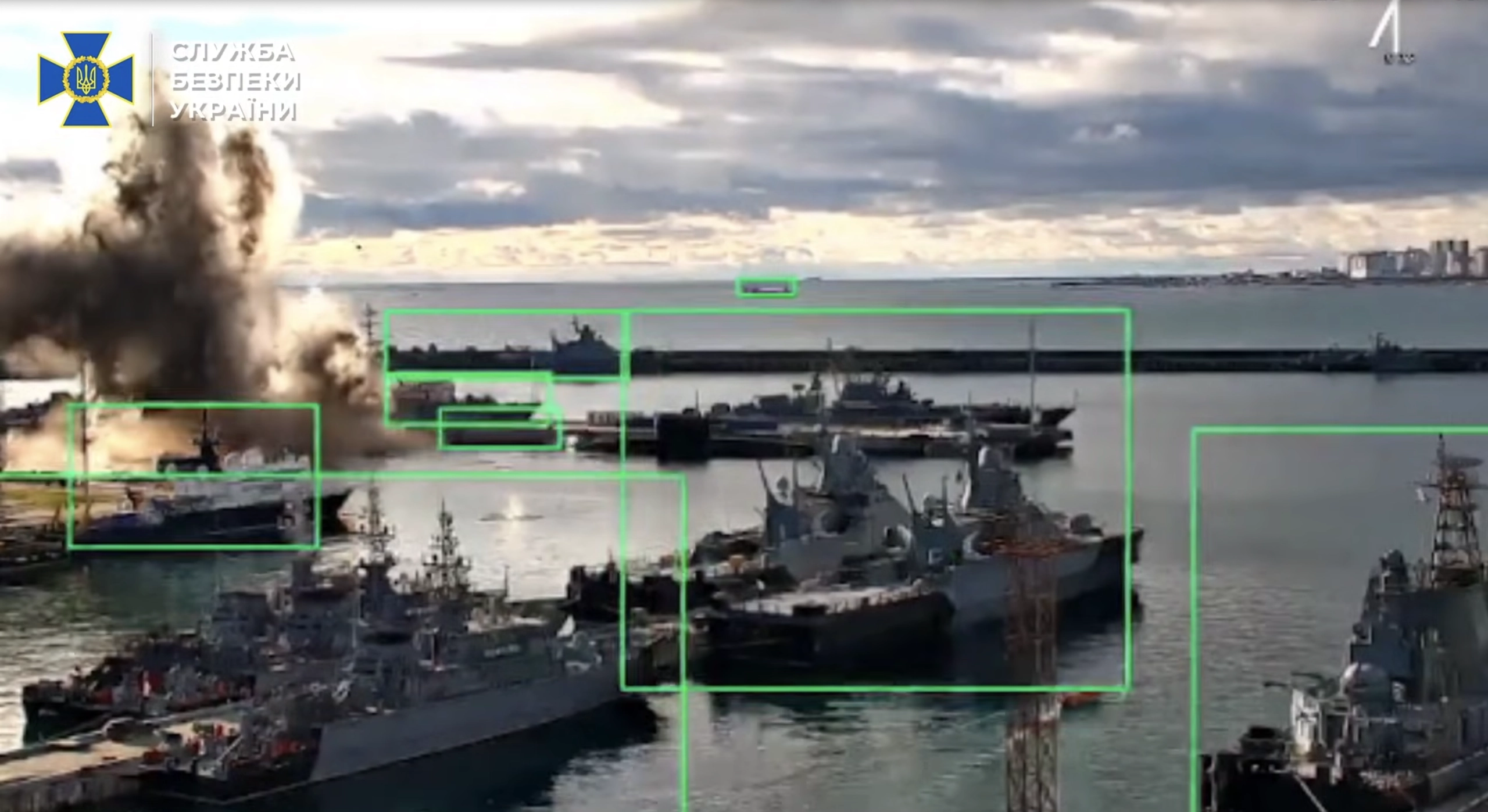
The heightened caution around Russian naval movements comes after a landmark Ukrainian strike in mid-December, when the Security Service of Ukraine (SBU) announced it had attacked a Russian submarine in the port of Novorossiysk for the first time. According to the SBU, the submarine suffered critical damage and was effectively disabled.
Pletenchuk later said preparations for the operation against the Varshavyanka-class submarine were complex and multi-layered, highlighting Kyiv’s growing ability to target Russian naval assets far from the front lines. As Ukraine has degraded the Black Sea Fleet’s traditional bases in occupied Crimea, Novorossiysk has become increasingly important to Russia’s naval logistics — a shift analysts say has made facilities there both strategically vital and increasingly vulnerable.
You can also highlight the text and press Ctrl + Enter