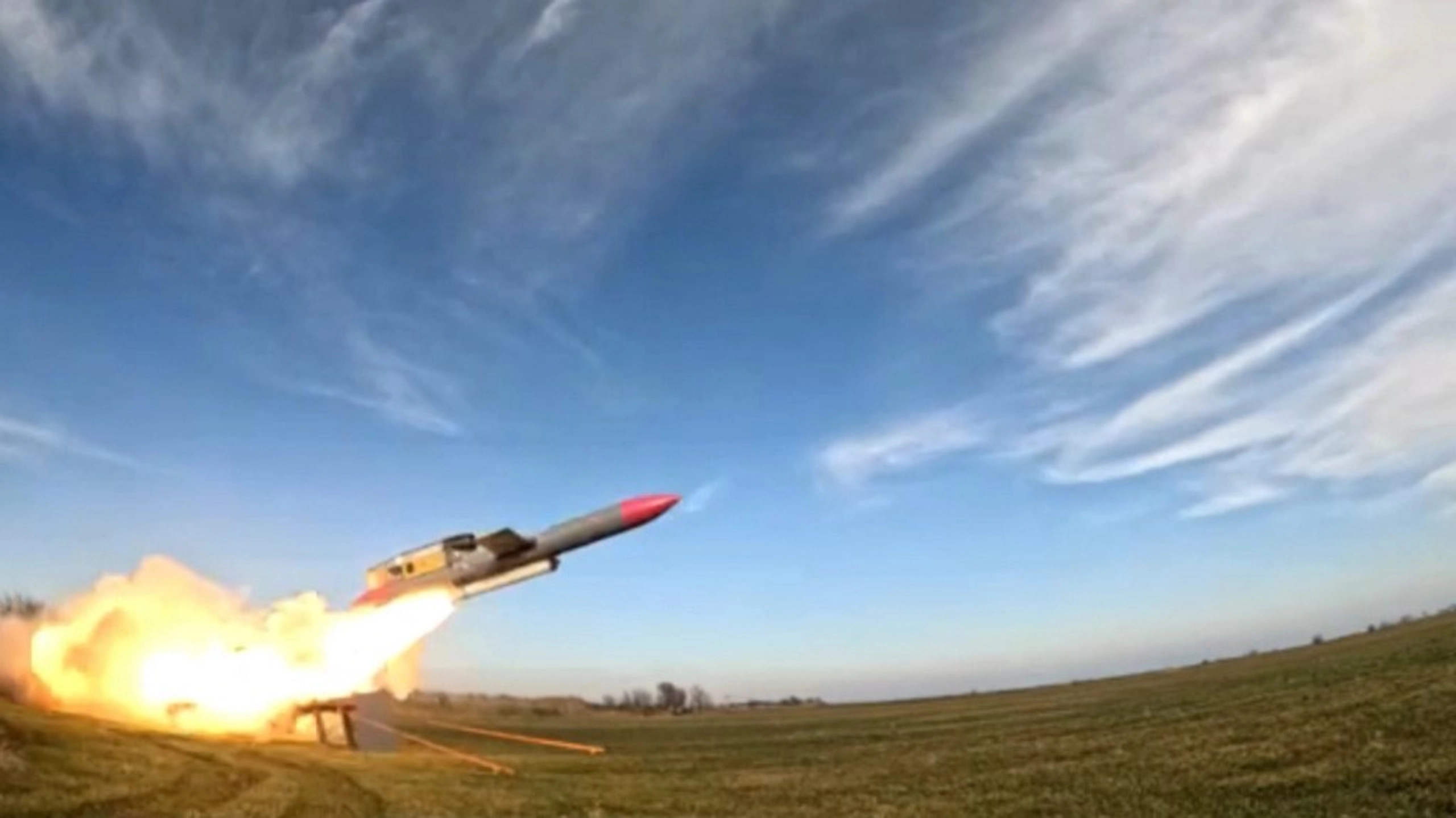
A salvo of Ukrainian Flamingo cruise missiles – a domestically developed weapon usually shot down or just missing its target in past air battles – for the first time delivered solid combat performance with three of five school bus-sized weapons plowing into and partially obliterating a critical military components factory deep inside Russia, geo-located images made public over the weekend showed.
Official Ukrainian sources had claimed that overnight June 26-27, five FP-5 “Flamingo” heavy cruise missiles built by the Kyiv-headquartered company Fire Point, and launched by the Armed Forces of Ukraine (AFU), flew roughly 500-900 km (310-560 miles) into Russian Federation air space to hit and damage the Titan-Barrikady Federal Research and Production Center military-industrial facility in Volgograd, Russia.
JOIN US ON TELEGRAM
Follow our coverage of the war on the @Kyivpost_official.
Region Governor Andrey Bocharov reported in a post-strike statement that a Ukrainian attack had damaged “a production facility” in Volgograd and injured at least 10 people, without offering details.
Analysis of from-the-ground images and video by the open-source intelligence (OSINT) research groups Dnipro Osint (Harbuz) and Exilenova+ agreed that two workshops at the plant, No. 2 and No. 38, suffered major structural damage from blast and fire inside the buildings.
Workshop 38 is the plant’s main production facility, containing machine tools and assembly lines, including final production for ballistic missile launchers and missile carriers used by the Russian military. The plant’s products include launchers and components for the Iskander-M missile, a ballistic weapon the Kremlin has used for years to hit Ukrainian homes and businesses.

Belarus Warns Ukraine of ‘Full-Scale Response’ Over Any Border Incursion
Visible damage to each of the workshops included collapsed girders, flattened walls, and wrecked heavy machinery, consistent with the normal detonation of about half a ton of high explosive.
Images from the Barrikady factory, including video of the actual explosion, showed a third, but unidentified workshop hit squarely as well. Some observers recorded having heard or seen a fourth blast on the factory premises, but independent researchers didn’t confirm it.
Neither Russian nor Ukrainian official sources stated where the two missiles not hitting the plant landed. On the same night, Russia’s armed forces claimed 175+ Ukrainian drones shot down in Russian Federation or occupied Ukrainian airspace, describing the targets as “drones.”
First announced as under development in August 2025 and with its first confirmed combat launch in May 2026, the FP-5 Flamingo missile, prior to the June strikes, had probably been fired by Ukraine at targets inside Russia a total of 34 times, by most measures far less successfully than the Volgograd attack.
In a June 10 strike against a defense electronics plant in Cheboksary, Russia, some 1,000 km (620 miles) from probable launch sites, Russian air defenses shot down three of a five-missile salvo, and of the two weapons reaching the target area, only one actually struck the factory premises and blew up, while the other missed. That attack was a follow-up to an attempt to hit the plant on May 4, during which Russian air defenses knocked down four of five missiles, and the only surviving weapon impacted hundreds of meters from the factory.
Per Kyiv Post counts and OSINT analysis, of the 34 launches prior to the Barrikady factory strike, only five of the FP-5 missiles credibly hit what they were aimed at.
The June 27 air raid was, in comparison, one of the most successful missile attacks conducted by the AFU of the entire war, rivaling a September 2023 strike by 10 Britain-manufactured Storm Shadow missiles against the Russia-occupied port of Sevastopol, of which three hit and severely damaged a fleet submarine and an amphibious assault ship lying in drydock.
Fire Point Director Denys Shtilerman, in a Saturday interview published on YouTube, said that building guidance systems precise enough to allow the missile to negotiate its path to a target, while flying at a nap-of-the-Earth below 20 meters (78 feet) altitude or lower, along with dense Russian air defenses, were the main reasons Flamingo missiles had failed to reach their target in the past.
A Friday Institute of Study of War analysis of the strike said that, possibly, the Ukrainian targeting of Russian AWACS airborne early-warning radar aircraft created gaps in Russian air watch coverage that the AFU exploited. Reportedly, the Russian Air Force operates fewer than ten operational A-50 AWACS aircraft with the job of monitoring and identifying flying threats across 13 time zones and the world’s biggest national airspace.
According to research published by the OSINT group OKO Gora, starting in January 2026 Ukrainian Flamingo strike planners shifted from targeting sites predominantly in southern Russia and the occupied Crimea region, to attacks deeper inside the Russian Federation, particularly against facilities located along the major Russian rivers, the Volga and the Kama. All seven 2026 confirmed Flamingo attacks, including the most recent hit targets located on the shore of a major waterway, the group said.
Ukrainian planners may have decided the most effective way to use the Flamingo missile is to attack targets near and ideally along the banks of a large stretch of water, because then the missile is able to fly at wave-top altitude and is much more difficult to intercept, while flight planners need not worry about avoiding hills and tall buildings, a Saturday report by that group said.
In contrast with legacy-era cruise missiles fabricated largely out of aluminum, titanium and steel, the FP-5 Flamingo uses carbon fiber extensively in its construction. According to designers, the missile has a relatively small radar signature but is not a stealth aircraft and can be spotted by air defense radars, provided the radar is able to observe very low-flying objects.
The main advantages of the missile, Shtilerman and other Fire Point executives have said, is that a Flamingo is designed to use discarded aircraft jet engines for power and Soviet-era aviation bombs as warheads, and so may be manufactured quickly and cheaply.
At around 14 meters (46 feet) long with a 6-meter (20 feet) wingspan, the Flamingo, costing between $500,000 to $1 million, is about four times bigger than the US military’s advanced Tomahawk cruise missile, costing about $2 million.
Fire Point executives in late 2025 claimed that serial production Flamingo factories would produce about 30 missiles a month, rising to 200+ by the end of 2026. President Volodymyr Zelensky, in mid-February comments to Kyiv media, said that production had been set back by Russian strikes hitting a Fire Point production facility, but that manufacturing would continue and expand.
“The danger of the ‘Flamingo’ lies in the fact that the mass production of this type of weapon may acquire an industrial character, and then our [Russian] air defense will be overwhelmed, it now already is with drones,” wrote the popular Russian milblogger (1.16 million followers) Dva Mayor in a Sunday report on the Volgograd strikes. “You can strengthen air defense and try to battle targets flying over your territory. And it is possible to think about striking the manufacturing plants, although they are not in Ukraine.”
Shtilerman, in the Saturday interview, confirmed Fire Point’s work on a new 800-km-range (about 500-mile-range) ballistic missile, called the FP-9, was going forward. Engine tests would take place in June and test flights soon after that, he said.“As soon as a test flight shows that everything is working properly, the next flight should be launched toward Moscow,” he said.
You can also highlight the text and press Ctrl + Enter