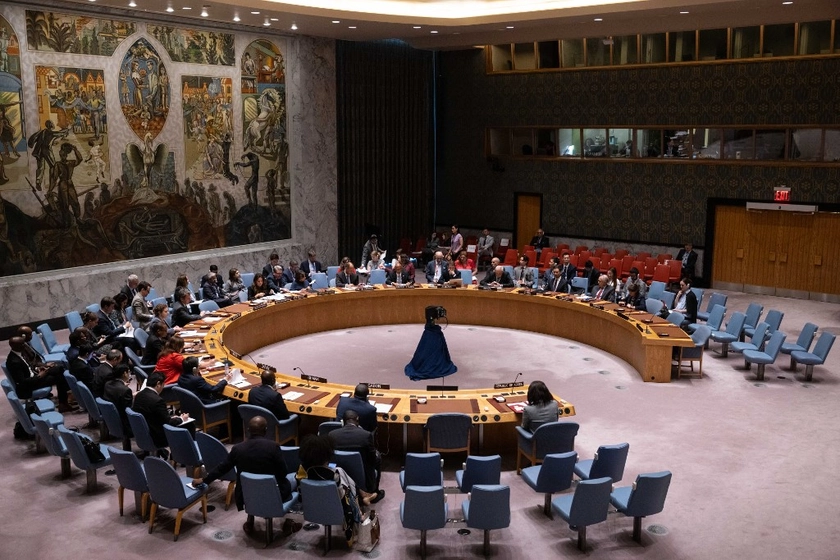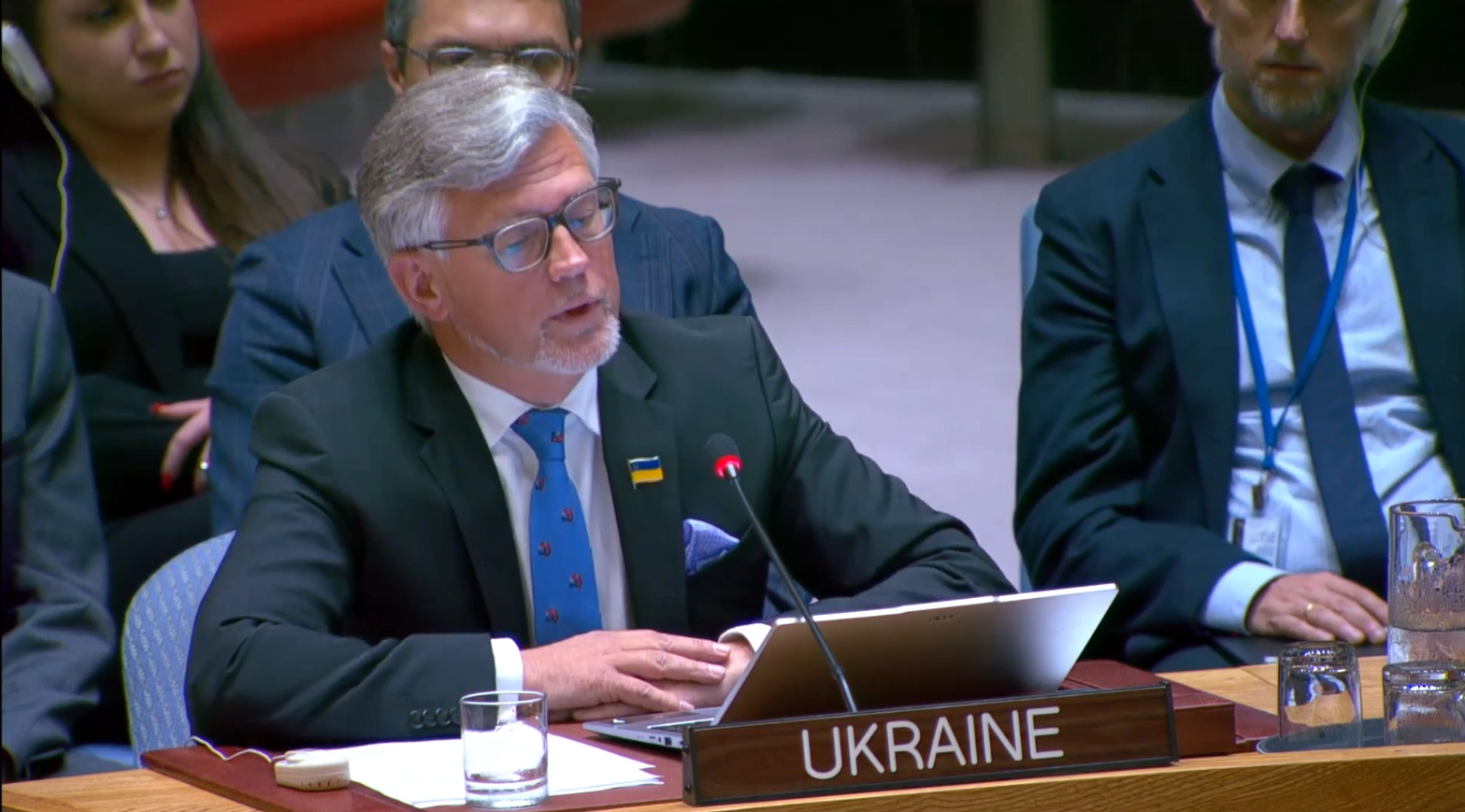
Ukraine’s ambassador to the United Nations delivered a blistering warning to Russia at the Security Council, saying Moscow’s hold over occupied Ukrainian territories was temporary and that Kyiv may revise its ceasefire offer if the UN continues a “wait-and-see approach.”
“So, addressing the Russian representative, I can give you one piece of advice: you will never be able to hold the occupied lands. Never. So get out of Ukraine as quickly as possible, before it is too late,” Andrii Melnyk, Ukraine’s Permanent Representative to the UN, told the Council.
JOIN US ON TELEGRAM
Follow our coverage of the war on the @Kyivpost_official.
Melnyk’s remarks came during a Security Council meeting on Monday, requested by Kyiv after a wave of Russian attacks on Ukrainian cities, civilians and cultural landmarks.
He warned that Kyiv may “recalibrate and modify” its current ceasefire offer if the UN continues what he called a “wait-and-see approach.”
“Ukraine stands ready to engage in direct negotiations with Russia to secure a just and lasting peace in accordance with the UN Charter, but our patience is not endless,” Melnyk told the Council.
‘Russia’s missile terror’
Melnyk noted that the Council was meeting for the sixth time in one month on Russia’s war against Ukraine, stressing that the frequency was not “Ukraine’s whim” but the result of Moscow’s escalating attacks on civilians.

Russian Light Aircraft Turns to Car Fuel as Aviation Gasoline Runs Dry
“It is the unprecedented level of Russia’s missile terror against Ukrainian civilians that leaves our delegation no choice but to request these emergency meetings of the Security Council,” he stated.
He accused Russian President Vladimir Putin of repeatedly revealing “a new dimension of barbarity” against Ukrainian civilians and cultural heritage.
“Every time we think that Russia has reached the very bottom of its brutality and can sink no lower in its cruelty, Mr. Putin shocks the world again and again,” Melnyk declared.
He pointed to the night of June 14 to June 15, when Russia launched one of its largest combined aerial attacks against Ukraine, using 70 missiles and more than 600 drones. Kyiv, he noted, was the primary target.
Five people were killed and dozens injured, including children and a pregnant woman.
Lavra strike called ‘slap in the face of the civilized world’
Melnyk devoted much of his address to the damage inflicted on the Kyiv-Pechersk Lavra, the 11th-century Orthodox monastery and UNESCO World Heritage Site.
“Russia has once again crossed yet another red line in its relentless barbarism,” he charged.A
Melnyk said Russian forces deliberately targeted and damaged the Dormition Cathedral, the principal church of the Kyiv-Pechersk Lavra.
“As a result of this treacherous attack by Russia, the cathedral, inscribed on the UNESCO World Heritage List, sustained significant damage,” he told the Council.
He explained that the upper part of the cathedral suffered the greatest impact from the fire, while the lower sections of the church, including historic murals, frescoes and iconostasis, were also placed at risk.
“This reprehensible Russian strike against the Dormition Cathedral was not only a stab in the back of Ukrainians. It was a slap in the face of the entire civilized world,” Melnyk emphasized.
Putin among ‘darkest figures of modern history’
Melnyk argued that the attack on the Lavra had exposed the falsehood of Moscow’s claim to inherit the spiritual and historical legacy of Kyivan Rus.
Driven by “imperial delusions,” he argued, Putin had sought to appropriate the legacy of Kyivan Rus, one of the most powerful medieval states in Europe, centered in Kyiv.
Yet by damaging the Dormition Cathedral, Melnyk asserted, Putin had struck at the foundations of his own narrative.
“He has driven a nail into the coffin of his own historic myth – the illusion of any legitimate connection to the spiritual heart of Ukraine’s Orthodoxy,” Melnyk said.
He added that by authorizing the attack on the Lavra, Putin had “secured his place among the darkest figures of modern history.”
“His name will forever be associated not only with the destruction of cities and the killing of civilians, but also with the targeting of humanity’s cultural heritage,” Melnyk warned.
“These crimes will be remembered for generations, even long after this war has ended and justice has been served.”
Ukraine’s ‘Hollywood’ reduced to ashes
Melnyk also accused Russia of intentionally damaging the Dovzhenko Film Studio, founded in 1926, which he called “our Hollywood” and “a symbol of a century of Ukrainian cinematic heritage.”
For nearly 100 years, he recalled, the studio had served as a cornerstone of Ukraine’s cultural life, producing more than 1,000 films, many of which received international acclaim and became classics of world cinema.
The Russian strike, he stressed, destroyed Ukraine’s largest and oldest film costume collection.
“This goes far beyond physical damage. It is an attack on Ukraine’s identity, artistic heritage and the legacy of generations of filmmakers whose work has enriched global culture,” Melnyk said.
“Buildings can be restored, and infrastructure can be rebuilt, but cultural artifacts are different. Once destroyed, they are gone forever. They are lost for humanity for all time,” he stressed.
“And that is exactly what happened in Kyiv on June 15, as the Dovzhenko Film Studio was reduced to ashes. Russia must be punished for this act of barbarism.”
‘War crimes and crimes against humanity’
Melnyk listed a series of Russian attacks across Ukraine in recent days, saying civilian infrastructure and cultural institutions had been damaged in Kharkiv, Dnipro, Sumy, Zaporizhzhia, Kyiv and other regions.
He reported that Russia launched more than 130 drones against multiple Ukrainian regions on June 16, more than 100 drones on June 17, and more than 200 attack drones and seven ballistic missiles on June 18.
Last Friday and over the weekend, he noted, Russia attacked Ukraine with almost 100 drones “every single day.”
“In every case, these drones were intentionally directed not at military objectives, but at innocent civilians across Ukraine,” Melnyk stressed.
He reported that a Russian glide bomb killed five people in Zaporizhzhia on June 20 and injured 13 more.
Melnyk also stated that three civilian merchant vessels en route to Ukrainian ports were struck by Russian drones, including a Panama-flagged vessel where an Egyptian crew member was killed. Vessels flying the flags of Palau and Belize were also attacked, he added.
“Such strikes represent a direct threat to freedom of navigation in the Black Sea and require a resolute response from the Security Council,” Melnyk warned.
“All these systematic and deliberate attacks against Ukraine and our civilian population constitute blatant and grave violations of international humanitarian law. These actions amount to war crimes and crimes against humanity and must be condemned in the strongest possible terms.”
Oil refineries are ‘legitimate military targets’
Melnyk defended Ukraine’s strikes on Russian oil refineries, arguing that they are legitimate military targets under international humanitarian law because they produce fuel for Russian tanks, combat aircraft and missile carriers.
“I would like to underline that Ukraine and our Armed Forces respect international humanitarian law. It is a Bible for us,” he emphasized. “Our troops never, ever attack civilians.”
He stressed that Ukraine upholds the principle of distinction between civilian and military objects, but rejected Russia’s argument that oil refineries supporting its war machine are civilian sites.
“An oil refinery that produces fuel for Russian tanks, combat aircraft and missile carriers is not a civilian object in the sense that the Russian delegation and some colleagues are trying to impose,” Melnyk argued.
“It is a legitimate military target. This is not our interpretation. It is the definition set out directly in international humanitarian law.”
He cited Article 52, paragraph 2 of Additional Protocol I to the Geneva Conventions, arguing that Russian oil refineries meet both criteria for military objectives: contribution to military action and military advantage from a strike.
“Russia’s oil refineries satisfy both criteria,” he concluded.
‘Exclusive club of murderers’
Melnyk also turned to the UN Secretary-General’s report on Children and Armed Conflict, noting that Russia has been blacklisted for four consecutive years as a UN member state whose armed forces systematically commit war crimes against Ukrainian children.
He said those crimes include killing, maiming and the destruction of schools and hospitals.
Since 2023, he noted, the number of children killed and maimed by Russian forces has increased by 78 percent. Attacks on schools and hospitals attributed to the Russian army have nearly doubled, while incidents of denial of humanitarian access have increased by more than 800 percent.
Melnyk argued that Russian forces had secured a place on the Secretary-General’s “list of shame” for grave violations against children in armed conflict, alongside terrorist organizations such as ISIS, Daesh, Al-Qaeda, the Taliban and Hamas.
“So Russia belongs to this exclusive club of murderers,” he said.
He asked Council members whether they felt comfortable sitting at the same table with a member state whose armed forces are responsible for verified, widespread and systematic war crimes against children, as well as crimes of sexual violence.
“I do not,” Melnyk answered. “It makes me shudder with disgust.”
He urged that Russian military and security personnel be banned from UN peacekeeping operations.
‘The boomerang of war’ has returned to Russia
Melnyk argued that Ukraine had “fundamentally changed the dynamics of Russia’s war,” noting that even Russian military bloggers now admit Moscow cannot win.
“The boomerang of war unleashed by Mr. Putin has returned to Russian territory, and for the first time, Russians are feeling the dark breath of this war,” he said.
He stated that almost 40 percent of Russia’s oil refineries have been damaged and no longer support its military campaign.
Recent days, he argued, had shown that even the air defense shield around Moscow, reinforced by systems pulled from across Russia, is failing to protect Russian military targets.
“And that is just the beginning,” Melnyk warned.
You can also highlight the text and press Ctrl + Enter