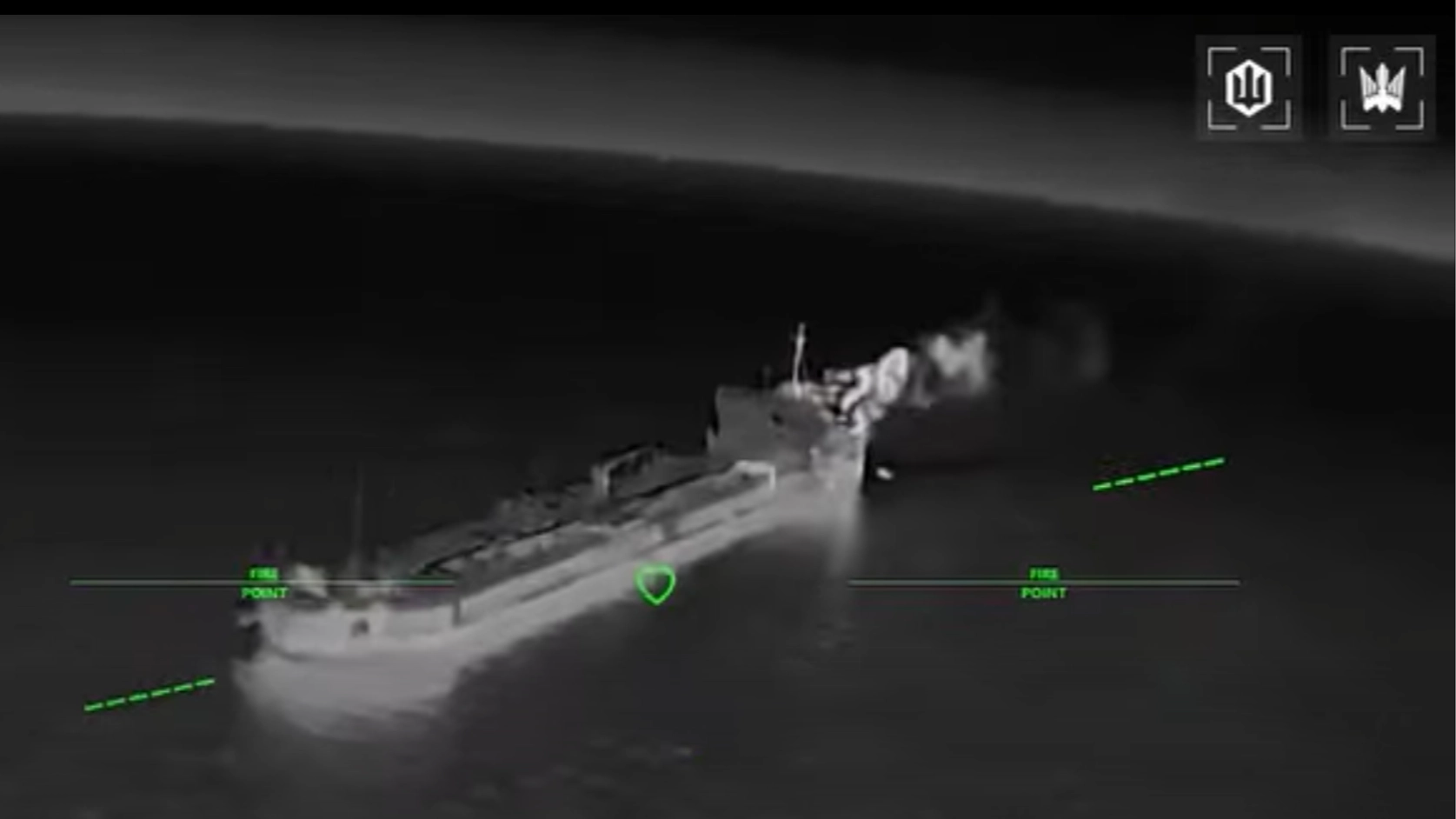
Ukrainian robot aircraft, overnight from Tuesday to Wednesday, hit and set afire a column of Russian shadow fleet tankers in the Sea of Azov, leaving at least one vessel adrift and forcing the crew of the vessel to abandon ship.
A statement published by Ukraine’s Unmanned Systems Forces (USF) claimed “more than nine” Russian tankers had been hit by drone swarms operating above the Kerch Strait that separates Ukraine’s Crimean Peninsula from the Russian mainland. Authorities credited three elite drone squadrons for carrying out the operation.
JOIN US ON TELEGRAM
Follow our coverage of the war on the @Kyivpost_official.
On the Russian side, Rostov Oblast Governor Yury Slyusar acknowledged that two tankers traveling to the port of Rostov without cargo had been struck by drones. He reported on Wednesday that two sailors were injured, one of whom required hospital treatment.
“It was found necessary to evacuate the crew of one of the ships,” Slyusar said, adding that Russian air defenses had allegedly shot down seven Ukrainian drones.
Ukraine’s General Staff echoed the USF report and identified the participating units as the 1st Separate Center, 413th Regiment “Raid,” and the “Kairos” Battalion of the 414th “Madyar’s Birds” Brigade.
According to Ukrainian military sources, drone forces have damaged 21 civilian vessels operating between occupied Crimea and mainland Russia since Monday. The reported tally includes 19 shadow fleet tankers, 1 dry cargo ship, and 1 automobile ferry.

EU Could Open Next Accession Cluster for Ukraine on July 14, Diplomatic Sources Say
Combat footage released by the USF shows drones striking vessels with tanker-like profiles. Some ships appear to be underway at speed, while others are stationary and engulfed in flames.
The attacks were reportedly carried out using Ukraine’s domestically developed FP-2 drones, which can carry warheads weighing between 50 and 100 kilograms (110 and 220 pounds). While large enough to inflict serious damage and ignite fires, the warheads are generally insufficient to sink major vessels. The video shows drones targeting ship bridges, personnel, engine spaces, and fuel bunkers.
Notably, no Russian anti-aircraft fire is visible during the two-minute combat video.
Although the footage could not be independently geolocated, a Kyiv Post review found that each vessel shown appeared to be a unique ship.
Ukrainian media widely reported that nine Russian tankers had been hit and set afire that night. Russia’s defense ministry made no mention of the engagement in its morning briefing, stating only that air defenses in Crimea and the Kerch region had intercepted Ukrainian drones.
FIRMS, the US-run worldwide satellite fire monitoring system, showed a major fire burning in the Kerch Strait shipping channel on Monday. The hotspot, located approximately 6 kilometers (3.7 miles) offshore in the Sea of Azov, covered more than 1 square kilometer (0.4 square miles).
According to Ukrainian and independent Russian media, Ukraine’s campaign expanded on Sunday to systematically target Russian tankers transiting the Kerch Strait. The broader drone offensive aims to reduce Russian fuel production and energy export revenues while disrupting transport links between occupied Crimea and the Russian mainland.
The first strikes, taking place overnight Sunday into Monday, hit and set afire a pair of Russian shadow fleet tankers carrying fuel across the Sea of Azov from Russia’s port of Taganrog to Crimea.
According to Ukrainska Pravda, both vessels – each carrying 7,000 tons of fuel – caught fire after being hit by kamikaze drones. Video released by the USF confirmed the direct hits and fires.
On Monday, the independent Russian Astra news agency, among others, confirmed that the two vessels failed to reach Crimea. Alongside massed complaints from motorists, the report suggested that fuel shortages on the peninsula remained unresolved as of Wednesday.
A Tuesday analysis published by the Ukrainian military publication Defense Express reported that Ukrainian anti-tanker attacks taking place overnight from Monday to Tuesday hit and “destroyed” eight Russian shadow fleet tankers operating around the Kerch Strait and identified the ships by name.
The report found the vessels to be Venera-3, Sanar-1, Sanar-17, Climene, Teti, Alexey Savrasov, Penelope, with one tanker not identified.
According to Ukrainian analysis and some international shipping news platforms, the eight tankers hit that night were shadow fleet vessels with an average deadweight of 7,000 tons – small for a modern tanker. All were reportedly Russian-flagged ships linked to the transport of sanctioned Russian crude oil.
On Wednesday, the tracking platforms Vesselfinder and MarineTraffic showed Sanar-1, Sanar-17, and Alexey Savrasov upstream of the Don River near Rostov, but with outdated plots ranging from two weeks to six months old. Penelope and Climene were seen in the Sea of Azov heading west on Sunday, two days before the Ukrainian drone attacks.
The freshest plot was the oil and chemical tanker Teti (Russian-flagged, 140 meters [459 feet] long), with a location fix recorded on the Don River on Tuesday and Wednesday, headed toward the city of Rostov. Data on the heading and speed were contradictory, which may indicate ship transponder jamming or spoofing.
Although the extent of its success is not yet fully confirmed, Ukraine’s ongoing naval blitz against Russia’s shadow tanker fleet is unprecedented. Within just 72 hours, 19 tankers were hit, making it the fiercest strike operation on commercial shipping conducted by either side during the Russo-Ukrainian war.
By comparison, the Ukrainian navy in late 2025 damaged six Russian tankers operating off Turkey’s northern coast and in the Mediterranean over three weeks. During the entirety of 2025, Russian forces attempted 15-18 attacks against Ukrainian commercial shipping, hitting around 28 vessels, according to the Institute for Black Sea Strategic Studies’ December 2025 report.
Revenues from oil exports account for about one-quarter of the Russian Federation’s national budget and are critical for sustaining Russia’s war effort against Ukraine. When Western states imposed sanctions on those exports, the Kremlin responded by building and chartering a fleet of 500 and 1,000 off-the-books tankers to carry Russian oil to non-Western customers like India, China, and even NATO member Turkey.
Ukrainian officials have complained that allies have been too hesitant to seek out and arrest ships in Russia’s shadow tanker fleet, which has forced Kyiv to employ drones to attack the Russian tankers on the high seas and Russian energy infrastructure on land.
The Kremlin has called the naval strikes illegal and piracy, and described strikes on energy infrastructure as war crimes because they target civilian industrial facilities.
You can also highlight the text and press Ctrl + Enter