Today, Ukraine marks its Day of the Constitution. This is symbolically a very important occasion as regards self-identification. It celebrates Ukraine’s freely chosen confirmation of itself almost three decades ago as a democratic state which had liberated itself from the Soviet totalitarian colonial rule and thereby aligned itself with the European family of democratic states, and more broadly with the free world.
The fact that it took almost five years after independence was achieved to adopt this crucial document indicates how complex the situation was at that time. It attests to the continuing struggle in those years between progressive political forces wanting Ukraine to remove the vestiges of its Soviet past and the still-powerful residual elements from the communist era who wanted to apply the brake and maintain their influence.
JOIN US ON TELEGRAM
Follow our coverage of the war on the @Kyivpost_official.
And of course, there was the problem, then as now, with a powerful Russian neighbor unreconciled to the collapse of the Soviet Union and the appearance of independent states, particularly, Ukraine, next door to it. So, the issue of security and finding a modus vivendi on which to base peaceful coexistence with Russia while looking westward, on the one hand, and bolstering Ukraine’s democracy internally, on the other, were both major and interconnected challenges that had to be addressed.
The struggle for a new democratic Ukrainian constitution began earlier than generally thought. As the Soviet Union was imploding and Russia itself being torn apart by the political rivalry between Soviet Communist leader Mikhail Gorbachev and Boris Yelstin, who was championing the cause of a “sovereign” Russian Federation within the Soviet Union, Ukraine’s voters on March 17, 1991 overwhelmingly supported Ukraine’s state sovereignty, declared by its Soviet Ukrainian parliament the previous July.
Syrsky: Russian Maps Show False Advances to Please Top Command
Subsequently, a “concept” of a new Ukrainian constitution was agreed upon within the republican legislature still dominated by the Communists. It formally endorsed the following democratic principles: a multi-party system, the rule of law, respect for human rights, religious freedom, and guarantees of the rights of national minorities. But this proved hard to enact.
On Aug. 24 that year, after a failed putsch attempt by Communist hardliners in Moscow, the Ukrainian parliament proclaimed the republic’s independence. Its formal endorsement in a referendum held on December 1, 1991, precipitated the final dissolution of the Soviet Union that very month.
Before his election at the end of 1991 as the first president of independent Ukraine, former high-ranking Communist official Leonid Kravchuk, who had finally embraced the cause of independence, had proposed that the Communist-dominated parliament should adopt a new democratic constitution and a law on multi-party elections and dissolve itself. He advocated a strong presidential system in order to push though reforms.
But the conservative leftist majority blocked this transition from the old to the new. An opportunity was squandered, and precious time was lost.
In June 1992 the Constitutional Commission proposed a draft proposing a compromise between a presidential and parliamentary forms of rule. But internal divisions, the legacy of the past, lack of democratic experience, corruption and mounting economic difficulties, blocked progress.
Eventually, this glaring indecision as to the division of powers led to a serious political crisis after Leonid Kuchma defeated Kravchuk in a democratic presidential election in July 1994. At the end of May 1995, he threated to hold a referendum on the issue and in this way intimidated the parliament into accepting a temporary “constitutional agreement” which broadened the executive’s powers.
The hope was to finalize preparations and end political squabbling so that the parliament could adopt a new constitution around June 16, 1996. A revised draft was completed and proposed in March. Kuchma declared that it “was completely European in letter and in spirit” providing for a “mixed republican type of government” based on a sensible division of powers and a bicameral legislature.
Weeks of political haggling followed in the parliament, with the leftists opposing the proposed draft. Once again, Kuchma threatened to call a referendum and broke the opposition. On June 4 the draft constitution finally got through its first reading with 258 votes to 109. But a two thirds majority, 301 votes, was needed for its adoption on its second reading.
The political battle was to have been resumed on June 19, but there were more delays. The main stumbling blocks were the state language, state symbols, the degree of Crimea’s autonomy, private ownership, and banning foreign bases on Ukraine’s territory.
On June 26, Kuchma threatened a referendum for the third time and this time even the democrats feared, as one of them, Volodymyr Yavorivsky, put it, that it “would tear Ukraine apart with an uncertain outcome.”
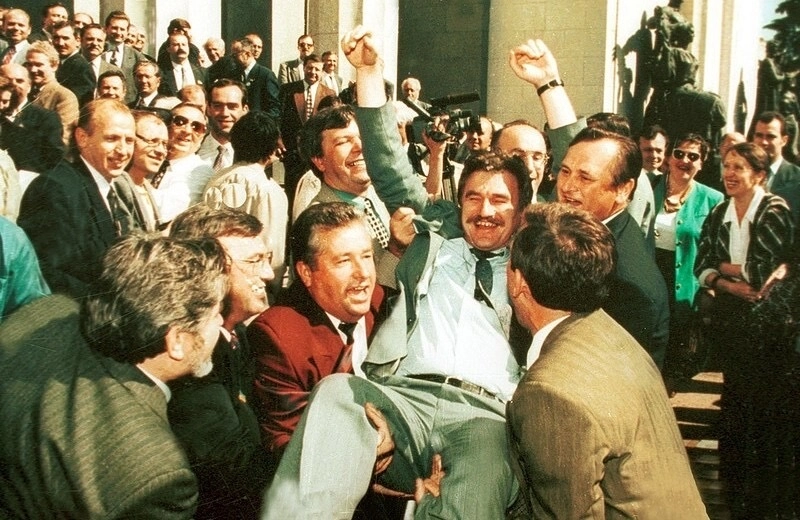
The acrimonious parliamentary session began the following day and continued through the night. A hitherto relatively obscure deputy, Mykhailo Syrota, an engineer from Cherkasy, played an outstanding role in steering the dates over every one of the 161 articles in a constructive direction. Finally, the fundamental law was adopted on the morning of June 28, 1996
The new constitution, describing Ukraine as a unitary state (with very broad autonomy given to Crimea), enshrined basic democratic principles; recognized: the right to own private property, Ukraine’s national symbols banned by Moscow, Ukrainian as the country’s sole state language (guaranteeing the free development, use and protection of Russian, and other languages of the national minorities of Ukraine), religious freedom; and allowed for the temporary stationing of foreign formations on Ukrainian territory on the basis of leasing arrangements approved by the parliament.
Incidentally, there was no mention of Ukraine being a “neutral” state, as Russian propagandists have subsequently claimed.
On the adoption of Ukraine’s constitution, President Kuchma declared: “Wisdom has triumphed… This historic event… will go down as one of the most significant moments in the annals of the modern history of the Ukrainian state.”
The author has written extensively about Ukraine’s road to and after independence in his book The Ukrainian Resurgence (University of Toronto Press, and Christopher Hurst, London, 1999).
You can also highlight the text and press Ctrl + Enter