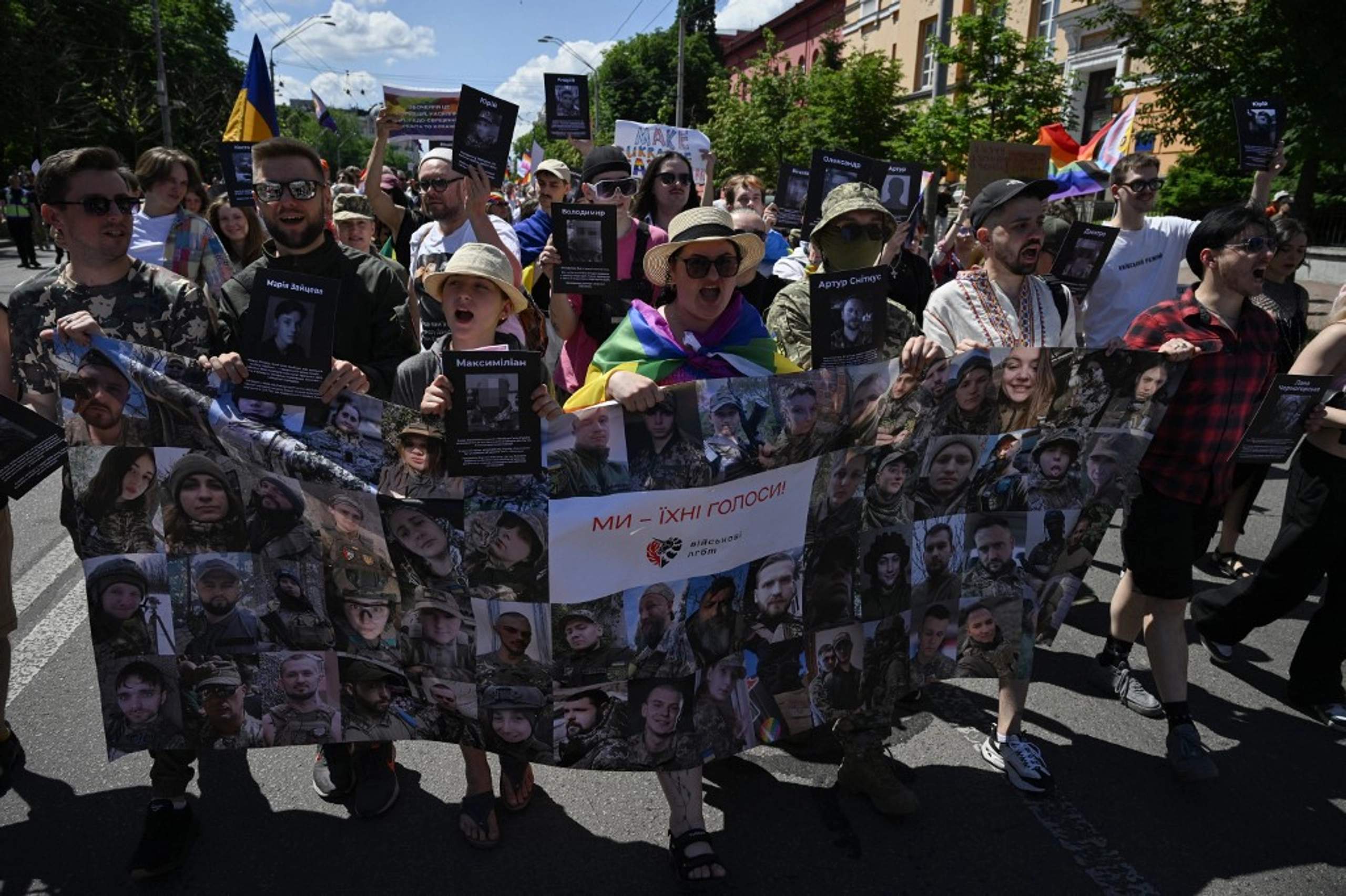
Armed with megaphones, glitter and rainbow banners, one group stood out in the colourful crowd of Kyiv Pride: soldiers in military fatigues, demanding their right to be considered a “part of Ukraine”.
Hundreds of LGBTQ fighters have joined the Ukrainian army to fend off the Russian invasion, which has killed hundreds of thousands and ravaged swathes of the country.
JOIN US ON TELEGRAM
Follow our coverage of the war on the @Kyivpost_official.
Many are fighting on two fronts: with guns and drones against Moscow’s troops, and with pickets and protests for the right to love in a country that does not recognise their relationships.
“It’s easier for me to get permission to kill someone than to marry the person I love,” said Victoria, a soldier AFP met near the front in eastern Ukraine.
Ukraine does not allow or recognise same-sex marriages or civil unions.
In April, lawmakers advanced a new civil code that would uphold the bans -- drawing condemnation from international watchdogs and stoking fears of a further rollback of freedoms.
For LGBTQ soldiers, the rules mean if they are wounded or killed in combat, their partners are denied compensation payments or even the right to visit them in hospital.
- ‘Three steps back’ -
Support for Ukraine’s LGBTQ community has been slowly increasing amid the Russian invasion.
A 2025 survey by the Kyiv Institute of Sociology, found more than 78 percent of Ukrainians supported granting LGBTQ people “the same rights as other citizens” -- up from 64 percent in 2022.
Syrsky: Russian Maps Show False Advances to Please Top Command
But a third said they had a negative opinion in general of LGBTQ people and that they should not be allowed to enter civil unions.
At Kyiv Pride in late June, thousands turned up to support the struggle for equal rights. But there were also dozens of far-right counter-protestors, their faces covered.
Near the front line, 27-year-old drone unit commander Victoria is fighting the Russian invasion in one of the most volatile sectors of the front, at the same time as campaigning for rights inside her brigade.
She wore a patch with a unicorn on her uniform -- a symbol of the LGBTQ soldiers and veterans movement, which has about 600 members.
“No one will defend our interests for us,” she said. “For every two steps forward, we take three steps back.”
“With this war, there are fewer and fewer of us. We must at least try to pass on our ideas,” she added.
- ‘To die together’ -
With pierced lips and bleached pigtails, Arina stood out in a frontline town in eastern Ukraine.
The 23-year-old moved there to be close to Anna, her partner, who she fell in love with at first sight in 2020.
Two years later, Russia invaded and Anna was sent to an assault unit near Bakhmut, one of the bloodiest battles of the entire war.
Over coffee, Arina -- who sometimes helps Anna evacuate wounded soldiers -- showed a video of her cleaning blood stains from an ambulance.
She plans to enlist in a few weeks and hopes to join Anna’s unit after a month of training -- to serve together and “share her burden”.
And, if it comes to it, “to die together”.
“Anything can happen. We would like, at the very least, to be able to get to the hospital in case rehabilitation is needed,” she added.
“The only thing we’re afraid of is losing each other.”
- Rejected by her family -
Clutching her coffee with a wedding ring on her finger, combat nurse Oksana, 35, said she has been shunned by her family for her sexual orientation.
“‘What exactly am I fighting for?’” she asked herself, waiting for wounded soldiers to be evacuated to her position in eastern Ukraine.
To make sure “our guys don’t die”.
At 18, she left Ukraine to marry her foreign partner, hoping to start a family.
“My mother told me she would have preferred if I were a whore,” she told AFP.
After the start of the war, her relationship broke down and she returned home to enlist.
She went abroad to spare her mother the shame, she said. “And when war came to my mother in Ukraine, I came here,” she said bitterly, still rejected by her family.
But amid the stigma Oksana said she faces and recent legal debates on the status of same-sex partnerships, she said her sacrifices have been “stripped of all meaning”.
In early June, President Volodymyr Zelensky said he was open to a debate about LGBTQ rights.
But Oksana has little hope.
Haunted by the feeling that “nothing changes at all”, she is considering leaving Ukraine again.
Her eyes welling up, she added: “This society has broken me.”
Message eng-ready-for-posting
You can also highlight the text and press Ctrl + Enter