Four years after Russia’s full-scale invasion of Ukraine, concerns are rising in Western Europe about the war’s end – specifically, the demobilization of hundreds of thousands of Ukrainian soldiers and the possibility that they may leave the country.
Such claims are voiced by politicians, representatives of state institutions, and anonymous internet users alike. “We must already begin preparing today for what will happen after the war in Ukraine ends,” said Poland’s Chief of Police, Marek Boroń, on Polsat News. This narrative may find fertile ground, particularly as some among those detained for cooperation with Russian or Belarusian intelligence services are also Ukrainian citizens.
JOIN US ON TELEGRAM
Follow our coverage of the war on the @Kyivpost_official.
On the other hand, crime statistics in Poland show no overrepresentation of Ukrainian nationals. The narrative of a potential crime surge rests on the assumption that former soldiers – suffering from PTSD and other traumas – will seek to reunite with their families in the EU. But can this truly be described as a real threat?
There will be no mass exodus
For such a scenario to materialize even theoretically, the war would have to be nearing its end – and today no such prospect is visible on the horizon. Even in the event of a frozen conflict, history offers no examples of mass demobilization in a situation of enduring threat. All the more so in a country where the best guarantee of security remains its own army – Fortress Ukraine.
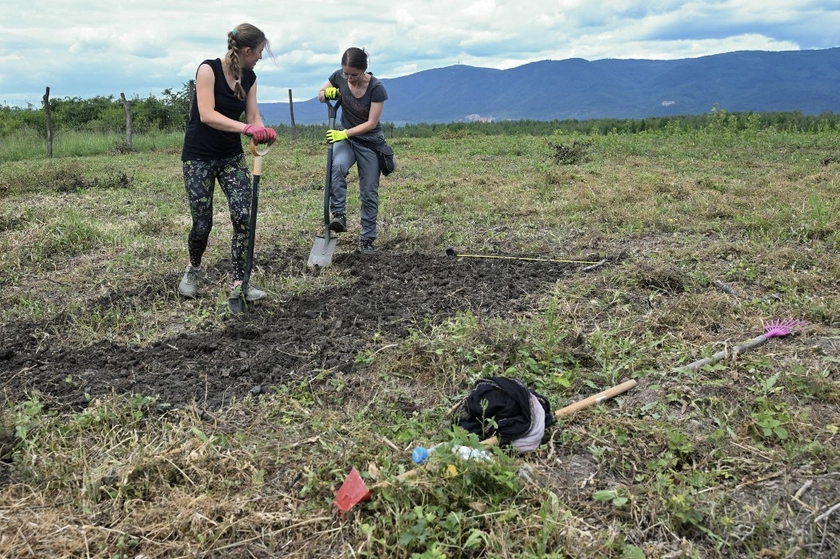
NATO Project Tests Perennial Grass to Clean Ukraine’s War-Hit Soil
All indications suggest that Ukraine will remain a highly militarized country. A hybrid model is possible, in which soldiers combine service with professional activity, participation in the economy, and family life. Demographics are also crucial. The overwhelming majority of war refugees are women and children – families of soldiers who stayed behind to defend the country. The narrative of a supposed exodus of former soldiers to the EU overlooks the fact that many of these families will want to reunite with their loved ones at home. The movement could be in the opposite direction.
The thesis of mass immigration from Ukraine is therefore absurd. Most of those who wanted to leave have already done so. The last extremely harsh winter demonstrated this as well. Despite power outages, lack of heating, and freezing temperatures – contrary to many forecasts – there was no new massive refugee wave.
Demography remains one of Ukraine’s key strategic challenges. In 1991, the country began its independence with 52 million citizens. Today, no more than 30 million live there – and according to some estimates, even fewer. The authorities are fully aware of the need to encourage people to return – for demographic, social, and economic reasons.
Veterans constitute a particularly sensitive group. They are heroes and defenders of the state – portraying them as a threat creates a moral dissonance. At the same time, they require support: rehabilitation and psychological assistance. Such programs are offered both by the state and by NGOs, although their scale is sometimes insufficient.
Veterans will also transform Ukraine – politically as well. They will become an important electorate and a real political force. Many will enter public life, representing their community – a natural process. Political ambitions have long been attributed, for example, to former commander-in-chief Valery Zaluzhny. This, too, is an argument for remaining in the country defended at such a high price.
Fear without foundation
Once martial law is lifted, rights currently restricted will return to their pre-war state – a democratic country cannot prohibit its citizens from leaving. The constitution does not allow for the permanent closure of borders in peacetime, and such a move would also contradict EU law, with which Ukraine is integrating.
At the same time, Ukraine will need a strong army as its primary security guarantee. Of course, some former soldiers may leave – temporarily or permanently – but it is difficult to imagine a mass exodus occurring within a short time frame. Just as there was no new refugee wave, this scenario also appears unlikely.
Scaring the public with such visions weakens Western societies’ attitudes toward Ukraine. On the other hand, every state should prepare for various scenarios – both Ukraine’s partners and Ukraine itself. Ukraine will need to take care of its heroes and face real challenges.
Increasingly, however, there are calls to ban Russian soldiers from entering the EU – and this solution is justified. They represent a state openly hostile to Europe, they are responsible for thousands of crimes, and it may not be in Russia’s interest to keep them on its own territory.
You can also highlight the text and press Ctrl + Enter