In 2025, former U.S. President Donald Trump announced plans for a grand military parade and the renaming of Victory in Europe Day — May 8th — into “Victory Day for World War II,” a direct challenge to Russia’s monopoly over the cult of militarized triumph. Why do democracies and autocracies alike invest in extravagant displays of symbolic power? And can such theatrics substitute for genuine victory over modern fascism?
American grandeur on parade
President Trump declared that the United States should rebrand May 8th, long commemorated as VE Day, into a broader Victory Day for World War II. “We did more than any other country to bring about the Allied victory,” he wrote on Truth Social. He further proposed renaming Veterans Day (November 11th) as “Victory Day for World War I,” arguing that America should honor its military wins: “We won both wars, nobody was close to us in terms of strength, bravery or military brilliance, but we never celebrate anything. That’s because we don’t have leaders anymore, that know how to do so! So we are going to start celebrating our victories again!”
JOIN US ON TELEGRAM
Follow our coverage of the war on the @Kyivpost_official.
A Pew Research Center study in 2024 showed that 61% of U.S. military veterans or reservists intended to vote for Trump. By March 2025, the Trump administration had announced sweeping cuts to federal departments, including the Department of Veterans Affairs — targeting roughly 80,000 jobs, over 15% of its staff. The move sparked strong criticism from veterans’ groups. Trump’s new emphasis on commemorations could be a political gesture aimed at reconciling with this constituency.
Ukrainian Missile Campaign Now Reaches Across Half of Russia
These efforts also align neatly with Trump’s longstanding campaign motto: “Make America Great Again.” In that spirit, the United States is preparing a massive military parade on June 14th — Flag Day and, not incidentally, Trump’s birthday — to mark the 250th anniversary of the U.S. Army. According to the Associated Press, the parade will feature some 6,600 troops, 150 military vehicles (including Stryker APCs, Bradley IFVs, Paladin howitzers), and 50 helicopters. The route will span from Arlington National Cemetery to the National Mall in Washington, D.C. Though the idea emerged only recently, the price tag is expected to run into the tens of millions — compared to approximately $12 million for a typical Victory Day parade in Moscow.
Trump had previously attempted to stage a military parade during his first term, inspired by France’s Bastille Day celebrations in 2017. Enthralled by the spectacle on the Champs-Élysées, he sought to replicate it on Pennsylvania Avenue. But the 2018 plans were scrapped due to projected costs exceeding $90 million and concerns over the impact on D.C.’s infrastructure, not designed to bear the weight of tanks and armored vehicles.
Trump’s rejection of Russia’s role in the Allied victory during WWII provoked an immediate backlash. Russian Foreign Ministry spokeswoman Maria Zakharova responded with a quote from President Franklin Roosevelt in 1943: “The Red Army and the Russian people have surely started the Hitler forces on the road to ultimate defeat and have earned the lasting admiration of the people of the United States.” She accused Trump of historical revisionism. Kremlin spokesperson Dmitry Peskov added his own dismissal of U.S. contributions to the war effort, saying that victory would have been achieved “even without American Lend-Lease aid,” and concluded: “We would have eaten dirt, but we would have won.”
Moscow’s ire stems not only from an affront to its sacred “Victory cult” but also from America’s attempt to construct its own. A pro-Kremlin Telegram channel with nearly 70,000 followers sneered that the American parade is “less a celebration than a projection of strength, a message to its own public.”
Trump appears to be playing on Putin’s own turf — challenging the Russian leader’s symbolic monopoly over military glory. This is a bid to seize the narrative of anti-fascist victory, long curated by the Kremlin. If the Washington-area parade proceeds as planned, it will serve both to galvanize domestic support and to signal globally — especially to Putin — that the United States still claims a leadership role in shaping the European order, just as it did 80 years ago.
Russia’s cult of victory
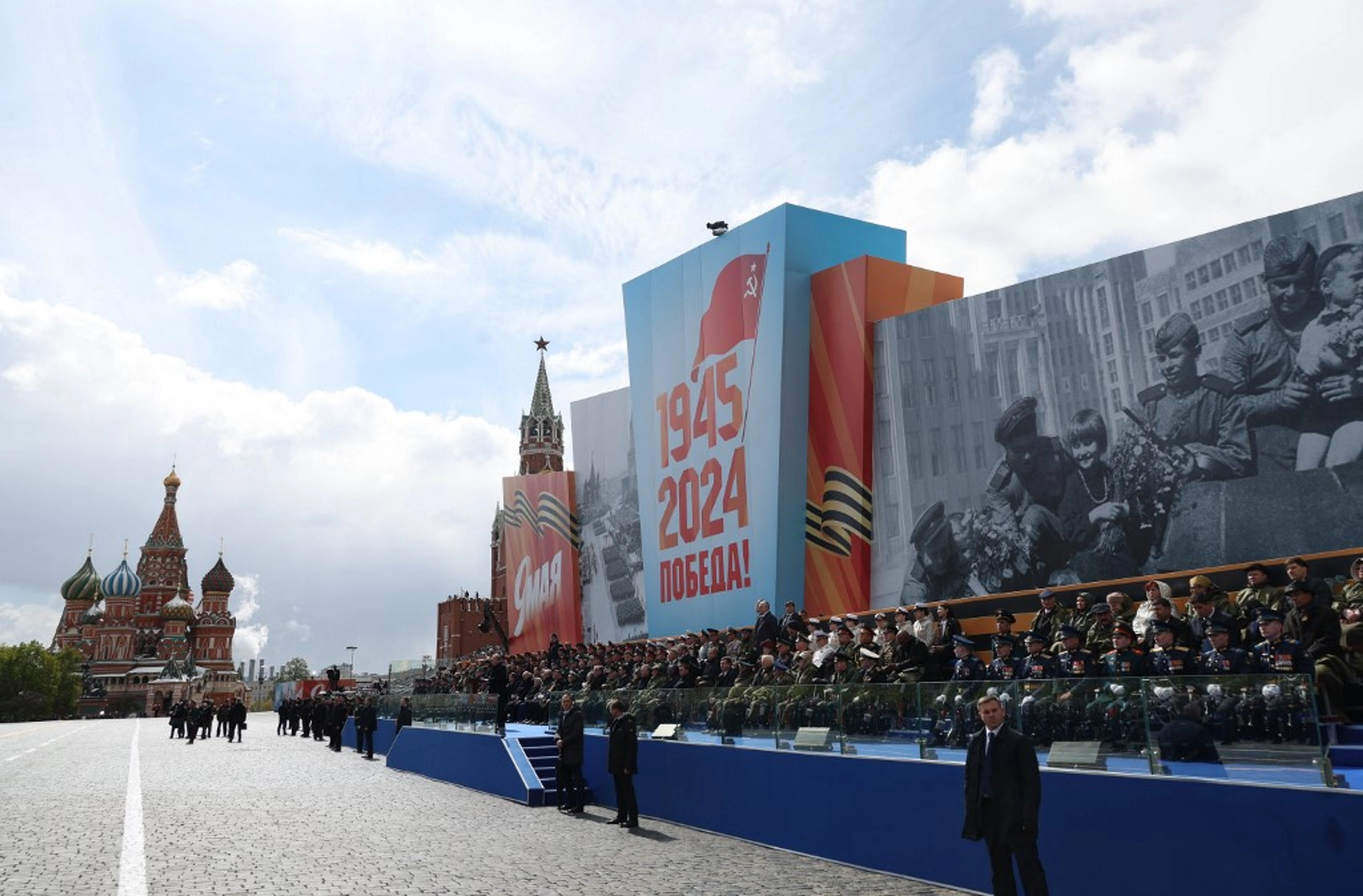
The tradition of May 9th as “Victory Day” was institutionalized during the 20th anniversary of WWII’s end in 1965, under Leonid Brezhnev — the first Soviet leader who was not a veteran of the Bolshevik Revolution but had served in WWII. By emphasizing the “Great Patriotic War,” Brezhnev added symbolic legitimacy to his rule. Only the second military parade since 1945 was held in 1965; another followed in 1985, but it wasn’t until 2008 that annual Victory Day parades resumed.
Soviet parades were designed to signal ideological strength against capitalist and fascist threats. Contemporary Russian parades echo this message but focus more on intimidation than remembrance. Since the 2000s, the Kremlin has emphasized showcasing advanced weaponry — such as T-14 Armata tanks or hypersonic missiles — underscoring Putin’s ambition to reassert Russia’s geopolitical stature, rather than to foster international unity against evil.
In contrast to universal anti-fascist ideals, Russian parades now serve domestic nationalist and militarist agendas. In 2024, for the first time, participants in the so-called “Special Military Operation” marched on Red Square. This explicitly tied Victory Day to the current war in Ukraine, collapsing the line between resistance to fascism and contemporary imperial aggression.
Russia’s growing international isolation has only reinforced the parades’ insular character. Diplomatic tensions, sanctions, and wartime security concerns have kept foreign dignitaries away. In 2025, Putin even proposed a three-day ceasefire — mockingly dubbed a “barbecue truce” — to ensure an uninterrupted May 9th spectacle. Ukrainian President Volodymyr Zelensky dismissed it as theater, offering instead a 30-day ceasefire as a pathway toward actual peace. Ukraine’s foreign minister Andriy Sybiha suggested the Kremlin proposal was motivated less by peace than by Putin’s desire to stage-manage the event.
One Russian military blogger with over 250,000 followers sarcastically proposed that, in place of lavish tanks, Red Square should display battlefield “buggies” built from retrofitted Ladas and Moskviches—symbols of the army’s dire equipment shortages. He quipped that “Armata” and “Boomerang” vehicles exist only in parades, not on the front lines.
The aesthetics of power: Parades in democracies and autocracies
Military parades are as much about spectacle as symbolism. In his 1936 essay The Work of Art in the Age of Mechanical Reproduction, German philosopher Walter Benjamin warned that the aestheticization of politics — through rituals like parades — can replace ethical norms with theatrical form, particularly in totalitarian regimes where mass participation becomes mass manipulation. As cultural theorist Simonetta Falasca-Zamponi argues in Fascist Spectacle, Mussolini used parades to craft a myth of the leader as artist, shaping the nation like clay.
In autocracies such as today’s Russia, parades reinforce ideological myths and regime legitimacy. But even in democracies like the United States, under populist pressures, they can signal a shift toward performative nationalism — a patriotic theater divorced from deeper civic commitment.
Trump’s model of governance increasingly reflects Max Weber’s concept of charismatic authority: leadership based on personal appeal rather than rational-legal norms. A Trump-era military parade would aim to elevate the presidency beyond a constitutional office, into a quasi-monarchical role, grounded in spectacle and personal glorification. But militarism in a democracy must be tightly managed — lest it overwhelm the civilian principles on which democracy stands.
In the end, Trump’s symbolic contest with Putin may irritate the Kremlin, but it is unlikely to significantly alter the strategic balance. The real blow to Putin’s mythos would not be an American parade, but a Ukrainian one — celebrating Kyiv’s eventual victory over Russian aggression. Such a parade could unfold in Kyiv, in European capitals, or even in Washington — not as a display of synchronized choreography or pageantry, but as a sober act of historical vindication. It need not aestheticize violence or elevate trauma into national myth. It would simply mark the end of a war begun in 2014, and the triumph of democracy over a revanchist empire.
The views expressed in this opinion article are the author’s and not necessarily those of Kyiv Post.
You can also highlight the text and press Ctrl + Enter

Russia Hit by 660-Drone Overnight Barrage Targeting Moscow, Crimea and Key Military Sites

Russia Hit by 660-Drone Overnight Barrage Targeting Moscow, Crimea and Key Military Sites