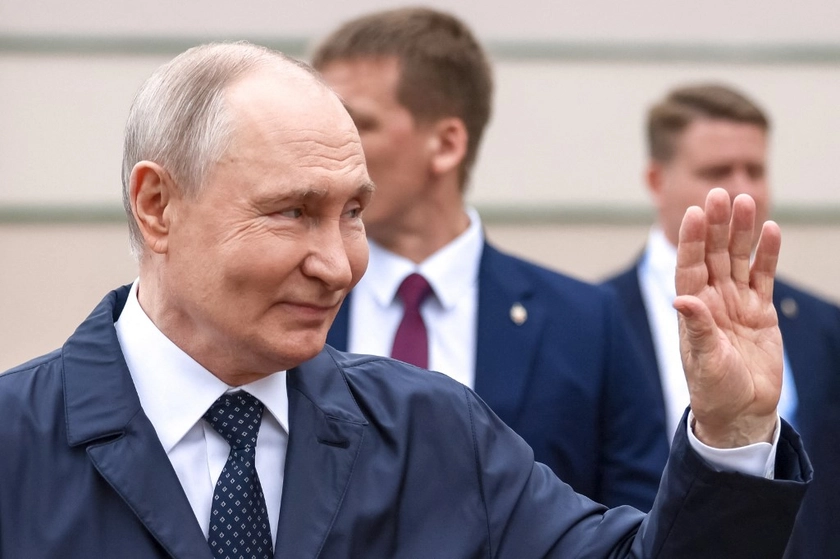
First, the synthesis of the Trump peace plan is that Putin has demanded territorial concessions from Ukraine as the price for peace, and to save lives, Ukraine should concede land for peace.
I would debate whether Putin is actually serious (he is not in my view) about delivering peace for territory, as I would argue that Putin’s aims are still not just Donbas, Kherson, Zaporizhzhia and Crimea, but securing control over the whole of Ukraine.
JOIN US ON TELEGRAM
Follow our coverage of the war on the @Kyivpost_official.
So, Putin’s peace offer is not to actually secure peace but to destabilize Ukraine to facilitate further attack by Russia.
I would contend that Putin assumes that if he and Trump succeed in getting Zelensky to concede these territories, the act will be so destabilizing to the political, social and economic situation in Ukraine that this will create opportunities for further Russian attacks, so as to gain yet more territory.
So, Putin’s peace offer is not to actually secure peace but to destabilize Ukraine to facilitate further attack by Russia.
Given constitutional limits on trading territory for peace, Zelensky will face an enormous challenge securing domestic political support for the kinds of constitutional changes required by any such territorial concessions.
At the minimum, to sell such a concept in Ukraine, Zelensky will need to have adequate security assurances that, having given up such territories the rest of the country remaining under the control of Kyiv will be safe from future Russian attacks.
Hence, the pitch by Ukraine, accepted and understood by its European allies, but made to Trump, is that it needs to be given adequate security guarantees.
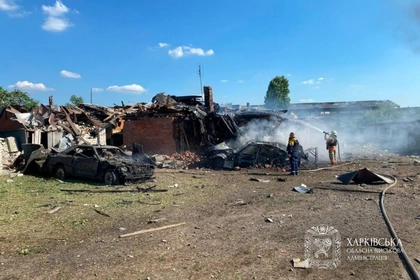
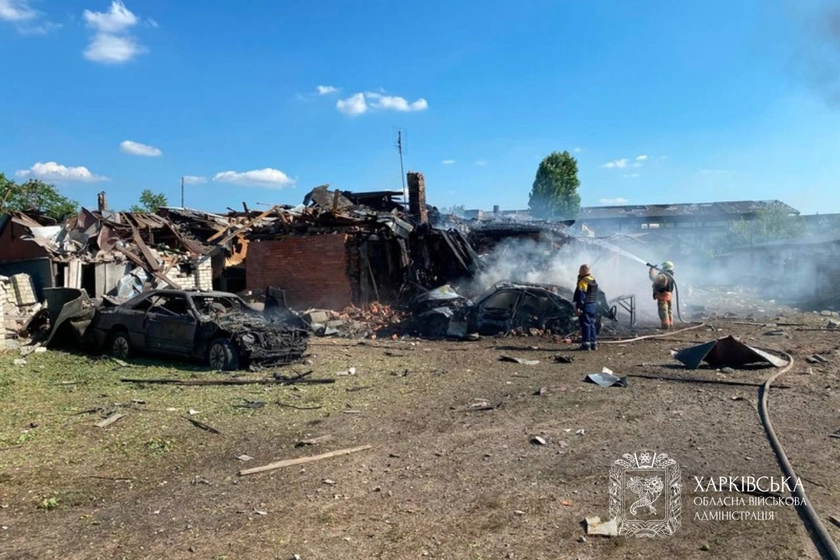
Russian Guided Bombs in Kharkiv Kill Teen, Wound 32, Including Children
The penny seems to have dropped with Trump that a Russian assurance that they would not attack further is an insufficient guarantee, and that Russia cannot be trusted, even though his envoy, Steve Witkoff, appears to have taken such a Russian assurance during his Moscow trip was a security guarantee worth the paper it was written on.
Ukrainians remember here the now infamous Budapest Memorandum of 1994 when it surrendered its huge nuclear arsenal for assurances that its sovereignty and territorial integrity would be respected by the then powers: Russia, China, the US, France and the UK.
The subsequent annexation of Crimea, Russian intervention in Donbas then full-scale invasion of Ukraine in February 2022, underlined to Ukraine that any future security guarantee has to be cast iron, and more than a bit of paper, which was the case with Budapest. Hence, now the debates around security guarantees.
So, at the DC summit of European leaders with Trump, and since, the focus has now been on what kind of security guarantees and assurances can be provided to Ukraine that it could possibly accept a peace deal that might include it making territorial concessions?
The understanding here is that Zelensky needs to be supplied with something very concrete and firm so that he can sell any such deal at home in Ukraine.
On the issue of security guarantees, which might meet Ukraine’s demands - security against future attacks from Russia, we can consider a number of options:
The reality is that NATO membership is not realistic for Ukraine any time soon.

First, NATO membership. Perhaps the easiest assurance to Ukraine as to its future security. NATO is a military super-power which massively outguns Russia. And during this conflict I think we have learned that Putin respects power and is afraid of NATO – he has set various red lines for NATO about not sending particular bits of military kit (Mig 29s, T72s, S300s, Leopards, HIMARS, ATTACMS, F16s, etc.) to Ukraine otherwise he would attack NATO supply routes. But he has not kept to these red lines, presumably as he does not want to get into a shooting war with NATO, which he would likely lose very quickly.
Ukraine would also add much to NATO’s defense, as it now has the second-largest military capability in NATO, aside from the US – and note there if the US walks away from the defense of Europe, Ukraine can fill lots of gaps for Europe.
All that said, Trump, and some other European NATO members, including Hungary and Slovakia have signaled that they would not support NATO membership for Ukraine – worried about annoying Russia, and perhaps not willing to provide their boots on the ground to fight in Ukraine’s defense which would be a commitment as per NATO’s Article 5 and 6.
The reality is that NATO membership is not realistic for Ukraine any time soon.
Second, short of NATO membership, an alternative is bilateral security guarantees from individual NATO member states, and perhaps some others (Australia, New Zealand, et al), to Ukraine.
Unfortunately, therein, while the US is unwilling to green-light Ukrainian NATO membership, it is also unwilling to commit to come to Ukraine’s defense in a direct security-type guarantee.
The question herein is how realistic a Coalition of the Willing (30 Western states, excluding the US) security backstop would be without the heavy fire power of the US? Simply put, excluding the US, any assurance from the rest – from the Coalition of the Willing (COW) – is not really worth very much, as they simply lack the level of military capacity to wage war with Russia.
There has been some creative license used to suggest that any COW force effect/deterrence could be multiplied if the US provided some assurance as to its ability to backstop them (intelligence, arms supplies, logistics) in the event of a further Russian intervention in Ukraine.
But still the COW would need to convince both Ukraine and Russia that it would be able and willing to intervene in Ukraine, to stop a Russian military intervention. The harsh reality is that at present the COW lacks the capability to provide a serious deterrent, barring a change of heart by the US.
So given a red card on NATO membership for Ukraine, and perhaps an amber card on bilateral security guarantees, focus has shifted to a hybrid which I would call the State of Israel equivalent security guarantee.
Perhaps on the latter some strategic ambiguity (about potential US involvement) could provide some deterrence to Russia - but again would this be enough to convince Ukraine that it is enough of a security guarantee to sign up on the line to a peace deal, surrendering territory up front for uncertain future security assurances, but also perhaps to COW countries (that their troops would be safe) to commit forces to the defense of Ukraine.
So given a red card on NATO membership for Ukraine, and perhaps an amber card on bilateral security guarantees, focus has shifted to a hybrid which I would call the State of Israel equivalent security guarantee.
On the latter, in effect, this is the assumption that the best assurance of Ukraine’s defense is Ukraine itself. After all, after 3.5 years, Ukrainians have proven able to fight to a standstill a much superior military power, Russia, that on paper at least is multiples more powerful in terms of manpower and kit. And the fact has been that Ukraine has survived this long after being drip-fed only third and fourth-generation Western military kit.
So, the idea is if Ukraine, like Israel, was assured the top of the range Western military kit – think of F35s et al. – it would be more than able to deter Russia from future attack. It also adds the advantage of providing a front-line defense for the rest of Europe.
Now, combining the State of Israel’s defense with support from the COW, the idea, I think, is that the COW provides a backstop in terms of training and support services, but not front-line boots on the ground, in the event of attack by Russia.
COW provides training, intelligence and equipment for Ukraine, but Ukraine would do the fighting. The COW, in effect, provides a multiplier effect for Ukraine’s own arms forces. And particularly for European members of the COW, the big advantage is that by investing in making the Ukrainian armed forces more effective – i.e., more able to stand up against Russia – they are actually investing in their own defense as obviously Ukraine is the front line for them against Russia.
Is the State of Israel security guarantee enough of an assurance for Ukraine that it would be willing to give up territory? I have my doubts as in the end the question is will the US continue, even step up, arms supplies to Ukraine, should it suffer future new invasion from Russia.
The question there is do Ukrainians trust Donald Trump in such a scenario? And therein I think, given the gyrations in US policy over the past six months, the Oval Office ambush of Zelensky, the Putin – Trump love fest in Alaska, the reality is just no. Ukraine will assume that in such a scenario of attack by Russia, Trump will think about what is best for him, and the US first.
And in the end, I might have termed this the State of Israel guarantee, but the reality is that Ukraine does not have the equivalent of AIPAC in the US. The mainstay of support for Israel in the US establishment and the religious lobby is just so much better cemented in the US, that it can ever be any time soon for Ukraine.
The other big question for me, or nuance, is around US sanctions. It was interesting to hear Secretary of State Rubio argue this week that the risk of levying new sanctions against Russia was that it would deter it from negotiations.
The irony therein is that many of the same Trump folks were prior arguing that only the threat of the 100% tariff on Russian exports got Putin to the negotiating table and to Alaska specifically.
But more importantly, I think while sanctions were initially imposed to change Russian bad behavior, I think a new reason to impose sanctions on Russia is to weaken the Russian economy to prevent it from regenerating military capability lost in Ukraine and which may well be used against the Western alliance in the future.
Tighter sanctions now make sense because Russia is a threat to the Western alliance, and surely we should be taking actions to reduce that threat.
Reprinted from the author’s tashecon blog! See the original here.
The views expressed in this opinion article are the author’s and not necessarily those of Kyiv Post.
You can also highlight the text and press Ctrl + Enter