From the editors: This post, originally published by Kyiv Post Senior Defense Correspondent Stefan Korshak on May 29, 2026, has been reformatted for publication.
Lots of Ukraine war news this week, pretty much the diametric opposite of “nothing happening, nothing’s going on.”
JOIN US ON TELEGRAM
Follow our coverage of the war on the @Kyivpost_official.
The most important was that the Ukrainian bombardment campaign to destroy Russian logistics in the 50–150 km (31-93 miles) envelope with swarms of cheap drones was confirmed by practically all possible sources as real, effective and expanding.
Not a one-off, not fake news, not pin pricks. The Kremlin is still stoutly pretending everything is okay, which is going to make things worse for them.
It’s a little too early to talk about a turning point in the war. But honestly, what’s been going on on the roads of the southern Donetsk and Zaporizhzhia regions really can’t be described any other way than as mayhem. Details below.
If you aren’t hearing about this in your mainstream news, then question the quality of that news. I am not kidding, it’s impossible to miss, this is a strategic bombardment campaign with the clear objective of demolishing the Russian Federation’s capacity to supply its troops in the occupied southern Donetsk, Zaporizhzhia and Kherson regions.
The front
Overall static but perhaps a slight positive trend for the Ukrainians in ground gained.
I would say the most important bit of information about the fighting on the front was a throwaway line by Brig. Gen. Andriy Biletsky, commander 3rd Corps, who told Reuters that things on the front were not ideal but certainly better than any time since the start of the war – which we knew – and that friendly losses are distinctly less, which we suspected, but hadn’t had any hard confirmation.
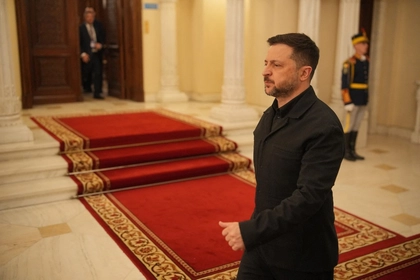
Zelensky Mocks Putin’s 15 Failed Deadlines to Capture Donetsk Region
This is the flip side of the Drone Wall. Not only does it maximize Russian losses, it does so while exposing Ukrainian troops to the minimum extent possible. That approach is certainly not a secret, nor is it new, but this is the first time an officer at Biletsky’s level has been willing to say the strategy is succeeding on the friendly casualty side.
He also pointed out – very perceptively, although there are more than a few US diplomats that don’t want to think about it – that the Russian ceasefire term that Ukraine must abandon the Donbas to Russia in order for a ceasefire to go into effect is stupid, because why do that when Ukraine is holding its ground, taking minimal losses, and honestly taking territory back?
Rubio wisely told reporters this week that the US is finished trying to broker a peace deal between Russia and Ukraine. Translated, that means Trump, Rubio, Witkoff and their buddies have concluded that they can’t shove Russia’s terms down Ukraine’s throat.
As we can see, like Russia, they blame Europe for helping the victim.
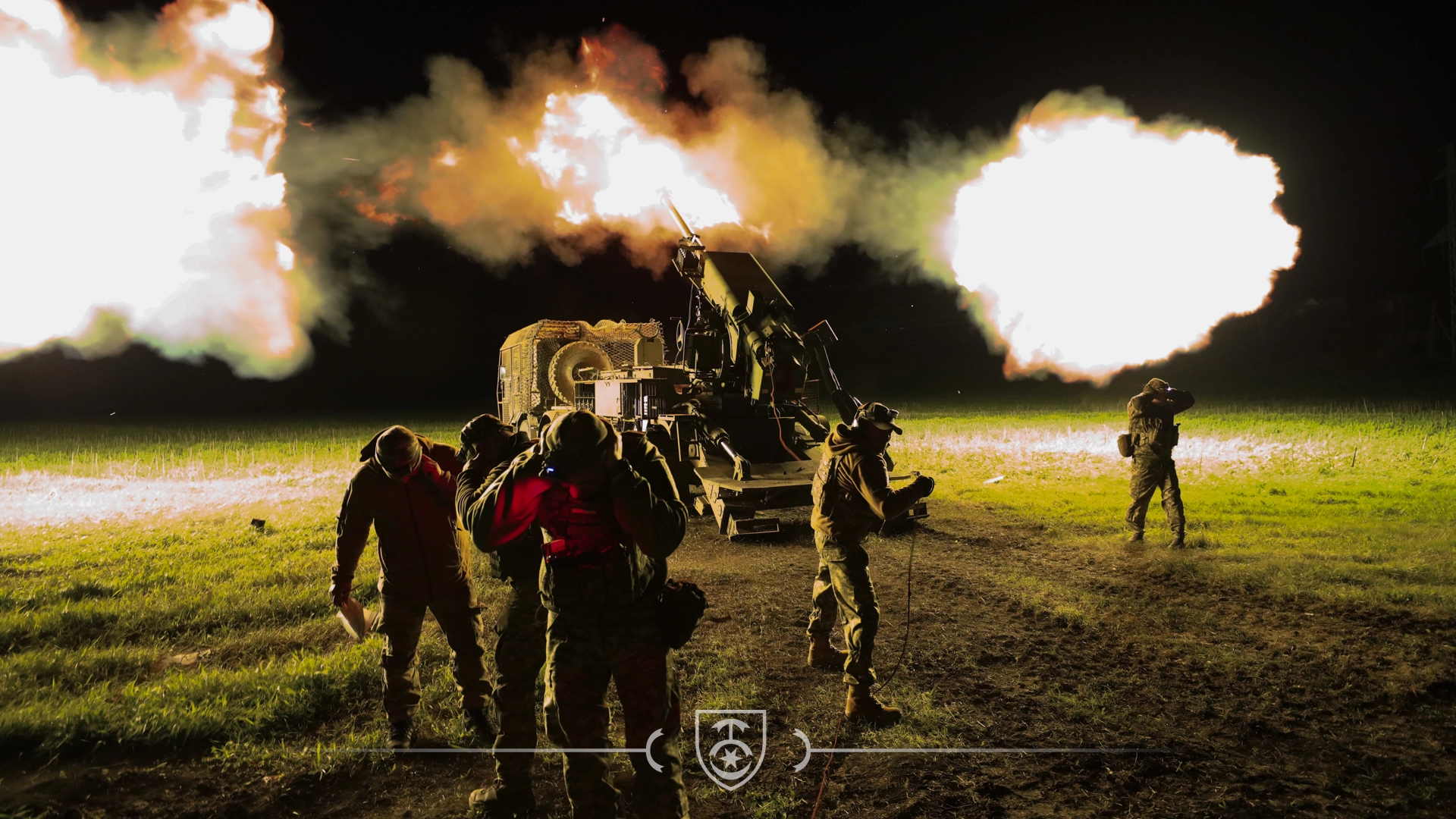
Biletsky said the next six months will show how long Russia can sustain itself in the war. Sounds possible, but there are other theories out there. This week was the official “Ukraine Special Operations Troops Day” so obviously, there were some spiffy images documenting sneaky-deaky coolitude.
The front in more detail:
Konstynivka
Remains a focus of fighting and honestly, it’s hard to understand the situation there. A Radio Liberty report said that the Russian army is inside the city but has not established itself and quoted a fighter there as saying, “The closest analogy to the current situation is a dam in the stage of cracks.”
I’ve seen a report that “The bulk of Ukrainian recon drone operators completed their withdrawal to safer positions out of Kostyantynivka” and partial confirmation of that, and there have been several reports of Russian troops moving — not freely, but spotted and attacked by drones — in the south of the city.
Infiltrators have penetrated to the west of the city and vehicles entering from the south-west have sometimes been fired on, but the H20/T0504 main road artery seems still to be used by Ukrainian vehicles. The Russian infiltrators are pushing mostly from the south-east and east, and units in the city are predicting a more conventional assault from the north.
On the other hand, the Ukrainians are holding their positions; their quick encirclement seems impossible, and the Russians are having serious trouble amassing enough troops to actually attack buildings and fortifications held by the Ukrainians.
I would say the easiest prediction is extended urban combat, with the main question being whether Russian reserves will hold out to pay the price of pushing into the city. The 36th Marines – a very experienced unit – are the backbone of defenses here.
Pokrovsk-Dobropillia
The 1st Corps Azov reports they are holding well here and conducting some counterattacks. Reportedly, the previous attacking formation, the 51st Army, is slowly replacing units with elements from the 41st Army. The standard expectation would be that when those replacements are completed, another push in the area might be expected.
The situation seems worse south of Dobropillia and north of Pokrovsk, with fighting seemingly centered on the villages Rodyn’ske and Bilyts’ke. The Ukrainians are still on the ground, and their drones are cutting into the Russian infiltrating infantry, but the Russian glide bombs are reducing both villages to rubble, and some hits inflict casualties.
Both places are protected by barbed wire, mines and deep bunkers. Therefore, as with Konstatynivka, lines are moving a lot, but the level of violence is high.
There are noises of a Ukrainian counterattack south-west of Pokrovsk, but no confirmation.
Zaporizhzhia
The Ukrainians are advancing. Following the capture/liberation of Stepanohirsk last week, this week the Ukrainians captured two villages to the east: Pavlivka and Mali Shcherbaky. These are local counterattacks almost certainly led by some piece of the 425th Assault Infantry “Regiment.”
Sumy region
Counterattack appeared to succeed near the village of Tur’ya.
Kharkiv region
Three villages were recaptured to the east of Velyky Burlik.
The northern “land route” to Crimea – middle strike lockdown on Russian rear area now official
This review formally flagged a new Ukrainian campaign to shut down Russian logistics traffic moving between mainland Russia and Crimea via, roughly, the M-14 highway, way back at the start of May.
It is difficult to overstate how much the Russian mil-blogger class has been complaining about increasing drone density and strikes along that route since then, although, as always, the official Russian line has remained that Russia is mighty and it’s silly to take any Ukrainian military capacity seriously.
Plenty of images have surfaced to contradict that.
In fact, dozens, if not hundreds, of trucks were hit by small drones operating at mid- to long-range over southern Donetsk and Zaporizhzhia regions.
On Wednesday, Ukraine’s Defense Minister Fedorov made it formal and told reporters in Kyiv that a “logistics lockdown” for the Russian army is in progress with the objective of making it impossible for Russian forces to attack effectively, by systematically attacking supplies and reserves heading to the front lines, roughly in the 50–100 km (31-62 miles) range window.
Further, he said, Hr.5 billion ($113 million) has already been allocated to support drone procurement “by our most effective frontline units,” primarily selected from the Unmanned Systems Forces (USF) as well as the 1st Corps/Azov, and further the Ministry of Defense is going to launch “large-scale” competitive tenders to keep the drones coming.
This is the first time, in the entire war that I know of, that a military operation of any kind, with a clear objective and a precise amount of funding, has been announced by the Armed Forces of Ukraine (AFU).
It is really unprecedented for a Ukrainian wartime official to be so clear and specific about intent and the expected outcome of an offensive operation against Russia. Here’s what Fedorov said:
“The enemy’s rear is no longer a safe haven. We are seizing the initiative – using technology and the cold math of war to paralyze their operations.”
I am not saying I am sure the Ukrainians can do it. But I have not seen such confidence before.
It’s not just the southern road to Crimea. From across the Donetsk region, the reports are similar – there are Ukrainian drones parked over main highways about 50-100 km (31-62 miles) from the front lines looking for military vehicles to hit, especially supply trucks. The Uglegorsk-Debaltsevo-Alchevsk-Luhansk road, known to not a small number of readers, was one of them.

As for results on the ground, this week the OSINT people had a field day compiling photographs of trucks burnt out on the M-04 and the M-14; it is obvious the Russian air defenses can’t stop the drones, the only question is this: Will the Ukrainians have sufficient drones to convert that into seriously degraded Russian logistics along the southern front?
But as best as I can see, the Kremlin’s response is to just act like the drones aren’t there and the trucks aren’t being burned.
On Friday, the Donetsk occupation authority simply banned civilian traffic on the M-14, meaning civilians wanting to reach Melitopol/Crimea along the north shore route will have to drive on roads the OSCE industriously patrolled day after day more than a decade ago, through the town Manhush and “resort” communities Urzuf and Beryansk. This is a two-lane road that will now have to carry four-lane traffic, including trucks.
There is no evidence whatsoever that the shift will protect the traffic, because some of these Ukrainian drones are reaching inside of Mariupol and up to the Perekop isthmus. This is the geographical facet of why these strikes are dangerous to Russia: There is no easy fix.
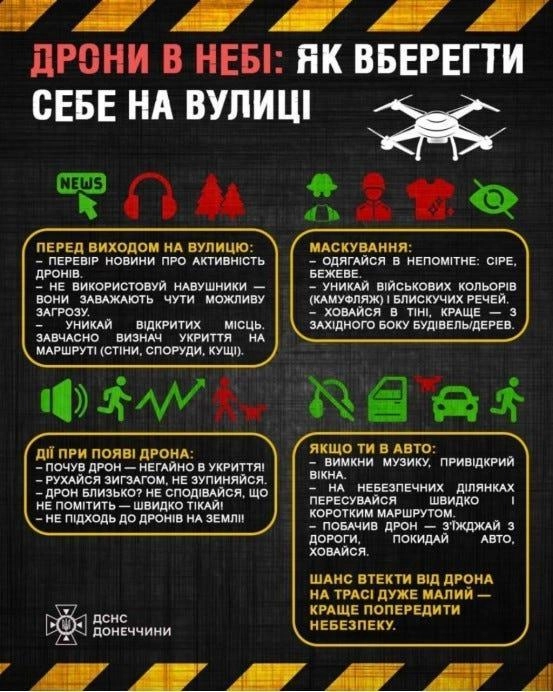
Routing onto smaller roads is being attempted, but with the persistence of Ukrainian observation, this seems to be funneling trucks onto narrow roadways where the entire column is stuck once the first and last vehicle are stopped.
Armoring Russian freight trucks is being discussed. Those of us with frontline knowledge know that if you are Russian and armor your vehicle against Ukrainian drones really, really well, the Ukrainian drones will play unfairly and not attack your thick armor, but instead your wheels or tracks, and then once your vehicle is stopped, they will just pound your vehicle until it catches fire.
Russian war bloggers are pointing all of this out, loudly, and demanding that those in charge do something, but as best as I can see, the Kremlin’s response is to just act like the drones aren’t there and the trucks aren’t being burned.
I have read Russian motorist chat groups reporting drivers are saying they won’t make the Mariupol-Crimea run for double the money, because of the Ukrainian drones. Or that, yes, it’s possible to drive to Crimea for a summer holiday, but if you stay too close to a truck on your road trip, you risk your and your passengers’ lives.
In other news, it seems the Russian knock-off version of Amazon, a company called Wildberries, announced this week its normal two-day delivery promise from mainland Russia to Crimea is now six days, and can’t promise it.
I have seen – unconfirmed º an order that motorists are no longer allowed to use their mobile phones at filling stations because that somehow might help the Ukrainians find targets and that would harm civilian morale.
But the carcasses are piling up. It’s very clear that the road service people in the south Donetsk and Zaporizhzhia regions are either unable or unwilling to pick up wrecks. So, a family driving from central Russia to Crimea has all manner of charred wrecks to look at on the way.

It is worth pointing out that less than a month before this strike campaign kicked off, specifically on April 6, Ukraine’s Defense Intelligence (HUR) reported that its drone pilots in a raid had struck and disabled the Slavyanin, which they described as Russia’s last operational railway ferry in the Kerch Strait. It had been previously damaged but was “finished off” in this attack.
Based on planning timelines, it looks like Ukrainians knew the only remaining route for heavy freight to reach Crimea was the highway Rostov-Mariupol-Crimea; then test raids were launched within a week or two, and a sustained campaign was underway in a bit less than a month.
In other words, based on the evidence, the Ukrainians have been planning this for months, if not years, but they had to amass drones and degrade Russian air defenses first. This is what strategic competence looks like.
Russia bombards Ukraine
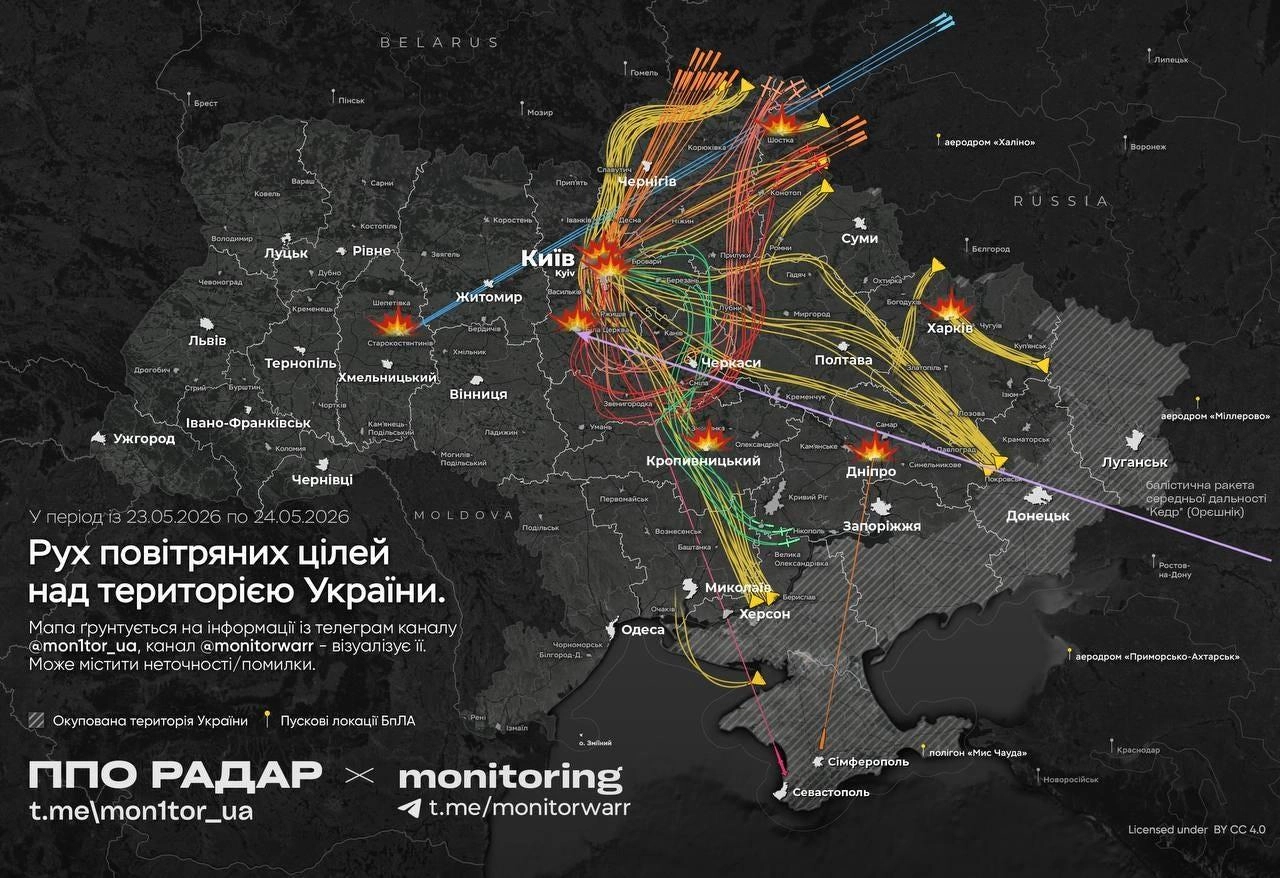
The big strike of the week came overnight from Saturday to Sunday, with the main target being Kyiv.
The attack lasted five hours and there was damage across the city. My guess this was a combination of Russian targeting just as much of the city as possible, and as a result, debris and expended anti-aircraft missiles falling across the city. Near where I am, the local Patriot (I assume) battery launched at least eight times and scored hits at least three times. One intercept was on a pretty flat trajectory; not sure what that was. But loud.
By the numbers, casualty count, two civilians dead and 86 wounded. In terms of strike size and Ukrainian intercepts, the attack was one of the most sizable in months. First number is intercepted, second number is the total launched:
- 604/690 — Weapons of all types,
- 0/1 — Oreshnyk big ballistic missile,
- 11/30 — Iskander-M/S-400 ballistic missiles,
- 44/54 — X-101/Kalibr/Iskander-K cruise missiles,
- 0/3 — Zircon hypersonic missiles,
- 0/2 — Kinzhal missiles,
- 549/600 — Shahed and Shahed simulators.
The Ukrainian air force adds that 19 missiles not intercepted did not reach their targets. This would logically be the Kinzhals and some percentage of the ballistic missiles that the Ukrainians were able to shift off-target with EW.
The last time Russia launched more ballistic missiles in a night was on Feb. 2, with 32 missiles. So this was a strike the Russians had probably been saving up ballistic missiles for.
Following the attack, there was damage at 40 locations across the city. The national Post Office was hit, and in Podil, the Chornobyl Museum was hit. Schools and apartment buildings elsewhere in the city. All that seemed purely civilian.
A big oil-related fire was touched off in the north of the city; this likely was the heating plant. The Lobanovsky football stadium was hit, as was the National Art Museum, as was an 18th-century Orthodox Christian church, as was the Opera and Ballet Theater, as was the Kyiv School of Economics, as was the Azerbaijan Embassy, and as was the Foreign Ministry building. Some, but far from all of this damage was relatively minor – busted windows, broken roofs, etc. The Chornobyl Museum lost 40 percent of its exhibits.
There was also severe damage in the Lukianivka district, hitting the Kvadrat shopping center, an open-air market, which burned fiercely, and the metro station (again). There are known government/military facilities in that area, so it’s technically possible that the Russians weren’t aiming at a purely civilian target.
On the other hand, the metro station strike blew debris down an elevator shaft into the underground, where people were sheltering, and some were injured, so it’s also possible the Russians were just trying to kill civilians. The next day, the station was shut down, which is really rare; the metro usually does full service no matter what.
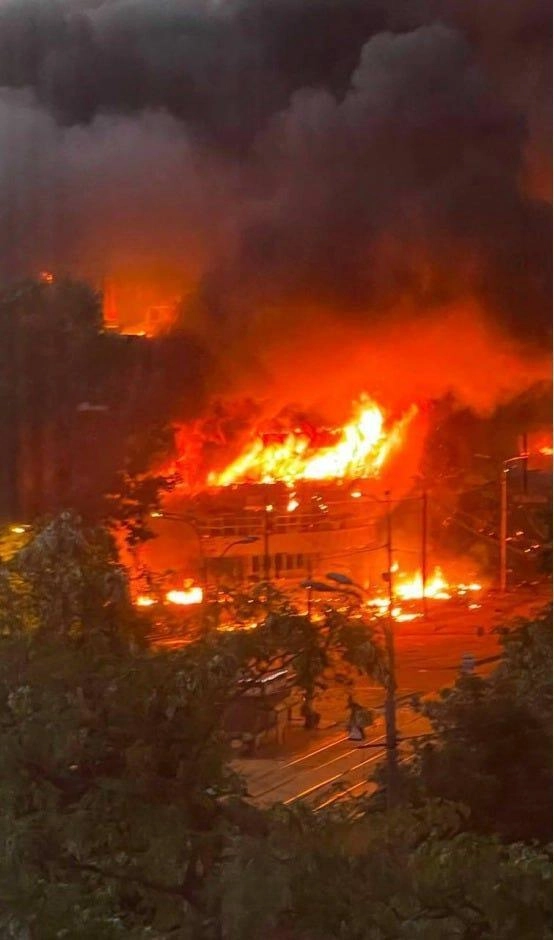
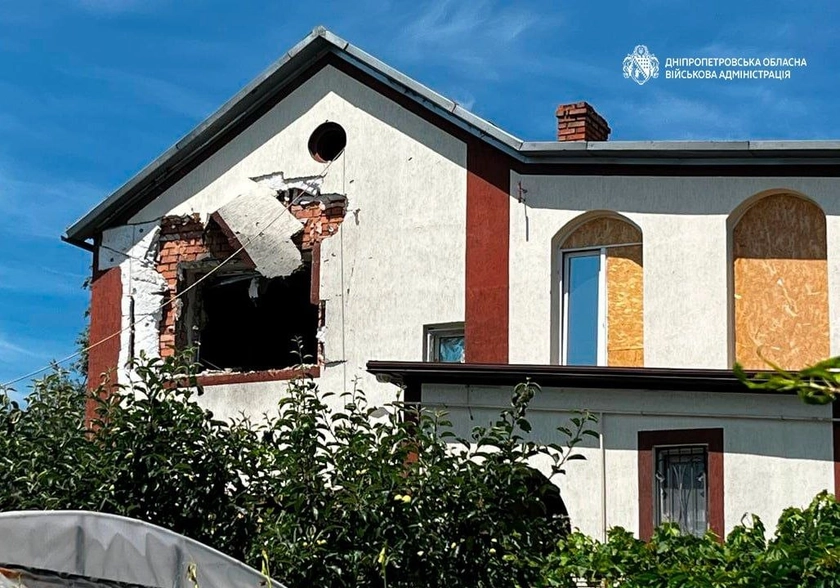
The Russians launched one of their IRBM Oreshnik missiles at Bila Tserka and another one – low chance but there is slight evidence – at Kyiv. No explosions, it looked like inert warheads punching holes in the ground. However, there’s a big air base by Bila Tserkiv, and it’s reasonable to assume the AFU flies fighters out of there sometimes. Reports are that some garages in Bila Tserkiv were set on fire. Drones hit apartment buildings in Cherkasy, Dnipro and Odesa.
The week finished with dark Kremlin promises that Russia will now bombard Kyiv into oblivion.
On Friday, reports came in that 2 Tu-160M strategic bombers were concentrating at the Ukrainka-Engels2 airfield in Samara region, MiG-31Ks with Kinzhals were collecting at Savasleika Airbase, Nizhny Novgorod Oblast. So another weekend strike seems possible.
Russian drones, again – over Izmail and Romania
On Thursday, the Russians carried out another strike against Izmail on the Danube, one Shahed crossed over into Romanian territory, hit an apartment building in the town of Galați, set the building on fire and injured two Romanian citizens.
In my day, in the Cold War, something like this would have triggered a decisive and unmistakable demonstration of NATO resolve, like full mobilization of all ground forces to go-to-war assembly areas next to East Germany, and deployment of air and missile assets to combat launch sites. It was OK in warm weather, but Germany is usually cold and wet. That was then.
These days, well, I’m sure in the coming days Brussels and Bucharest will come out, with some nice declaration about how blowing up Romanian citizens is bad, but since NATO eastern frontier defenses are already impregnable, no action needed.
Rant
And I say again, the way for NATO to stop this and protect NATO member state citizens is to use its military resources to intercept and destroy Russian missiles and drones flying over western Ukraine. Military and civilian officials in NATO countries opposing that are engaging in appeasement and professional negligence. If it goes to war, then it will be criminal appeasement and criminal negligence.
Ukraine already culls, on average, 90 percent of the aircraft approaching NATO’s eastern frontier. If NATO isn’t willing to do it as an alliance, then individual states need to do it unilaterally. It is a basic function of government to protect citizens. Romania, Poland, Slovakia and Hungary have radars, pilots, anti-aircraft systems, ground crew and fighter jets.
That is paid for by the citizens of those respective countries to protect taxpayers and their families. Air defense does not exist in Romania, Hungary, Slovakia and Poland, so that military service personnel in those countries can have nice, safe careers.
Two Romanian civilians were injured by a Russian drone in their home. This is an acid test to see where the Romanian government’s priorities are.
I will also repeat: This is a golden opportunity for NATO to develop tactics and equipment to handle drones, and if anyone wants to see what it looks like when national governments fail to do that, I direct your attention to the Gulf States and March.
It’s not Donald Trump that’s killing NATO, it’s official cowardice.
From a military point of view it is idiocy of the first order not to embrace the chance to defend national air space against a small but real Russian drone threat, so that if Russia ever contemplates a major attack, the Kremlin will do that knowing air defenses have a lot of practice against Russian drones, rather than the present situation, which is they would be surprised by them and for the most part incapable of coping with them.
Update from Brussels
“Secretary General Mark Rutte is in touch with Romanian authorities. We condemn Russia’s recklessness, and NATO will continue to strengthen our defenses against all threats, including drones.”
It’s not Donald Trump that’s killing NATO, it’s official cowardice. Every one of these highly-paid bureaucrats knows exactly how Adolf Hitler came to power, in their own d**n continent, which led to mass deaths and destruction in their own d**n countries.
I see zero resignations in protest, not by NATO senior officials, not by NATO senior officers, not by NATO mid-grade officers who swore to lead them.
What did we see? This week, on Wednesday, NATO’s great bulwark, the United States, announced it was reducing its presence in Europe because, well, that’s in America’s interest. Specifically, the number of fighter jets will be cut by one-third, also reduced will be numbers of strategic bombers, transport aircraft, and aerial refueling tankers committed to alliance obligations.
On the naval side, US submarines will cease participation in NATO operations. Also, the US will reduce its involvement in providing NATO with reconnaissance and strike drones.
The naval implication is less or more exactly possibly no more US submarines to monitor, track and deter Russian attack and missile subs operating out of Murmansk and Severomorsk on the Kola peninsula and less or more exactly no more US Global Hawk and E-3 Sentry reconnaissance flights along the NATO eastern frontier and over the Black Sea. These are unilateral cuts that were announced without consultation with allies.
The only possible way for Moscow to interpret NATO’s reaction to a Russian military strike inside NATO territory that blew up a NATO nation’s citizens’ homes and injured a NATO nation’s citizens hit by the explosions, as an open invitation to do it again, because America is cool with it. Which America may be, but it doesn’t excuse the criminal inaction of the rest of NATO, which is paid (well) to do a job.
Starobilsk messaging and targeting innocent “students”
The Russians said the heavy attack on Kyiv was retaliation for an “inhumane” strike the Ukrainians carried out against a “college” in the occupied city of Starobilsk, as a result of which 21 “children” died and 63 were injured.
Ukraine’s General Staff said it was a training center and headquarters used by the Russian drone unit Rubikon, which is the Russian military’s most effective drone unit.
Prior to the big Kyiv strike, Putin gathered a bunch of functionaries in a room in Moscow and gave a speech about the evil Ukrainian regime which, he said, had recently attacked a school and murdered dozens of children, and now Russia was going to retaliate.
He even led the group – I am not making this up – in a group cheer, “Urra!” Crowd participation looked a little unenthusiastic to me, but I’m jaded.
The facility in question, the “college,” is called Starobilsk College, a long-standing vocational school in the Luhansk region. The attack using FP-1/2 drones on May 21–22 hit a five-story dormitory, massively damaging upper floors and collapsing part of the structure.
Supposedly, 86 students were in the dormitory at the time.
In the old days, this narrative disconnect would have just been another case of he said/she said, but this is the 21st century, and the Ukrainians are very industrious when it comes to dredging up compromising evidence against Russia in the Russian media. So, effectively at the same time Putin was leading his toadies in rah rah exercises, the Ukrainian internet offered up Russian RT1 national television direct from Starobilsk College, aired about two months ago.
The subject covered and aired across all 13 of Russia’s time zones… wait for it… was the excellent drone pilot training and military drone pilot instructors at Starobilsk College. There was even some footage of a Russian Orthodox priest blessing pilot cadets in military uniforms, with Holy Water, that was aired on LPR TV. You can’t make this stuff up.
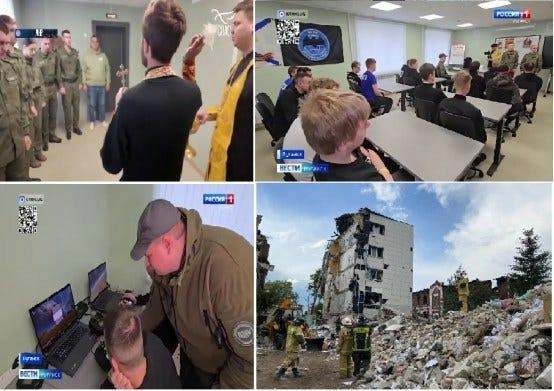
Predictably, post strike, the Russians bused in “Western” journalists (the likes of Reuters and CNN declined the offer) to Starobilsk to create images of the damage and interview “survivors and relatives” of the “children killed in the strike.”
I normally try to stay away from crossing others working in journalism, but here’s a profile on one of the “journalists” who came in from Moscow to churn out content:
Lu Yuguang (Chinese: 卢宇光 / Лу Юйгуан) is a veteran Chinese journalist and war correspondent for Phoenix TV (凤凰卫视). He is 64 and has reported from Donbas since 2022, and in the past from Syria and Chechnya. He has lived in Russia for decades, studied journalism at Moscow State University, and often reports in Russian. Phoenix TV is pro-Beijing biased and it follows directives from the CCP’s Central Propaganda Department.
On the other hand, the channel supposedly has 500 million viewers worldwide and is watched by 50 million Chinese households, so more reach than this review.

Ukraine bombarding Russia (besides mid-range)
Biletsky also said the bombardment campaign isn’t going in Russia’s favor as well. It’s becoming very obvious that the Ukrainians have no plans to level off; every week, they are hitting targets in Russia and Russia-controlled territory harder than the last week.
If someone had told me in May 2022 that four years later the Ukrainians would be at a pace where they’re carrying out 1–2 special long-range air attacks, 3–5 “generic” long-range air attacks, and dozens to low hundreds of medium-range strikes WEEK AFTER WEEK, I would have suggested that person have their head examined.
Obviously, the Russians would never be so stupid as to fight in Ukraine for four years, and even more obviously, those are capacities I would expect out of the likes of India or Pakistan, not little Ukraine.
The “middle-strike” attacks, first section, are the most obvious way the strikes are widening in ambition and destruction. The point of this section is that none of the other types of attacks have stopped, not in pace, not in destructiveness.
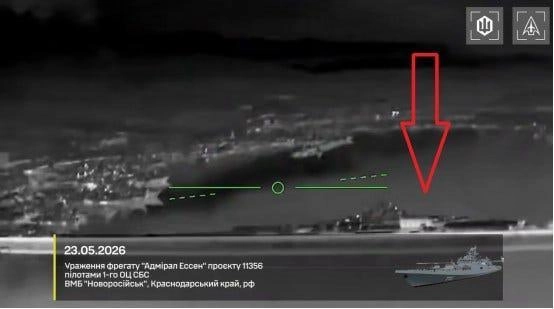
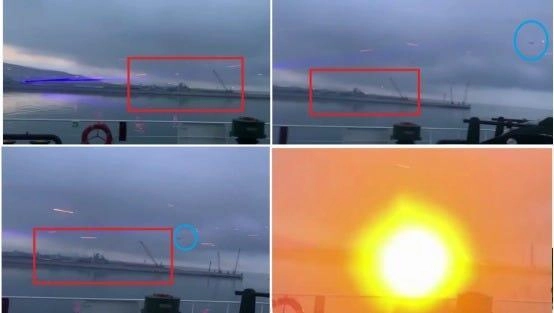
Possibly the most impressive attack was a strike that hit and, according to some reports, rendered combat ineffective the frigate Admiral Essen, a missile carrier, and a small missile hovercraft, not named publicly in Novorossiysk overnight between May 23 and 24. It was a standard complex operation involving HUR, the SSO and the SBS, with 9th Bn/414 USF “Madyar” carrying out the actual attacks on the warships.
Per the video, Essen was hit on the port beam near the deck. Three other drones attacked, results unclear. The Russian sailors returned fire with an Osa-M air defense system but scored no hits. In parallel with that strike, other drones struck the Tamanneftigaz oil terminal and set it on fire.
On May 25 at about 7 p.m. local, a salvo of British Storm Shadow missiles hit a headquarters in the Luhansk region, possibly in the Luhansk city satellite town Dovzhansk, and just possibly where elements of Russia’s 90th Tank Division are located.
The General Staff confirmed the strike, and Luhansk authorities are absolutely quiet; if you look at Luhansk’s official media, it never happened. So, really, there is no information about results, but as we know, the AFU launches Storm Shadows like Scrooge McDuck hands out lunch money.
Then, early morning the following day, another flight of Storm Shadows, most reports say a pair, hit Sevastopol in Crimea. One appears to have plowed into an administrative building of the Black Sea Fleet Air Force Headquarters on Gogolya Street. Another missile hit the Bank of Russia building, the Sevastopol branch. Moderate damage, four people injured.
Sevastopol authorities announced it was a victory because the bank remained functional. No mention of the hit on fleet headquarters.
According to the Ukrainian internet, one of the fleet HQ buildings was burnt out completely, right down to the basement. Russian troops roped off the scene, the police showed up, the security guys appeared riding in Tiger armored cars, and someone set up a satellite dish just like one does if one is a professional emergency manager. Local reports housing the entrance to the headquarters, but only the windows were broken.
Reportedly – this is not confirmed – ambulances were still running at 11 a.m. and “black bags” were observed being loaded into a Ural truck.
In the courtyard of the headquarters itself, large black bags were being placed in a Ural truck. These bags contained either belongings or documents, or those who were in the building when it was hit.
The General Staff on Wednesday announced it had launched Storm Shadows, hitting “Russian aerospace, reconnaissance and command automation systems” in Voronezh, Taganrog and Sevastopol (again) on Wednesday. Some photos of smoke rising in all three of those places appeared, but I can’t confirm much. Supposedly, the facilities help the Russian air force process targeting data and coordinate air strikes.
Then there were the “routine” strikes.
- May 23 – Shadow tanker hit in the Black Sea, oil refineries near Novorossiysk and in Vladimir set on fire;
- May 24 – Oil refineries set on fire in Belgorod and Yaroslav, plus once again the Unecha/Druzhba pipeline station got hit in the Bryansk region;
- May 25-26 – Military airfield near Voronezh, Aviation repair plant in Taganrog, Tuaspe oil refinery (yet again), Luhansk HQ (Storm Shadows),
- May 26-27 – Samara chemical factory, Krasnodar/Afipsky oil refinery (again),
- May 28 – Volgograd Lukoil refinery (10th time since 2024, possibly Flamingos used),
- May 29 – Yarslavl Oil refinery.
According to the Russians, the Wednesday strikes probably contained around 340 drones penetrating into Russia-controlled airspace, among which were 10 jet-propelled drones that flew in three streams. On Thursday, there were more than 300 drones, including jet-propelled ones.
This is already a scale of air operations. If we are honest, Western air forces would have to work hard to replicate as a one-off, and besides the Americans, Chinese and Russians, I can’t think of an air force on Earth that could maintain that pace of air operations, in an actual war, week after week.
Overnight from Wednesday to Thursday, three alleged Russian shadow tankers were hit by sea drones, all off Turkey’s southern Black Sea shore in international waters about 75 km (47 miles) offshore. One was the James II (Palau), in ballast, 20 crew, hit in the engine room. At least one drone didn’t detonate and jammed under the stern of the tanker. No injuries. Yes, the ship is sanctioned. Explosions audible in Istanbul. Turkish coast guard on the scene.
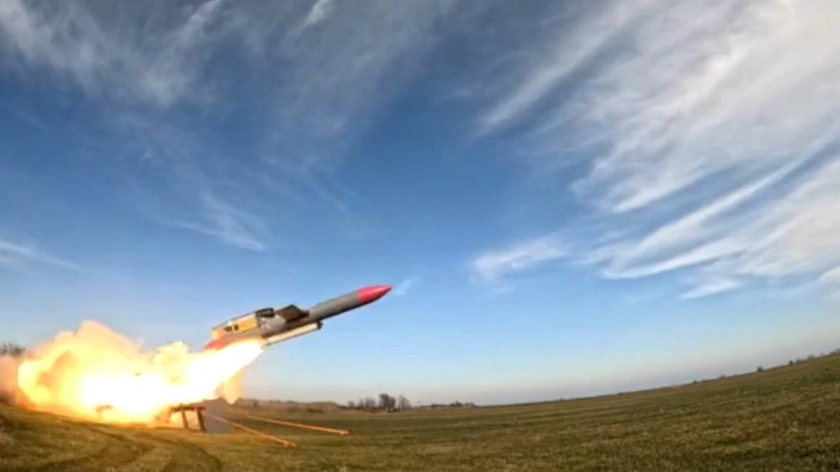
In drone tech news, the chief designer of the Fire Point company Denis Shtilerman was on the news on Tuesday and announced that the workhorse Ukrainian attack drone FP-2 is still being upgraded and the next one is increased warhead weight of 200 kg (440 pounds) (from 50-100 kg or 110-220 pounds) and a (reduced) range of up to 370 km (230 miles).
Gripen!
It’s an indicator of how much news an actual large-scale conventional war produces in a week that an arms deal like the following is almost an afterthought.
It’s official: Ukraine is getting 16 Gripen fighter jets donated by Sweden, and another 20 bought with European funding; first deliveries expected by late 2026 or early 2027.
Pilots are already training. Many expected this. President Volodymyr Zelensky said the Gripens will be equipped with the Aster missile, which, in theory, has the range to push most Russian glide bombers out of attack range.
Training of Ukrainian pilots and technicians is already underway (if you read this review, you already knew that) and will be “significantly expanded” this fall. I interpret that to mean that, this fall, the air crews and ground crews will stop training individually and start training together.
Under normal circumstances, the work-up from there would ideally be six months. In war, it should be faster.
Details on the deal you can read about here.
Zelensky, in speeches, made much of the fact that, along with IRIS-T and AMRAAM air-to-air missiles, which the Ukrainian air force already has, the Gripens will come equipped with long-range Meteor missiles. He suggested that the long range (150–200 km, on paper; 93-124 miles) would make it difficult or impossible for Russia to continue glide bombing Ukrainian forward positions, with glide bombs that fly 100-150 km (62-93 miles) perhaps.
Or perhaps Zelensky just mentioned Meteor, because the potential presence of it would supposedly be enough to push back the Russian bombers? We’ll see on that.
Zelensky also said that this donation/sale would go far towards getting the Ukrainian air force to its objective 150–200 modern fighters needed to protect national airspace against most Russian attacks.
Probably, right now, the Ukrainian air force can put into the air 30 or just maybe 40 fighters at a given time, a ragged mix of F-16s, Su-27s, Mirage 2000Fs, and MiG-29s – all of which are at least 30 years older than the best Russian fighters.
Gripen, on the other hand, is comparable, and the latest versions of the Gripen, which Sweden is just receiving itself, are at least as good as the best Russian fighters and in some aspects more capable. However, Saab produces Gripens at about two airframes a month right now, and “hopes” to push that to three.
An obscure tactical/organizational factoid only AFU fans will care about
On Thursday, reports appeared that Ukraine’s 7th Rapid Reaction Corps of the Air Assault Forces received an M142 HIMARS system for its 147th Separate Artillery Brigade, and said the system has already been used in combat, destroying several Russian guns during counterbattery fire. This is from a 7th Corps official announcement.
Ho-hum, right? HIMARS has been a thing in the AFU since summer 2023, so who cares about this?
This is the thing: Up until now, open sources, HIMARS and its armored big brother M270 ALWAYS were assets controlled and operated by independent rocket artillery brigades which, in turn, got their missions and targets directly from the General Staff.
This is a hard example of the AFU pushing a valuable strike asset down the chain of command, and the only reason – remember, Syrsky is a commander who prefers to control the powerful assets directly – can be a decision that more Russian stuff will get blown up faster, if it’s the field corps rather than Kyiv HQ picking out targets for HIMARS. At least in the case of the 7th Corps, which is one of the high-performing corps.
In other words, this is another little, but real sign that the AFU is maturing.
Bezimminne
This item can be skipped by those wanting important news and is included for the benefit of readers who worked in SE Donetsk Ukraine during the “ceasefire” period when there was all that shooting.
A news report came down the pike on Wednesday that a Russian military base in the Azov shore settlement of Bezimmene was severely hit by either drones or missiles, and according to the unconfirmed report, up to 40 Russian service personnel were killed.
This is a notorious site that started out life in the 2000s as a nice seaside resort facility that was taken over by the Russian army in 2014-15, and used during the 2015-21 “ceasefire” period as a base for uniformed Russian service personnel to live, in the capacity of “independent monitors” of the security situation in the region.
You had to go through all sorts of permits and request letters to be allowed to visit the base, but sometimes you could just show up if something had been blown up in the vicinity, you know, as a result of the “ceasefire” not really being a “ceasefire.”
I remember the officers there were sort of jerks, but also they seemed more interested in doing BBQ and enjoying the usually nice weather rather than actually working as monitors.
Anyway, as of Wednesday, the site is supposedly gutted and no longer usable.
Ukrainian journalist murdered in Russian prison
I bet this doesn’t make the Western mainstream.
Per testimony in Ukraine’s parliament on Wednesday, Ukrainian journalist Viktoria Roshchina died in Russian captivity because a warder smashed the side of her head and broke her occipital bone. The Ukrainian police came to this conclusion after coroners looked at her remains.
Roshchina died on Sept. 19, 2024, a week after her arrival at the Kizel pretrial detention center in Perm in central Russia. She was 27 when she died. As a reporter, she worked for Ukrainska Pravda, Homadske and Radio Free Europe/Radio Liberty – all solid publications.
Roshchina disappeared in the occupied Zaporizhzhia region while doing reporting work near the Dnipro River flood plain and Zaporizhzhia Nuclear Power Plant. Nearly a year later, in May 2024, Russian authorities acknowledged she was being held in Taganrog’s Pretrial Detention Center №2, cell №124, without hot water. Meals were on a three-minute restriction. Prisoners were forbidden to sit or lie down during the day.
At some point later in 2024, authorities transferred her to a detention center in Perm, historically a territory settled by state prisoners. Perm is a Ural Mountain region roughly as far north as the Outer Hebrides or the Yukon territory. In October 2024, authorities reported she had died in custody and in April 2025, her body was returned to her family.
The corpse’s internal organs were removed and the head was shaved. Coroners found Roshchina’s remains were missing eyeballs and brain. Her thyroid bone and one rib were also broken. There were burn marks consistent with electric shocks on her feet, and abrasions and bruising consistent with beatings on her hips, head and elsewhere.
The funeral was held in August.

The views expressed in this opinion article are the author’s and not necessarily those of Kyiv Post.
You can also highlight the text and press Ctrl + Enter