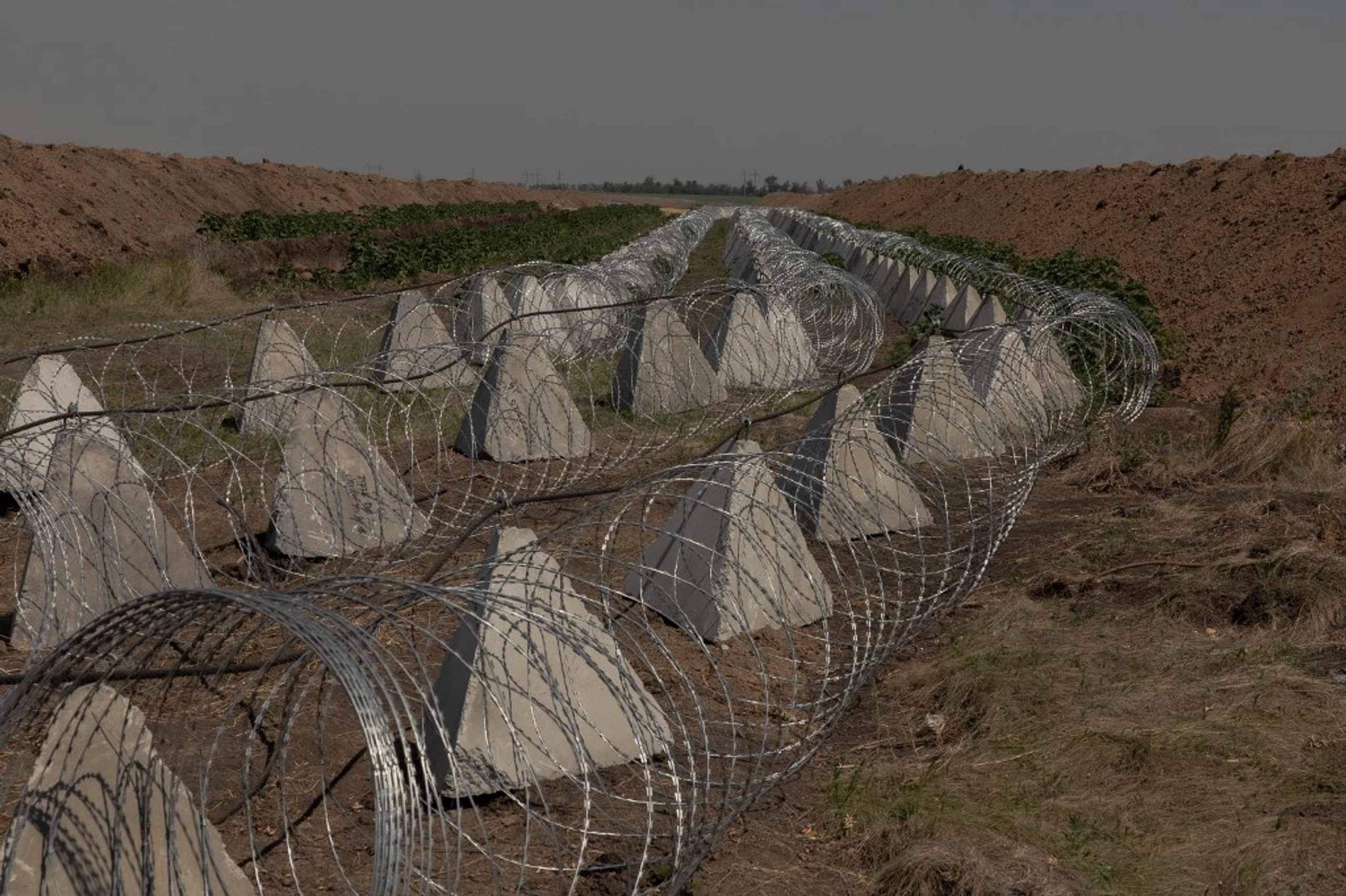
Ukrainian border guards and engineers in the Chernihiv region have been building a defense line along the border, designed to meet any possible “surprise” from Belarus, turning forests and marshes into a layered barrier of wire, ditches, and anti-tank concrete.
Ukrinform spoke directly with the border post commander Yevhen, callsign “Nissan,” from the State Border Guard Service of Ukraine, in an on-site interview near the Ukrainian-Belarusian border in the Chernihiv region.
JOIN US ON TELEGRAM
Follow our coverage of the war on the @Kyivpost_official.
“Engineering barriers consist of a complex of artificial and natural obstacles,” Nissan explained. “Artificial ones are low-visibility wire obstacles and ‘Egoza’ [registered trademark for a highly durable type of reinforced razor wire]. Natural ones are forest blockages,” he added.
“We use nature as an ally,” Nissan said. “A tree can be cut so that it falls at a certain angle and stays half-sawn. It simultaneously stands, overhangs, and seriously complicates movement for vehicles and infantry.”
Dragon’s teeth anti-tank barriers
“Dragon’s teeth” are concrete barriers that weigh around 1.5 tons, and are about 10 meters (33 feet) wide, designed to block likely routes for armored vehicles. In the Chernihiv region, they have been placed alongside the forest edge. Behind them, Ukrinform reports, lie deep anti-tank ditches with steep vertical walls – the result of weeks of excavator work in heavy, waterlogged soil.

What the 30th Anniversary of Ukraine’s Constitution Means in a Nation at War
Much of the defense system, however, remains almost invisible.
Thin, strong wire is strung low between the trees as a low-visibility obstacle, while belts of “Egoza” razor wire form continuous traps for soldiers and a critical hazard for vehicles.
Nissan notes that the local terrain helps greatly – dense forest limits enemy aerial reconnaissance, and off-road heavy equipment tends to bog down in the marshes, even as those same conditions make construction more demanding.
Building the border since 2022
The commander notes that they haven’t stopped building the defense layer since Russia’s initial advance through the area in 2022, when war had just begun.
“The build-up of engineering infrastructure goes on constantly,” Nissan said. “Compared to the first months after de-occupation, volumes have increased by about 500%. It’s a continuous, echeloned system that stretches for kilometers along all our land borders,” he added, explaining that there can’t be too many obstacles.
“To be sure 100% that even a bird will not fly through is impossible,” Nissan said. “But we are ready for any development.”
Behind those figures lies the daily work of digging and wiring. One excavator cuts up to about 200 meters (656 feet) of anti-tank ditch per day, depending on bucket size, and two soldiers can lay about 100 meters (328 feet) of “Egoza” wire in roughly four hours, with ten soldiers closing up to a kilometer in the same time.
On average, as per the report, a unit can prepare around 500 meters of reliable barrier in a day.
Local support and harsh conditions
Local authorities and communities support the effort with coordination and machinery, Nissan says, describing the interaction as smooth-going, with village elders and community leaders helping with equipment and logistics. Still, the construction is mainly dependent on military personnel.
“We cannot cover absolutely everything on our own,” said Nissan. “The locals are our eyes and ears,” he added, explaining that their help is very valuable. “This allows you to get advanced information,” if “they heard something somewhere, saw a stranger or a suspicious car – they immediately report.”
However, the hardest factor is not the resources, but the weather – during the winter time, frozen Polesia ground means every meter of ditch or wire is done in punishing conditions. Through the summer, “we stand in T-shirts and sneakers,to build comfortably” Nissan said, but “in winter, when the temperature drops to minus thirty degrees,” turning work into a genuine test.
Designed to slow, fix and destroy
Nevertheless, any barrier can be overcomed or bypassed, as the obstacles are not meant to destroy the enemy but to force them into slowing down. For this reason, the Ukrainian forces employ a three-step logic – delay, slow, and then destroy.
“When the enemy has to stop and waste precious time, that time works in our favor,” Nissan said, adding that the obstacles make it possible for Ukrainian forces to gain an ideal target for artillery or other fire.
“If a tank drives into them [low-visibility wire obstacles], the wire instantly winds onto the tracks, blocks rollers and mechanisms, and then the machine no longer moves. It becomes a stationary box.”
Drones and mutual watching on the border
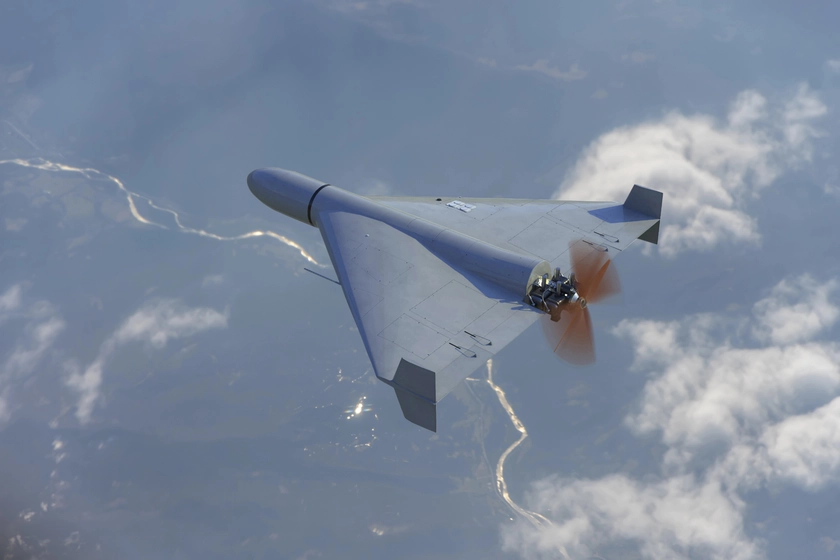
The main aerial threats are not first-person-view (FPV) strike drones that are typical along the front, but Shahed-type and Gerber attack drones that combine strike and reconnaissance functions. Anti-drone netting over roads is therefore less common than in frontline areas.
According to Nissan, these drones often fly along the border or in from Russia’s Bryansk region, but do not usually cross directly from Belarusian airspace.
On both sides of the frontier, cameras and reconnaissance unmanned aerial vehicles (UAVs) remain near the treeline. Reportedly, Ukrainian units observe the Belarusian side to the necessary tactical depth without crossing into its airspace, while Belarusian forces do the same.
“Both sides are watching one another,” Nissan said, describing a tense reality of neither peace nor open war.
No recent provocations from Belarus, but no confirmed safety either
For now, there are no signs of major enemy troop build-ups or any new movements on this part of the border. The State Border Guard Service spokesman said there are no strike groups ready for an incursion.
“There are currently no provocations by the Republic of Belarus,” Nissan confirmed, although he noted that Belarusian forces are also reinforcing their own barriers.
While there were “no clashes,” he added that the situation changes day by day. “There is nothing static here.”
Ukrinform reports that, despite the silence along the border, the Kremlin is still pressuring Minsk. Reportedly, Moscow is demanding permission from the Belarusian leader Alexander Lukashenko to use Belarusian territory for strikes with drones, with the aim of expanding the front and involving Belarusian units in direct participation.
“All previous miscalculations, shortcomings and errors in the assessment are taken into account,” Nissan said, adding that “there will certainly be no such a surprise effect as in 2022.”
A broader wave of border fortifications
Earlier, Latvia began installing concrete “dragon’s teeth” anti-tank barriers along its border with Russia, as part of the joint Baltic Defense Line, while Estonia has followed suit by installing similar obstacles.
In June, Estonia placed its first modular reinforced concrete public shelter in Tallinn as well, aimed at improving civilian protection after Russian drones have increasingly begun entering NATO’s airspace.
In May, a Russian drone crossed into NATO-member Romania’s airspace during overnight attacks on Ukraine, crashing into an apartment building in the city of Galați, triggering a fire and injuring two civilians.
You can also highlight the text and press Ctrl + Enter