Russia’s destruction of culture and historical sites is now well documented. From the historicthousand-year-old Lavra to the bombing of publishing houses and churches, the attacksagainst Ukraine’s heritage are numbing.
What is less covered by the international media is the extensive damage to scientificinfrastructure. Science may not attract as much attention as culture because its facilities arerarely the repository of centuries of art and history. Yet it is through its scientific institutionsthat a nation maintains its contribution to wider scientific advances from fundamentalknowledge to useful applications in physics, medicine and other fields that improve thequality of life that we all enjoy.
JOIN US ON TELEGRAM
Follow our coverage of the war on the @Kyivpost_official.
Attacking scientific institutions is as much an assault on human dignity and the light ofcivilization as the assault on cultural sites.
The O.V. Palladin Institute of Biochemistry belongs to the National Academy of Sciences ofUkraine. It is one of the oldest research institutes founded in 1925 in Kharkiv byAcademician Oleksandr Palladin. It moved to Kyiv in 1931. Palladin, like another one ofUkraine’s scientific stars, Volodymyr Vernadsky, was both a scientist and a pioneer ininstitutional arrangements.
Palladin carried out foundational studies on muscles and the nervous system, a legacywhich continues to motivate much of what his eponymous institute studies today. Heuncovered new knowledge about vitamins. Following the Second World War, he became thepresident of what was then the Academy of Sciences of the Ukrainian SSR and he helpedrebuild Ukrainian scientific institutions after the war.
Europe’s Unsanctionable Stupidity
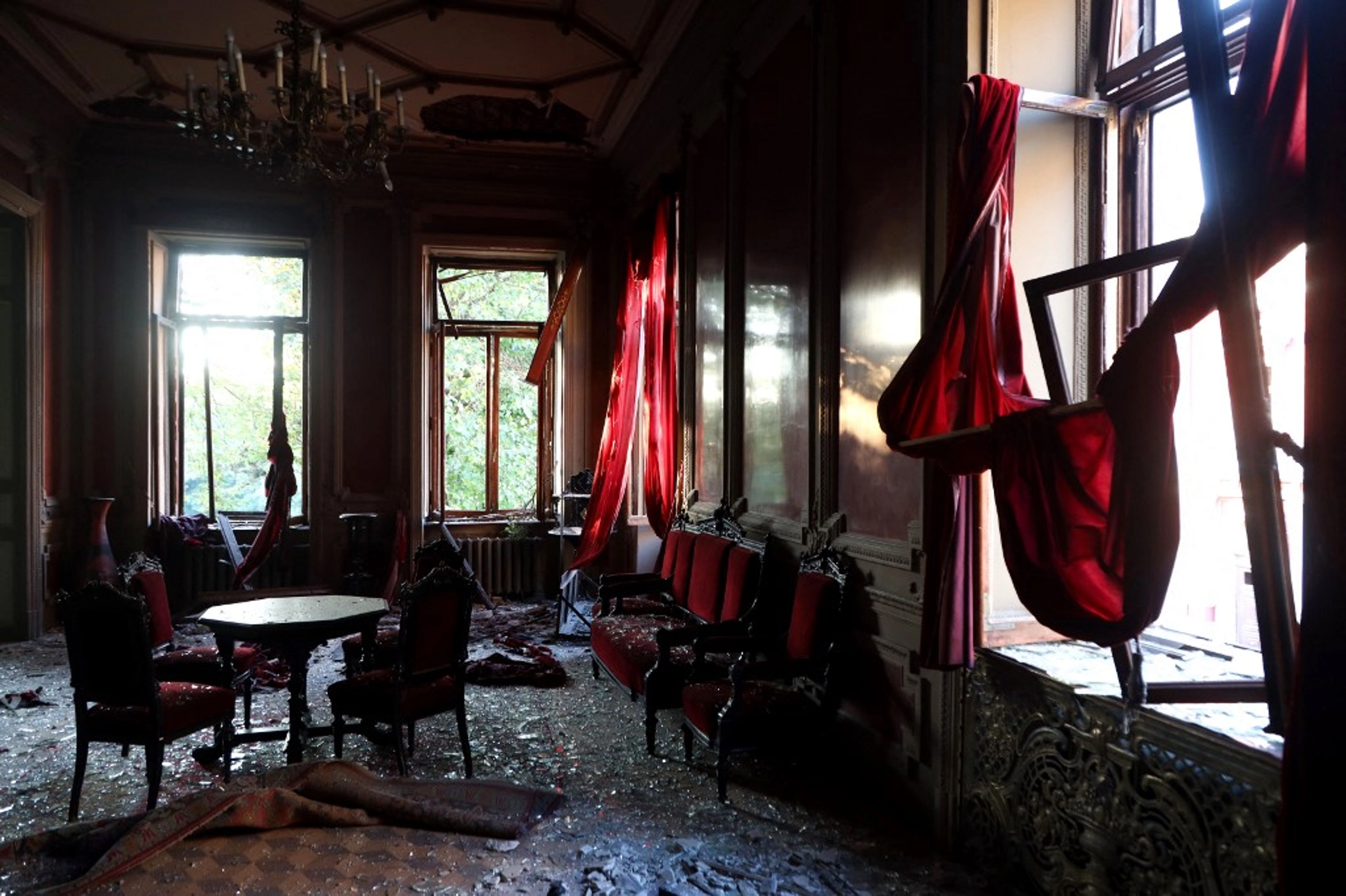
The damage to his institute is more than symbolic. Whether the missile was aimed at theinstitute or whether it was collateral damage is beside the point. The wrecking of an instituteestablished by one of Ukraine’s finest scientists, and ironically, a person who helped buildscience back after Nazi destruction – the last time Ukrainian science came underwidespread attack – is an emblem of the pointless barbarism of this war.
Since the start of Russia’s full-scale invasion, UNESCO estimates that over 1,400 buildingsacross Ukraine housing scientific work have been destroyed or damaged, belonging to over150 scientific organizations. From astronomical observatories to biological laboratories,bombs do not respect scientific boundaries. Wartime destruction to science is a thoroughlyinterdisciplinary affair.
The human cost has been vast. Over 10,000 scientists have left Ukraine, just over 10% ofUkraine’s pre-war core scientific population. Many scientists have joined the Armed Forcesof Ukraine (AFU) and a proportion have given their lives. There is no institution acrossUkraine that does not mourn the loss of staff and students.
Away from the battlefield, attacks on civilians have claimed the lives of the talented. In theearly hours of Jan. 1, 2025, cancer biologist Olesia Sokur and neurobiologist Ihor Zyma, amarried couple, both of whom worked at the Institute of Biology and Medicine of TarasShevchenko National University of Kyiv (KNU), were killed in their apartment when dronedebris fell through their roof. Ihor was also a well-known popularizer of science. The couplehad already lost their foster son on the battlefield in 2022. They are just two of the manyscientists and students who have been killed.
Rebuilding Ukraine’s scientific capacity
The world, of course, must commit itself to ending this war by defending Ukraine, but it mustalso take on the responsibility of building and restoring Ukraine’s scientific capacity. Theestimated cost of reconstruction is well over $1 billion, but money isn’t the only requirement.Moral and intellectual support to maintain Ukrainian science is needed. Above all, theintegration of Ukrainian science into European and other global collaborations will acceleratethe restoration of its scientific institutions and the building of new scientific enterprises.
Like the proverbial Phoenix, there is no reason that Ukrainian science cannot emerge fromthis fire stronger than ever. Sitting at the eastern edge of the Euro-Atlantic world, the westernedge of an Asian world in which science is rapidly blossoming into global significance inplaces like India and China, and as a conduit to the global south, Ukraine’s geographicalposition places it in a powerful location as a scientific cross-roads of the world. In its widestsense, civilization benefits from a scientifically strong Ukraine.
The damage done to Ukrainian science is of course a tragedy for Ukrainian scientists, but itis also a catastrophe for the Russian people. There are undeniably powerful strands ofscientific heritage that emerged during Soviet times which Ukraine led, from biochemistry tocybernetics and aviation. The best way to peacefully disassemble an empire is to take pridein that collaboration and, through mutual respect, to be enduringly recognized as havingcontributed at least something significant to Ukrainian science.
Having damaged or destroyed many of Ukraine’s key scientific institutions and caused aterrible human toll, that sense of a contribution is largely erased. Ukraine’s science willhenceforth emerge in antagonism to past efforts. That is an historic disaster and lostopportunity for Russia.
Despite the devastation, Ukrainian science remains undaunted and strong. Ukraine’syoungest scientists carry enormous creativity, imagination, aspiration and ability. It isessential that other countries do not see the current situation as an opportunity to snatchUkraine’s best. Even if they provide scientist emigrants with temporary shelter, it isincumbent on the hosts to help build Ukrainian science by encouraging those who left toreturn and build the scientific infrastructure of the country.
Joining the EU, or its scientific programs, would undoubtedly help Ukraine obtain funding tobuild scientific institutions, but Europe should not wait for this to happen before offeringsupport for refurbishment and scientific equipment.
Although the damage to institutions is extensive, the network of scientific minds andorganizations in Ukraine remains, and will continue to remain, extensive and rich. Nomissiles or bombs can lighten or diminish the inspiration that Palladin, Vernadsky, andothers evoke.
It was Vernadsky who described the idea of the “noosphere,” a new state of the planet inwhich human rational thought, science, and technology would become the primary forcesshaping the future of the planet and our civilization. In the current situation, his inspiring ideahas gained more relevance, poignancy and wisdom than it ever had.
Today, it remains a vision to which we should direct our scientific efforts if we are to beremembered by the future as creators of knowledge and not the destroyers of globalscientific potential.
The views expressed in this opinion article are the author’s and not necessarily those of KyivPost.
You can also highlight the text and press Ctrl + Enter