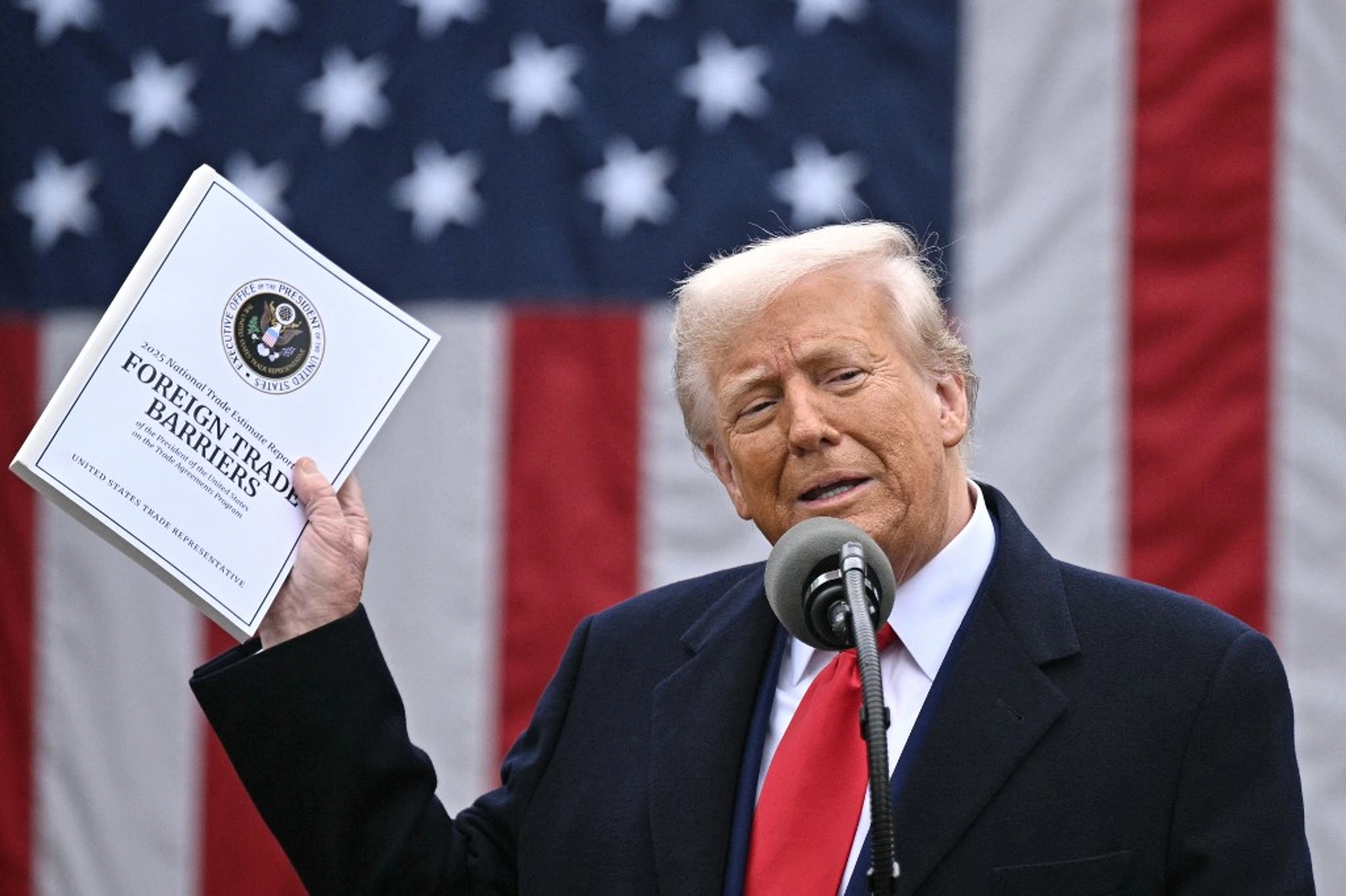
US President Donald Trump on Wednesday announced the most sweeping tariffs of his administration so far, including levies that exceed 30% on Asian economies such as China, Taiwan, Vietnam and Thailand.
The tariffs will be two-tiered. First, there will be a 10% baseline tariff on all countries. A higher reciprocal tariff will be charged on roughly 60 countries – those with which the US has the largest trade deficits. For instance, China’s total tariffs against the US were calculated by Trump’s team to be 67%, so the new tariffs would be half that at 34%.
JOIN US ON TELEGRAM
Follow our coverage of the war on the @Kyivpost_official.
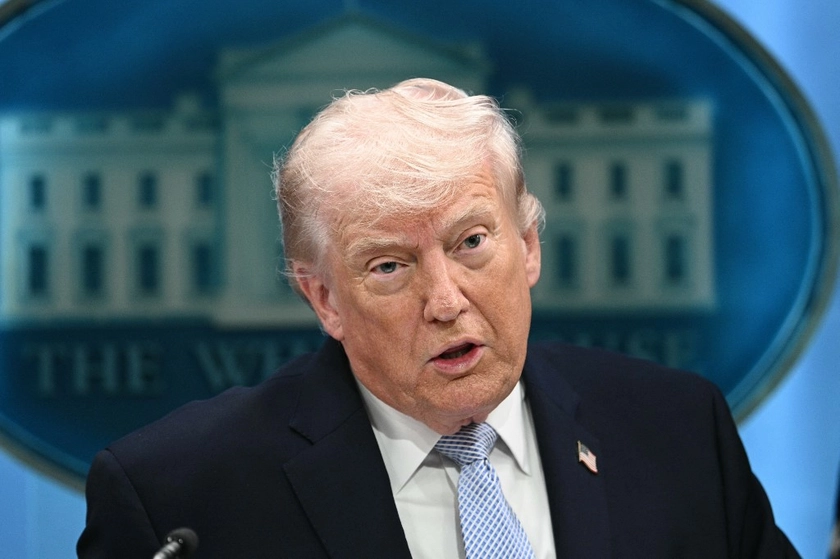
In a media event in the Rose Garden of the White House, Trump declared it to be “Liberation Day in America,” and held up a chart with the reciprocal tariffs, including 32% on Taiwan, 24% on Japan and 25% on South Korea.
Trump said Wednesday would be remembered as “the day American industry was reborn, the day America’s destiny was reclaimed and the day we began to make America wealthy again.” For decades, the US has been plundered by friend and foe alike, he said. “Foreign leaders have stolen our jobs, foreign cheaters have ransacked our factories, and foreign scavengers have torn apart our once beautiful American dream.”
The baseline tariffs go into effect at 12:01 a.m. EDT on Saturday, while the higher reciprocal tariffs go into effect at 12:01 a.m. on April 9. Many on the list were Asian economies, including Cambodia and Vietnam, which were slapped 49% and 46%, respectively.
Syrsky: Russian Maps Show False Advances to Please Top Command
European Commission president Ursula von der Leyen said the EU was “prepared to respond” to the US president’s new 20% levy on the bloc. She said the world will “massively suffer” from the tariffs, the FT reported.
While UK Prime Minister Keir Starmer tells business chiefs in Downing Street that “clearly there will be an economic impact” from Trump’s tariffs – but the government will respond with “cool and calm heads.”
The Trump administration notably did not include Russia on an expansive list of countries that will face major new tariffs, Reuters noted. Ukraine was slapped with a 10% levy, according to a fact sheet released by the White House. Trump has expressed frustration with Ukrainian President Volodymyr Zelensky, who he said was trying to renegotiate a minerals deal.
The sweeping tariffs extend to countries and territories across the world – including the uninhabited Heard and McDonald Islands in the sub-Antarctic Indian Ocean. The remote UNESCO World Heritage-listed Australian territory, which features a mostly barren landscape, was included in the list of baseline 10% taxes on US imports, along with mainland Australia.
The Heard and McDonald Islands were included because they are Australian territory, according to a White House official. This region that features the only volcanically active subantarctic islands is “teeming” with colonies of seals, penguins and other birds, according to an Australian Antarctic Program post. Humans need a permit to visit the Heard and McDonald Islands, which are more than 2,000 miles southwest of Perth, Western Australia. It takes two weeks to sail from the Australian mainland.
Another region with no permanent human population on Trump’s list is the volcanic island of Jan Mayen in the Arctic Ocean. It’s collectively designated with Svalbard, an archipelago with polar bears and a small human population some 580 miles north of north of Tromsø, Norway.
In Asia, major stock indexes have fallen in morning trading as concerns grow over the threat of a global trade war. Stock markets in mainland China have just opened with the Shanghai Composite index trading broadly flat, while Hong Kong’s Hang Seng is down by 1.2%. The Nikkei 225 in Tokyo is down by 2.9%, the Kospi in South Korea is down by 1.7%, and Australia’s ASX 200 is around 1.2% lower. Futures tied to the Dow Jones Industrial Average were down by around 800 points, or 1.8%, while S&P futures fell 2.7%, and the tech-heavy Nasdaq 100 futures were 3.3% lower.
Initial reactions from the US business sector were mixed. Gary Shapiro, CEO and vice chair of the Consumer Technology Association, said he was concerned the sweeping tariffs will result in “massive tax hikes on Americans that will drive inflation, kill jobs on Main Street, and may cause a recession for the US economy.” He pointed out that “this will not be a golden age – but a return to the global economic catastrophe of the Smoot-Hawley tariffs of the 1930s that will disproportionately hurt low-income and hardworking Americans.”
David French, executive vice president of government relations for National Retail Federation, echoed those concerns. “More tariffs equal more anxiety and uncertainty for American businesses and consumers. While leaders in Washington may not care about higher prices, hardworking American families do,” he said.
“Even more so, the immediate implementation of these tariffs is a massive undertaking and requires both advance notice and substantial preparation by the millions of US businesses that will be directly impacted,” Nikkei Asia reported.
This summary is reprinted from the author’s World Briefing blog. See the original here.
You can also highlight the text and press Ctrl + Enter