





Key Takeaways from the ISW:
- The United States and Ukraine signed a bilateral economic partnership agreement on April 30.
- Russian officials continue to demand full Ukrainian capitulation as the sole basis on which Russia is willing to accept a future peace agreement.
- Peskov overinflated Russia’s current military strength and battlefield victories thus far in the war in an attempt to justify Russia’s continued unwillingness to make territorial concessions.
- Russian officials continue to call for the cessation of Western aid to Ukraine as part of efforts to reintensify offensive operations when Ukraine’s defense capabilities are weakened.
- Senior Russian officials continue claim that Russia is open to diplomacy to end the war while rejecting US and Ukrainian ceasefire proposals that would allow for formal peace negotiations to begin.
- Russian officials continue to falsely portray European efforts to increase their own defense capabilities – in line with US President Donald Trump’s objective to have Europe shoulder more of the burden for collective security - as a threat to Russian national security, likely to support Russian efforts to justify future Russian aggression against NATO.
- North Korea and Russia continue to enhance bilateral cooperation, particularly in the military and labor spheres.
- Ukrainian sources continue to report on cases of Russian commanders ordering their subordinates to execute Ukrainian prisoners of war (POWs) in violation of international law.
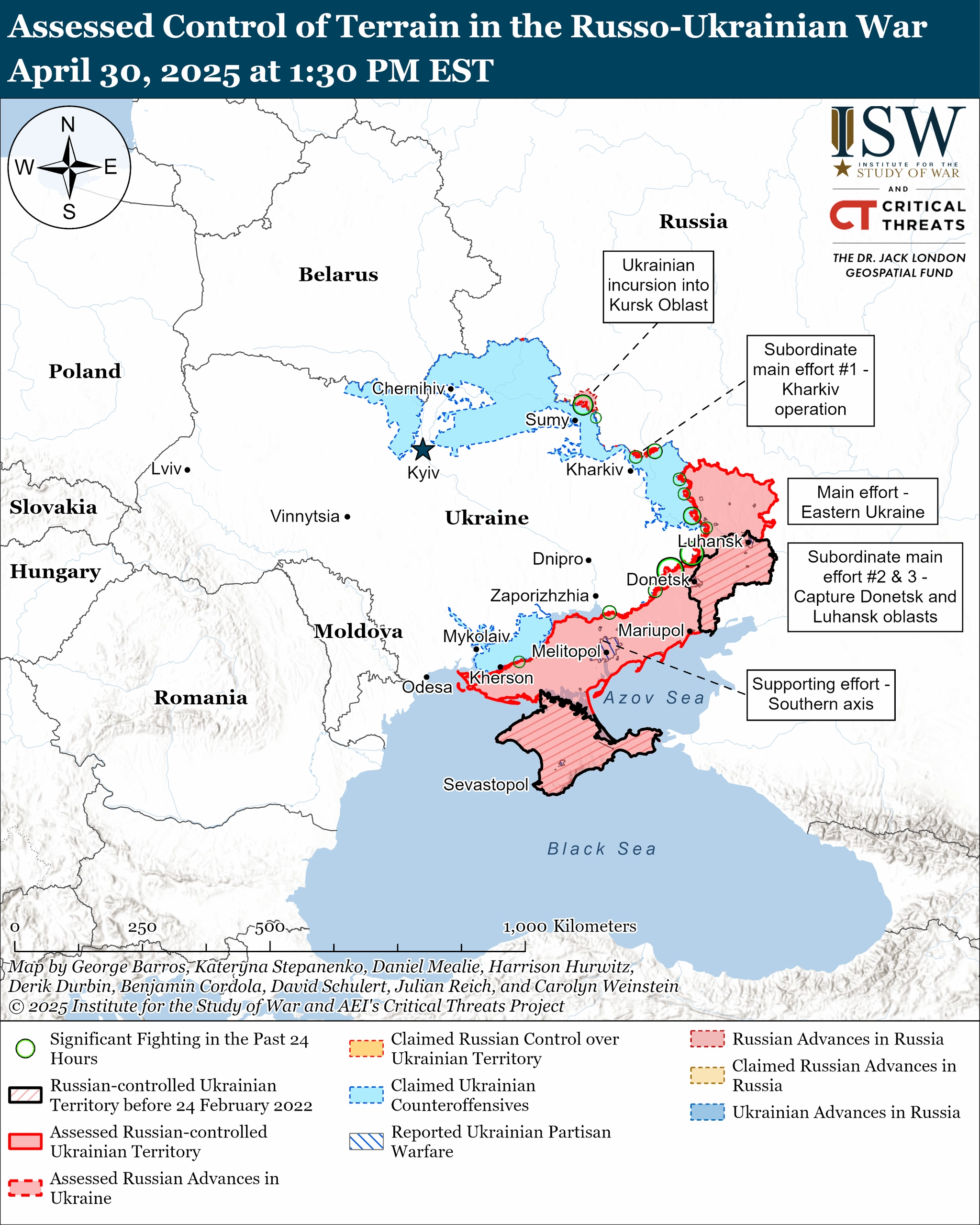
- Ukrainian forces recently advanced in Kursk Oblast and near Toretsk. Russian forces recently advanced near Lyman and Toretsk.
JOIN US ON TELEGRAM
Follow our coverage of the war on the @Kyivpost_official.
Authors: Daria Novikov, Nicole Wolkov, Olivia Gibson, Davit Gasparyan, and George Barros with William Runkel.
See the original here.
To suggest a correction or clarification, write to us here
You can also highlight the text and press Ctrl + Enter
You can also highlight the text and press Ctrl + Enter

ANALYSIS: Why Ukraine has Abandoned Four Years of Caution over Belarus
Ukraine has issued a public ultimatum to Belarus, demanding the removal of relay equipment used to guide Russian drone strikes.
June 28, 2026