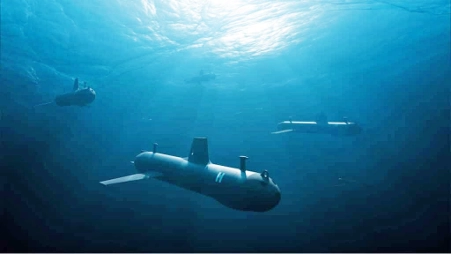
The UK’s Royal Navy is preparing to launch hundreds of underwater drones armed with artificial intelligence (AI) to detect Russian submarines and protect critical offshore infrastructure.
According to the Times, these autonomous gliders – described as a “constellation” of underwater sensors – are part of the new Lura system, developed by European defense company Helsing.
JOIN US ON TELEGRAM
Follow our coverage of the war on the @Kyivpost_official.
The drones will silently patrol the ocean for up to three months, detecting and identifying enemy vessels by their unique acoustic signatures in real time.
The system is based on a classified archive of submarine sounds collected over 56 years by Royal Navy sonar operators. Lura uses this data to distinguish between different types of ships and even different vessels of the same class, according to the report.
“Lura detects so our navies can deter,” Gundbert Scherf, co-founder of Helsing said. “We must harness new technologies to keep pace with the threats against our critical infrastructure, national waters and way of life.”
“Deploying AI to the edge of underwater constellations will illuminate the oceans and deter our adversaries,” he added.
The drones will be equipped with advanced sensors, but are small and silent, gliding through the water without the use of propellers.
Gould said the system was designed to work with SG-1 Fathom underwater gliders, originally developed by Helsing’s partner Blue Ocean to track whale migration and monitor underwater environments.

Polish Defense Ministry Admits Using AI on Minister’s Photo

“They are perfect for hunting submarines because it hasn’t got a propeller and they glide through the water,” said Amelia Gould, former Royal Navy weapons engineering officer and now maritime lead at Helsing. “Lura... will only get better the longer it’s deployed.”
By feeding acoustic data into Lura, the Royal Navy can dramatically cut the time needed to identify threats, speeding up defensive reactions and making it harder for Russian subs to sneak close to UK shores or undersea cables.
“One on its own can’t do much, but the fact is they are so cheap and simple you can throw hundreds or thousands of these in the water,” Niall Cartwright, Helsing’s lead technology expert said.
“When they hear something – a Russian submarine or something doing an unusual activity - they pop up and report that back. The enemy will think twice about coming through,” he added.
The drones could be deployed across key choke points like the “GIUK gap” – the area between Greenland, Iceland, and the UK that’s vital for naval traffic – to monitor suspicious movement, the report adds.
Helsing hopes Lura will soon become a standard part of the Royal Navy’s surveillance and defense strategy, turning Britain’s undersea domain into a hostile zone for any intruding submarine.
How the system works
- Silent Patrol: These gliders remain underwater, drifting quietly through the ocean without propellers. This makes them hard to detect and energy efficient.
- Listening for Trouble: While submerged, they use acoustic sensors to listen for sounds that might indicate the presence of a submarine or other suspicious activity. Each vessel, including submarines, has a unique acoustic “signature” that the gliders are trained to recognize.
- Reporting Back: If a glider detects something unusual, such as the noise of a Russian submarine, it rises to the surface and sends that information back to command. This alert can trigger further monitoring or defensive action.
By deploying hundreds of these gliders, the Royal Navy hopes to create a network of underwater “ears” capable of spotting threats like submarines or anyone tampering with undersea cables long before they reach critical areas.
“Just accidents?” Intel shrugs while Europe’s cables keep getting cut
Since 2022, a series of incidents have damaged undersea infrastructure across Europe – including power cables, telecom lines, and gas pipelines – raising alarms about potential Russian sabotage as part of its hybrid war tactics.
These include the Nord Stream explosions, a ruptured gas pipeline between Finland and Estonia, and several severed data cables linking the Baltics to mainland Europe.
Yet despite the suspicious pattern and mounting evidence, unnamed US and European intelligence officials told The Washington Post that these incidents were likely “accidents,” caused by aging vessels and inexperienced crews - claims based on classified material they did not disclose.
Earlier, Finnish and German leaders had pointed directly at Russia, while experts like former Finnish intelligence chief Pekka Toveri dismissed the accident narrative as “total BS”, arguing the events fit squarely into Moscow’s playbook of deniable aggression.
Finland’s National Bureau of Investigation has kept the probe open, saying it’s “too early” to draw final conclusions.
You can also highlight the text and press Ctrl + Enter

OPINION: The New Line Kyiv Quietly Built Into NATO