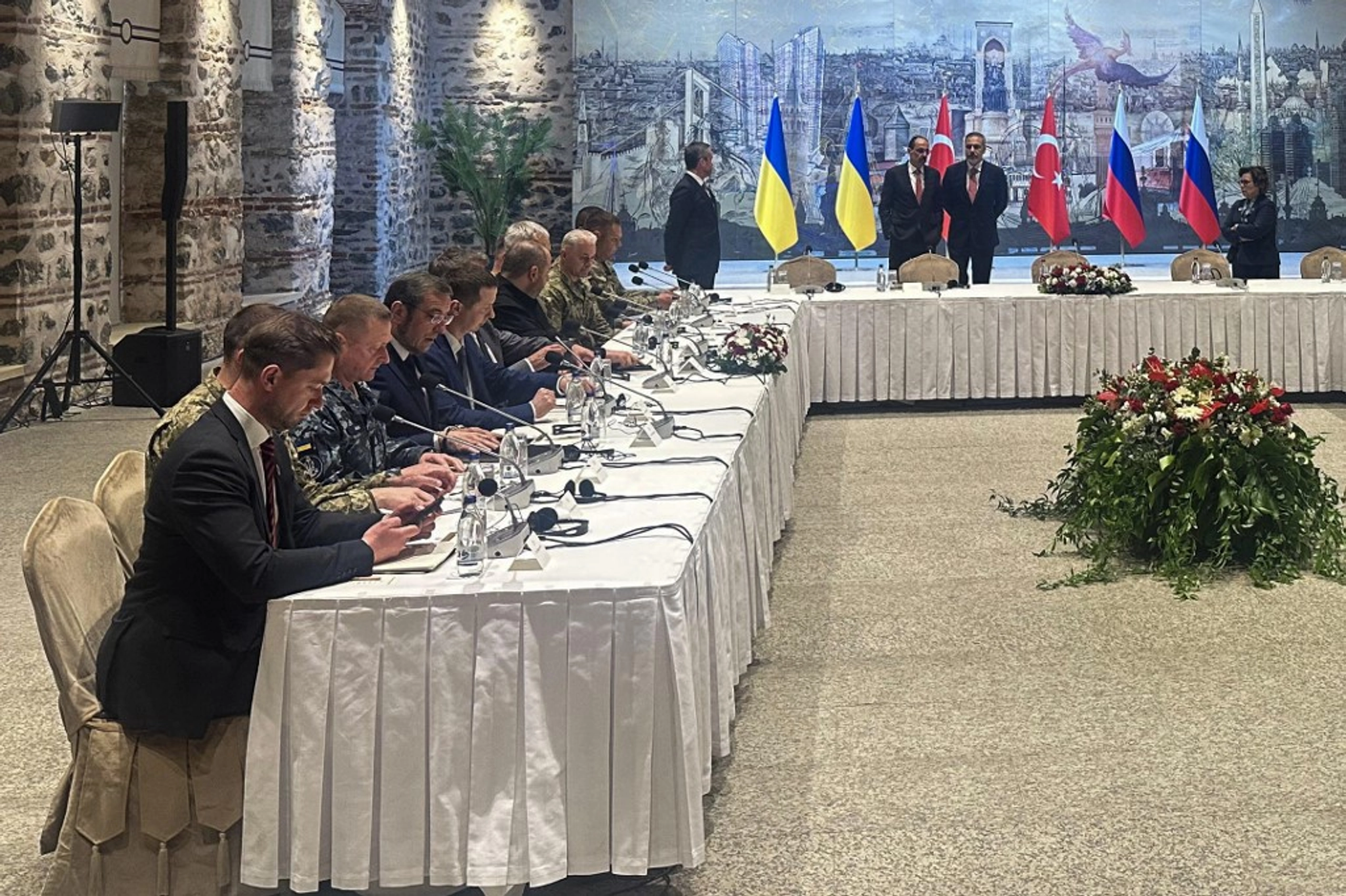
Russia’s imminent return to the negotiating table in Istanbul is not a step toward peace but a tactic to delay Western aid while expanding its military operations. The Kremlin’s diplomatic overtures mask an aggressive strategy of escalation, making sustained Western support for Ukraine more urgent than ever.
The Kremlin’s uncompromising position
JOIN US ON TELEGRAM
Follow our coverage of the war on the @Kyivpost_official.
The June 2 Istanbul meeting is unlikely to bring any substantive results due to the Kremlin’s uncompromising position and unwillingness to secure an enduring peace in Ukraine. While the Ukrainian side has already shared a document setting out its negotiating position on an unconditional ceasefire, the Russian side has refused to do so.
The Kremlin’s approach points to stalling tactics and a push for unrealistic demand of Ukraine, such as the withdrawal of its troops from four regions (Donetsk, Kherson, Zaporizhzhia, and Luhansk) and an end to Western military aid.
Not surprisingly, Russia’s posture ahead of the Istanbul talks was signaled by Vasily Nebenzya, permanent representative of the Russian Federation to the UN, who insisted on the cessation of military aid to Ukraine and a halt to Ukraine’s mobilization as preconditions for peace discussions. He also reiterated that the Kremlin rules out the West’s peacekeeping initiatives and is ready to continue and escalate military actions in Ukraine for as long as needed.
All EU States Approve Opening Cluster 1 in Ukraine’s Accession Talks
Upcoming talks are unlikely to yield meaningful progress toward a lasting peace in Ukraine. The Kremlin is dragging its feet to undermine support for Ukraine, while putting unilateral preconditions on the table to discuss any ceasefire. These actions are part of broader hybrid warfare tactics to confuse the West, undermine support for Ukraine, while focusing on capturing more of Ukraine’s territory. It is critical to judge the Kremlin by its actions, not statements.
Pursuit of maximal territorial gains
The Kremlin is preparing for a new offensive in Ukraine to further solidify its territorial capture in the south and east of the country. Furthermore, Russia has been stepping up its ground offensive efforts in north-eastern Ukraine. Its stated aim is to establish a so-called “buffer zone” in areas of Russia that border Ukraine’s Kharkiv, Chernihiv and Sumy regions to supposedly protect Russians from sabotage and drone raids. Recent developments include the capture of several frontline settlements in Sumy oblast, signaling a renewed effort to expand control along the border.
Further Russian advances beyond those “buffer zones” should be expected, echoing Russia’s 2022 full-scale invasion. This was clearly communicated by Dmitry Medvedev, deputy chair of Russia’s Security Council, who escalated the rhetoric with a video displaying this zone covering almost the whole of Ukraine except territories bordering Poland.
The Kremlin’s so-called diplomacy should be judged as tactical maneuvers rather than genuine peace-making. The Kremlin is genuinely not interested in achieving compromises or making any concessions to attain a just and lasting peace. It only understands the language of power, and it is a clear signal for Western leaders to step up support for Ukraine in its fight against Russia’s invasion of the country.
Continued support of Ukraine is a prerequisite for lasting peace in Europe
The Armed Forces of Ukraine (AFU) has faced ammunition shortages, reducing its artillery firing rates and hindering its ability to counter Russian advances effectively. President Volodymyr Zelensky’s May 27 statement called on Western allies to provide about $30 billion by the end of the year to boost domestic weapons production and hold off Russia’s advance.
In this context, the EU must scale up its defense support for Ukraine. Following the ReArm Europe plan, the EU seeks to advance its defense production capabilities with cost-effective technologies to achieve strategic autonomy, especially in light of dwindling US aid. Hence, supporting and investing in Ukraine’s defense production can ensure substantial economic and security benefits for the EU and Ukraine.
Several vital steps have already been taken in this direction. For instance, on May 29, Germany’s Chancellor Friedrich Merz announced that his country would provide an additional €5 billion ($5.6 billion) in military aid to Ukraine and collaborate with Kyiv to co-produce long-range missiles.
Closer EU-Ukraine defense cooperation would also have positive geopolitical implications for European security as a whole. A more integrated Ukrainian defense sector would advance the EU’s ability to ensure stability along its eastern flank and ensure deterrence against the Kremlin’s aggression.
The views expressed are the author’s and not necessarily of Kyiv Post.
You can also highlight the text and press Ctrl + Enter