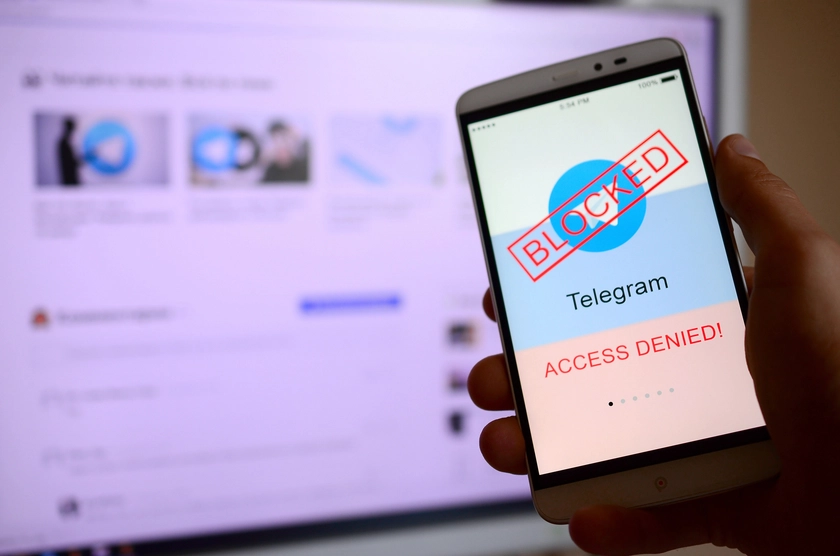
A recent investigation by the Russian outlet Important Stories, in partnership with the Organized Crime and Corruption Reporting Project (OCCRP), has raised questions about whether Telegram, the popular messaging app, has links to Russia’s Federal Security Service (FSB).
What did the investigation find?
Many of Telegram’s messages pass through servers controlled by a company called Global Network Management (GNM), the investigation found. Although GNM is officially registered in Antigua and Barbuda, it operates mainly from Russia.
JOIN US ON TELEGRAM
Follow our coverage of the war on the @Kyivpost_official.
The owner of GNM, Vladimir Vedeneev, is a Russian engineer who has known Telegram’s founder Pavel Durov for years. Court documents reveal that Vedeneev is the only person with authorized access to some of Telegram’s servers, including those located in the United States.
Vedeneev also owns or controls other companies, such as Globalnet and Electrontelecom, which provide internet and telecom services to Russian government agencies, including the Federal Security Service (FSB).
Some of these companies have contracts to support secret government facilities used for surveillance and military operations.
The IP addresses Telegram uses to send messages were previously owned by Russian companies connected to the FSB. Even after ownership changed, these IP addresses remain registered as Russian, meaning internet traffic can be traced back to Russia.
Why does this matter?
Telegram offers two types of chats: secret chats with end-to-end encryption, and regular cloud chats, which are stored on Telegram’s servers and not end-to-end encrypted by default. Most users rely on these regular chats.
SBU Says It Foiled Planned Terror Attacks in Kharkiv, Detains Alleged FSB Agent
Security experts warn that because Vedeneev’s companies control the network traffic and routers that handle Telegram messages, they could potentially see metadata such as user IDs, IP addresses, and locations – even if they cannot read the message content itself.
This kind of “man-in-the-middle” access allows tracking of users and their communication patterns.
Telegram also transmits unique device identifiers unencrypted, which can be linked to user locations. This raises concerns that Russian intelligence could use the infrastructure to monitor Telegram users globally, especially those seen as threats.
How has telegram responded?
Telegram has strongly denied the allegations. The company states it has no employees or servers in Russia and that all Telegram servers are owned and maintained by Telegram staff.
It insists that unauthorized access to its infrastructure is impossible and that its encryption has never been broken or private messages handed over to third parties.
Telegram also says it contracts with dozens of service providers worldwide but none have access to data or confidential infrastructure.
However, Telegram did not directly address the specific links to GNM, Globalnet, Electrontelecom, or Vladimir Vedeneev that were highlighted in the investigation.
It also did not explain how user safety is guaranteed if infrastructure companies have ties to the FSB or why device identifiers are transmitted unencrypted.
Telegram’s use in Ukraine
Telegram is one of the most widely used messaging apps in Ukraine, with about 10 million active users – nearly a quarter of the country’s population. The app has become a crucial platform for news, communication, and information sharing amid the ongoing war with Russia.
According to a 2023 study, 72% of Ukrainians get news from Telegram channels, which range from official government accounts to independent and anonymous sources.
Ukrainian officials and even President Volodymyr Zelensky use the platform for public communication. Zelensky’s official Telegram channel has over 2 million subscribers, although he reportedly avoids using the app on his personal phone for security reasons.
The app’s channel feature allows rapid dissemination of news and updates, making it a vital tool in Ukraine’s information landscape, even as authorities weigh potential restrictions due to concerns over disinformation and espionage.
You can also highlight the text and press Ctrl + Enter

Attack on Moscow Oil Refinery: Putin Under Pressure?