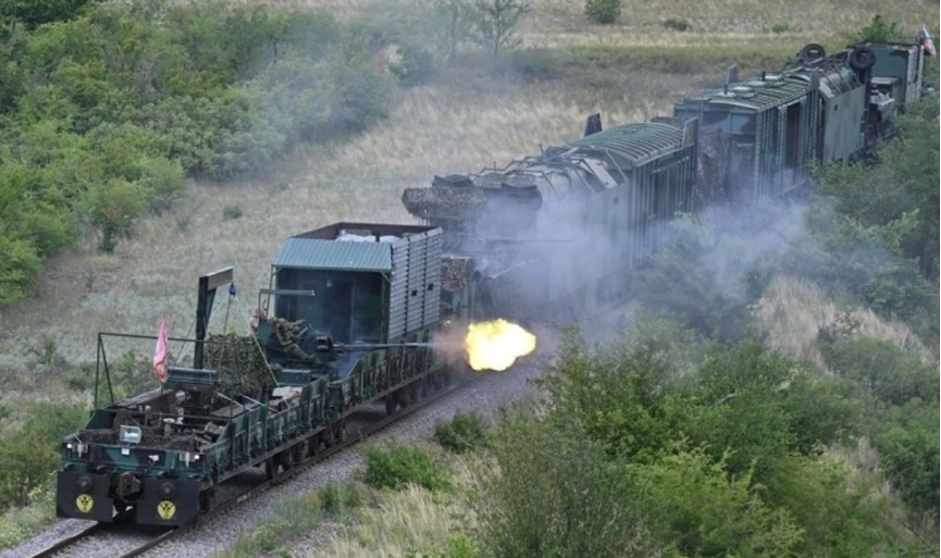
Pro-Russian mainstream and social media have published images of the deployment of the “Yenisey combat train” supposedly being used to resupply army units and protect rail line repair operations close to the front line in occupied Donbas.
The Soviet rail network was extensive and linked all regions and republics including Ukraine in a unified system. This allowed the use of its railways for transportation of goods and people both during peacetime and the early 20th century wars fought on its land. Trains allowed the rapid movement of military materiel, equipment and personnel with these vital supply lines protected by dozens of armored trains, carrying heavy machine guns, artillery and anti-aircraft guns.
JOIN US ON TELEGRAM
Follow our coverage of the war on the @Kyivpost_official.
The Russian military, like its Soviet forebears, makes extensive use of its railways to not only resupply its front lines but also to establish forward area resupply depots and particularly in bringing North Korean supplied weaponry from Russia’s far east.
Ukraine has not overlooked that fact and has made considerable efforts over the last three and a half years of war to do its best to interdict Russian logistic lines – including simple arson attacks on trackside electric junction boxes, cyberattacks on railway control networks, full blown sabotage attacks on major routes and drone strikes on military trains.
The Yensiey train looks like something straight out of a World War II movie. Along with armored carriage the train is carrying ZU-23-2 air defense cannon, multiple “Utyos” heavy machine gun mounts, and somewhat surprisingly, a BMP-2 infantry fighting vehicle, complete with “cope cage” strapped to a flatbed car.
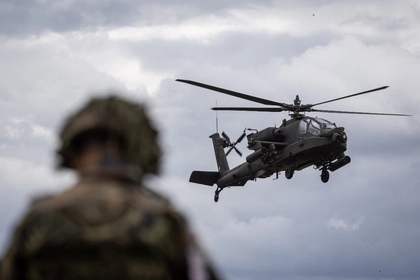
Russia Could Attack NATO One Year After Ukraine War: Dutch Govt
There are reports that this is just one of several protected trains being used by Russia to protect its ever-more vulnerable logistic routes as Ukraine’s special forces and “partisan” groups focus on this key target. Cutting a rail line, even for a short period, has the potential to disrupt Russia’s ability to fight particularly as Ukraine’s long-range drones increasingly strike its forward ammunition and logistic storage sites.
The lessons of protecting and attacking rail networks is also something Western militaries need to learn. To date the majority of its wars have been “expeditionary” relying mainly on resupply by sea and air with in-theater logistics relying on road transport. If, as many fear, there could be a war with Russia in the not-too-distant future rail networks in Europe could become the essential lifeline for NATO forces.
Armored trains like the Yensiey may one day become a feature of modern warfare along with drones, electronic warfare, missiles, mines and “dragon’s teeth.”
You can also highlight the text and press Ctrl + Enter