A political storm is brewing in Ukraine over a criminal case targeting prominent anti-corruption activist Vitaliy Shabunin.
On Tuesday, July 15, a court ruled on his pre-trial restrictions. However, public outcry had already begun four days earlier when news of the charges first broke. Waves of support for Shabunin have poured in from media outlets, civil society leaders, military personnel, and ordinary citizens.
JOIN US ON TELEGRAM
Follow our coverage of the war on the @Kyivpost_official.
Social media has been flooded with messages condemning the case as politically motivated persecution. So what exactly is happening — and why has it struck such a nerve in Ukrainian society? Kyiv Post explains.
Who is Vitaliy Shabunin?
Vitaliy Shabunin is one of the most prominent (and quite controversial) Ukrainian activists. The 40-year-old has headed the Anti-Corruption Action Center (AntAC), a non-governmental organization, for nearly 14 years, exposing hundreds of corruption cases at the highest levels of government, among the police, in the military, among local authorities, and in other institutions.
This has made Shabunin one of the country’s most influential and well-known activists.
However, his sharp tone and uncompromising stance have made him an enemy of many politicians and businessmen.
What’s further frustrated many of Shabunin’s critics has been his organization’s financial independence – funded entirely through international grants, it’s operated beyond the reach of Ukrainian authorities — unlike during the Yanukovych era and, to some extent, under Poroshenko, when domestic funding often came with strings attached.
SBU Says Drones Hit Russian Military Ships in New 40-Day Crimea Campaign
Some activists, particularly those who have failed to secure grant funding the way that Shabunin has, have accused him of being a “representative of foreign interests in Ukraine.” Pro-Russian politicians have made similar accusations.
Many experts note that the mandatory asset declarations for public officials (aimed at preventing corruption), which were introduced with the active participation of Shabunin’s Anti-Corruption Center, made Shabunin a persona non grata among some government officials.
“Shabunin, a corruption whistleblower who has done a lot to fight corruption in Ukraine, naturally made enemies across all levels and generations of power and business,” lawmaker Maryana Bezuhla wrote on Facebook, adding that he was “eccentric by nature and behavior.”
Several criminal cases were opened against Shabunin under different pretexts under various governments.
In 2017, after criticizing Petro Poroshenko’s entourage – specifically lawmaker and businessman Ihor Kononenko – and one of ex-PM Arseniy Yatsenyuk’s party leaders, Mykola Martynenko, a criminal case was opened against him for allegedly “assaulting” the provocateur blogger Vsevolod Filimonenko. In 2023, Filimonenko admitted he blackmailed Shabunin in 2018.
But Shabunin’s troubles didn’t go away after 2019 after President Volodymyr Zelensky took power.
In 2020, Shabunin’s house was set on fire by arsonists who were never discovered. Simultaneously, pro-government Telegram channels launched an active smear campaign against the activist. Nevertheless, Shabunin continued his work.
The criminal case
In 2022, after the start of Russia’s full-scale war on Ukraine, Shabunin voluntarily joined Ukraine’s defense forces, specifically the Territorial Defense units (TDF).
At the time, many activists, journalists, public figures, and celebrities joined various units, including the TDF, which was widely discussed and popular. Moreover, for many activists and journalists during Kyiv’s defense, serving in the TDF allowed them to partially maintain family life or continue their main professions.
However, the war dragged on, and TDF units began carrying out combat tasks across the entire front, far from the capital.
Shabunin, who remained active in anti-corruption work, spent over six months – September 2022 to spring 2023 – on official assignment from his unit to the National Agency on Corruption Prevention (NACP) in Kyiv, while his unit was at the front.
This is not unusual – many soldiers spend months on assignment away from their units if their work is needed elsewhere. This article’s author is aware of similar cases, for example, when military personnel were deployed elsewhere to develop or manufacture drones.
But this detail became the basis for the accusations against Shabunin.
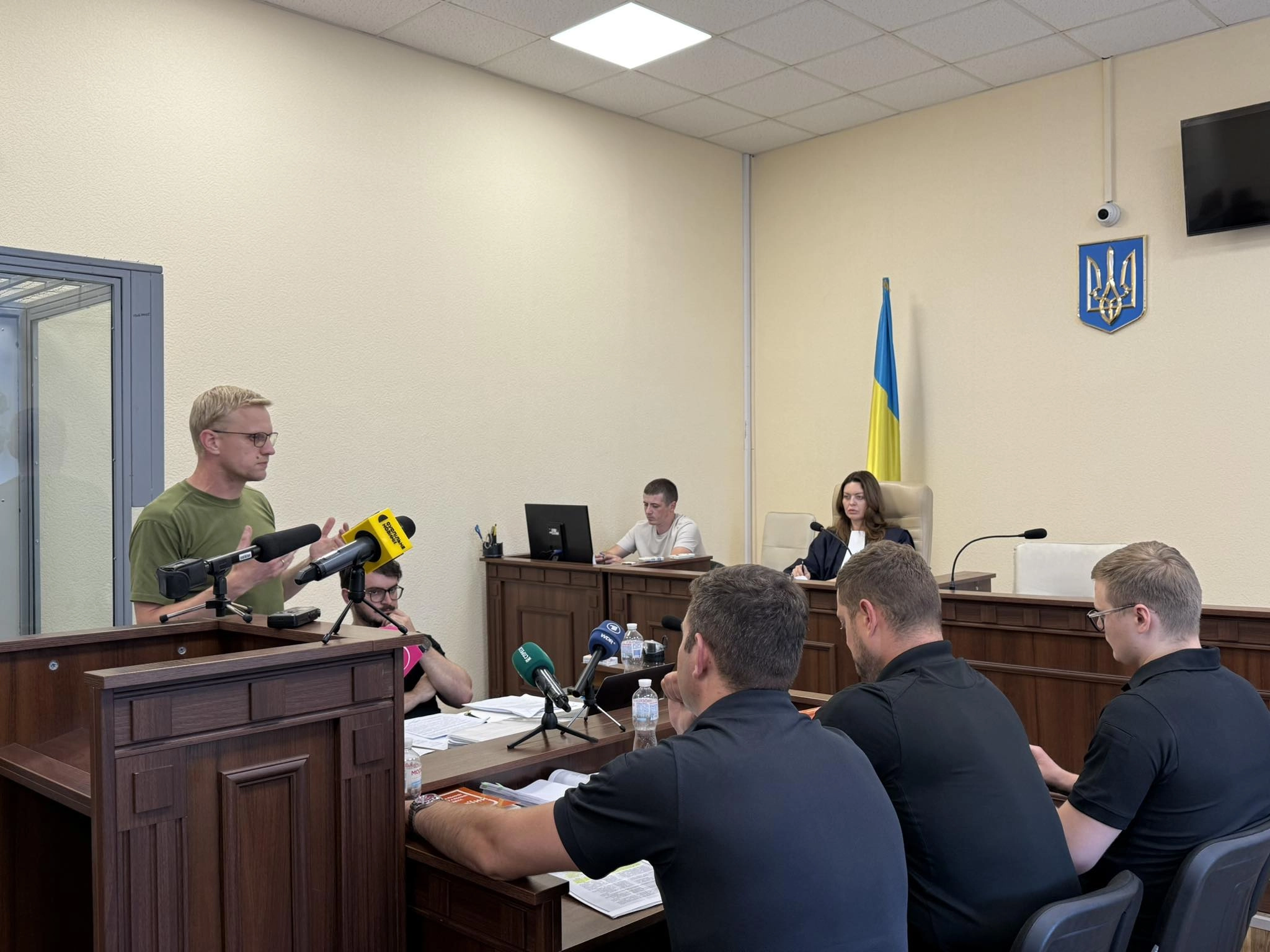
On July 11, State Bureau of Investigations (SBI) officers served Shabunin with suspicion of evading military service and fraud.
The SBI claims that from September 2022 to February 2023, Shabunin, as a serviceman, arranged a “fake” assignment from his TDF battalion to NACP. The core accusation: while on assignment, Shabunin wasn’t doing battalion-related work but other activities unrelated to the war.
“After being mobilized in 2022, the individual in question failed to appear at his duty station for a long time and, under the guise of ‘assignments,’ was stationed at civilian institutions not part of the defense forces. It was also documented that he received over 50,000 UAH [$1,192] per month in salary despite his actual absence from the military unit,” the SBI reported.
According to a Pechersk court ruling, Shabunin was “not appointed to a position, not given a workplace, and not assigned a supervisor” at the NACP.
“According to the Armed Forces Statute, he should have informed his battalion commander, but did not. Instead, he received four letters from NACP and four assignment orders from the battalion commander.”
Shabunin was charged under Part 4, Article 409 of the Criminal Code of Ukraine – evading military service during wartime – and Part 2, Article 190 (as per the law at the time) – large-scale fraud.
The SBI pointedly notes that the charges carry up to 10 years in prison.
While serving, Shabunin continued making YouTube videos about major corruption scandals and highlighted corruption risks in various laws. Notably, he produced many videos alongside investigative journalist Yuriy Nikolov.
They published content on the controversial competition to appoint the head of the Bureau of Economic Security, a scandalous bill proposing amnesty for corruption in the defense sector, procurement problems at the Defense Procurement Agency, and the corruption scandal involving Deputy Prime Minister Oleksiy Chernyshov.
Notably, Shabunin said this is not the first punitive action against him during the war. A few days before the charges, he was reassigned from his post in Kharkiv to a frontline brigade.
“After the scandal where the AntAC opposed the bill on corruption amnesty in defense, I was transferred from Kharkiv to another brigade near the LBZ [the combat line]. This bill, the attempt to save Chernyshov, the blatant abuse surrounding the BEB [Bureau of Economic Security] competition – it all shows Zelensky no longer cares about even the appearance of legality. Pure Louis XIV: ‘I am the state,’” wrote Shabunin.
Shortly after, the charges and home searches followed.
Reaction
The severity of the accusations have raised many questions among experts and military personnel. Specifically, that Shabunin wasn’t performing military tasks at NACP is a common army occurrence – many soldiers are formally on assignment, but verifying their actual duties is difficult.
Soldier of the 110th Brigade and former lawmaker Yehor Firsov described it like this:
“Shabunin’s case shows that any soldier today is vulnerable if they dare criticize the government. If there’s a person, there’ll be a Criminal Code article for them. Even a dozen. My guys and I once counted how many ways we could easily be ‘locked up,’” Firsov wrote on Facebook.
The AntAC responded to the charges – saying what’s happening is politically motivated selective prosecution.
“President Zelensky is building a corrupt authoritarian regime during martial law, and the case against Shabunin is nothing but a show punishment to demonstrate that the authorities can do anything to anyone in the country – no matter how absurd. The President’s Office, via [lawmaker Oleh] Tatarov-controlled SBI and anonymous Telegram channels, wants to turn Vitaliy Shabunin into a ‘draft dodger’ and a ‘fraudster,’” said AntAC.
The charges of evading service at NACP during fall 2022-spring 2023 were called “absurd” by the organization, since the unit was not on the front line at that time.
According to his family and colleagues, the search at Shabunin’s home occurred without a lawyer present. His wife was not shown a court order. The search happened in front of their small children, whose phones were also confiscated. This triggered a sharp public reaction.
Representatives of various political forces and civic movements were almost unanimous: the case is trumped up, and given Shabunin’s role as a major critic of questionable government initiatives – especially legislative ones – it is politically motivated.
“The charges and house search of civil activist and Ukrainian Armed Forces serviceman Vitaliy Shabunin is another shameful case, one whose sole aim is to silence everyone, intimidate, and suppress criticism of corruption, abuses of power, authoritarian trends, and backsliding from reforms,” said Poroshenko’s opposition party European Solidarity – even though many of its own members had also been targets of Shabunin’s investigations.
“I believe Shabunin’s work was mostly socially beneficial, even if sometimes harmful. But he had every right to do it. I don’t understand what kind of service he was performing in Kyiv and not even in HQ offices. What role did he have as a soldier? But I see no reason for house searches, phone seizures from kids, and these charges. All this is clearly political persecution and selective justice orchestrated by investigators at the behest of corrupt officials criticized by Shabunin,” wrote MP Mykola Kniazhytsky.
One of Ukraine’s biggest outlets, Ukrainska Pravda, published an editorial titled “Selective Justice and Silent Approval – The Road to Authoritarianism,” supporting Shabunin.
“I’ll be honest: I don’t like Shabunin. For many reasons. But what their Anti-Corruption Action Center does is good for the country. What Shabunin investigates and says about corruption in Ukraine is literally saving the country. AntAC, Slidstvo.Info, Bihus.info—these are our immune system. Immunity from sliding into Russia’s autocratic model of government… That’s why I consider the searches at Shabunin’s and his family’s homes to be pressure on independent anti-corruption forces,” wrote lawyer and blogger Kostiantyn Korsun.
In total, nearly 70 organizations publicly supported Shabunin and signed a letter to Zelensky and the Prosecutor General.
“We, the undersigned representatives of human rights, anti-corruption organizations, and other civil society groups, appeal to the President of Ukraine, Prosecutor General, and Director of the SBI with a demand not to allow the justice system to be used for political retribution and persecution of government critics,” reads the joint statement, supported by major NGOs like Automaidan, OPORA, investigative outlets Bihus.Info and Slidstvo.Info, CHESNO movement, CASE Ukraine, Transparency International, Renaissance Foundation, the German Marshall Fund of the United States, and others.
At the same time, some social media users smugly claimed that Shabunin deserved the persecution because he himself had often been unfair to his investigative targets, and his sharp statements damaged reputations even before guilt or innocence had been established.
Kyiv Post continues to monitor what has become Ukraine’s most high-profile criminal case.
You can also highlight the text and press Ctrl + Enter