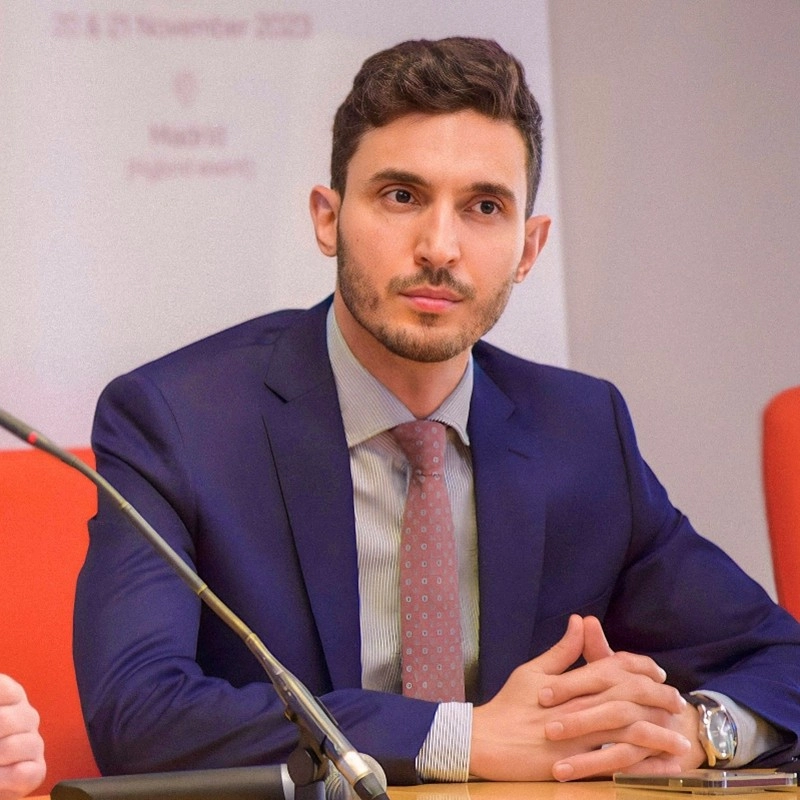
Kyiv Post recently sat down with Matteo Pugliese, PhD, an analyst at Debunk working on Russian disinformation campaigns around the world. He recently returned from a training trip to Latin America, where he helped train civil society groups to recognize and resist Russian disinformation campaigns in their country.
KP: Please tell us about your work fighting Russian disinformation.
JOIN US ON TELEGRAM
Follow our coverage of the war on the @Kyivpost_official.
MP: As an analyst at Debunk, I monitor the campaigns of disinformation and foreign manipulation attempting to interfere in domestic politics to shape the public perception.
The EU coined the concept of “Foreign Information Manipulation and Interference” (FIMI) to describe the activity of the threat actors, and the focus of our analysis is not on the content but rather on the behavior. For example, a coordinated inauthentic behavior on a social media platform with fake accounts made to go viral with a topic or disinformation content.
In our efforts, we use AI to scrape data and spot campaigns, as well as a number of digital tools such as Junkipedia, Meltwater, and OpenCTI to analyze the content we gather. We work a lot with EU-funded projects and, before the current administration, we worked with the US institutions too.
As part of my job, I have given training courses and lectures on Russian disinformation in Ghana, Nigeria, Moldova, Lithuania, Ukraine, Colombia, and Mexico for both intelligence officials and journalists about the risks of foreign interference and disinformation.
Ukraine Launches Database of Russian Recruiters as Moscow Seeks 18,500 More Foreign Fighters
We are also monitoring the elections in different European countries with field missions, so far Germany, Poland, and this fall in Moldova and the Czech Republic.
KP: Can you expand on how you got into this field? Was there some personal motivation?
In 2022, I was reporting for an Italian newspaper about international security, and I traveled to Kyiv to write about the invasion. At the same time, I started covering propaganda and hybrid threats, which is when I noticed a huge presence of Russian propaganda figures on Italian TV shows. I published quantitative research about it, which is how I entered the field and then joined Debunk.
KP: Can you tell us a bit more about your experience in Latin America, in particular your recent training in Colombia and Mexico?
We were invited by the EU External Action Service for workshops with local journalists and civil society organizations to raise awareness about FIMI and to introduce basic concepts for FIMI analysis. This is because Latin American countries are targeted too by these campaigns, especially by Russia, China, but also Venezuela and Iran.
As we expected, some of the participants had biases related to the former colonial role of European countries in the region and the US, given its controversial legacy during the Cold War, but we tried to explain the difference between mere political interference and the sophisticated clandestine operations carried out by Russia with disinformation.
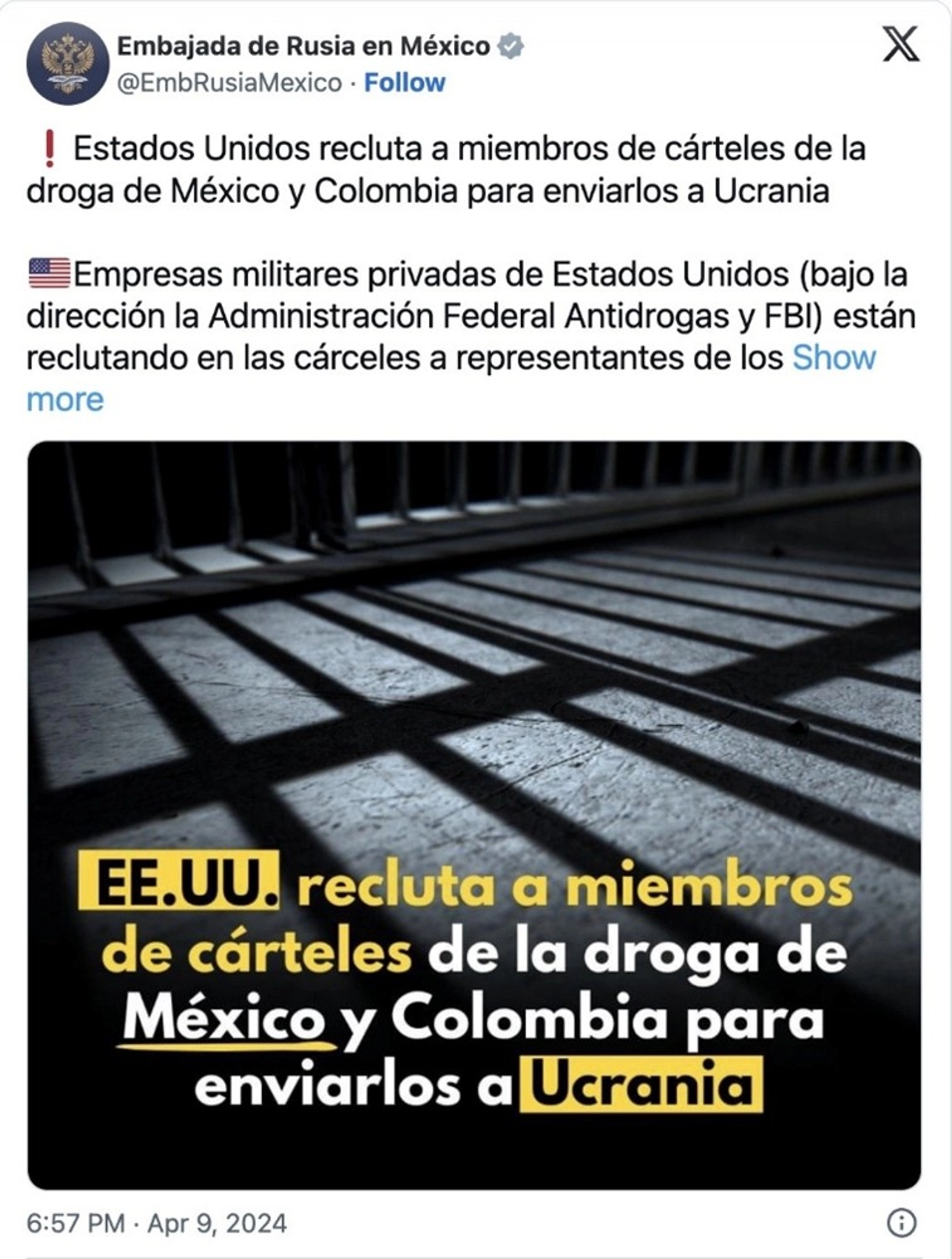
(Translation: Russian Embassy in Mexico. “The US is recruiting members of drug cartels in Mexico and Colombia to send them to Ukraine.”)
KP: Do you see a throughline to Soviet propaganda during the Cold War in Latin America?
MP: In Latin America, Moscow recycles the playbook from Soviet times, in terms of narratives and techniques. The main pillar remains the anti-US rhetoric and anti-imperialism message.
For example, Moscow will try to deepen the divide with Mexico, exploiting the issues of migration and racism in the US and the degrading relations with President Sheinbaum.
In Colombia, President Gustavo Petro just announced that his country will withdraw from the NATO Global Partners – the only member of this partnership in Latin America – because of Western inaction on the war in the Middle East.
This represents a significant victory for Russia, which will try to consolidate this anti-NATO narrative on social media using its networks such as RT en Español, banned in the EU, and the help of Venezuela’s Telesur.
KP: How does Russian disinformation work differently in Latin America or Africa than in Europe or North America?
MP: In Latin America, the narrative is often anti-US and the main goal is to weaken the political partnership with Western countries, so that Moscow may establish stronger ties with local governments and get access to harbors, infrastructure, contracts for extracting natural resources, and in general having a stronger influence near the US border.
In Africa, the main narrative is anti-colonial, and the main target is France, especially in the Sahel region. In the EU and in North America, the main goal is to exacerbate internal political tensions to weaken the Western response vis-à-vis the invasion of Ukraine and, in general, Russia’s neo-imperialist agenda, disguised by “a new multipolar order. This actually means empowering authoritarian regimes to replace the democratic model. Cognitive warfare with manipulation and disinformation is a key component of this strategy.
KP: What does Russia want from its resources invested in Latin America? Recruits for the war? Natural resources? Support at the UN on key votes?
I don’t think Russia wants recruits from Latin America at this stage. They are definitely working to weaken the US and EU partnership and presence in Latin America, deepening political relations with Moscow, and establishing alliances starting from Venezuela, Cuba, and Nicaragua (through ALBA), but there is a second layer extended to leftist populist governments like in Bolivia, but also Petro in Colombia, López Obrador and then Sheinbaum in Mexico. Yet a third layer includes a stronger cooperation with Brazil through the “BRICS”.
Mexico has around 11 diplomats in Moscow, but Russia has around 85 in Mexico City, most of whom are intelligence officers. The strategic goal for the Kremlin is to gain influence through the public opinion of these countries, leveraging the narratives about fighting US imperialism, European colonial legacy, and building a “multipolar world” with the community that they call “global majority”.
We have noticed that often they work together with Chinese networks of propaganda on social media, using the same tactics and narratives.
KP: What kinds of things can civil society and media figures in Latin America do to combat and protect themselves from Russian disinformation campaigns?
MP: There are many ways, starting from digital literacy programs and raising awareness among the public about the risk of foreign manipulation, but CSOs from Latin America need to train analysts and experts able to track down campaigns and detect disinformation operations. They need better OSINT skills because working with a journalist or a fact-checker is not enough to address this challenge.
KP: What is next for disinformation campaigns in Latin America?
As you probably know, President Petro announced plans to join China’s Belt and Road Initiative (BRI), so it would be difficult to talk with Colombia’s authorities about Beijing’s propaganda campaigns on social media, especially via TikTok, implemented to improve the image of China in Latin America.
Both Petro and Sheinbaum, but also other Latin American leaders, are in bad relations with [US President Donald] Trump, who imposed tariffs on their countries, so Russian propaganda can exploit these divisions and vulnerabilities to gain further influence in the region.
So far, we haven’t spotted in Latin America disinformation operations as large as those launched against Europe or the US, but it will likely happen soon, so at least the civil society should be aware and prepared for this risk.
You can also highlight the text and press Ctrl + Enter