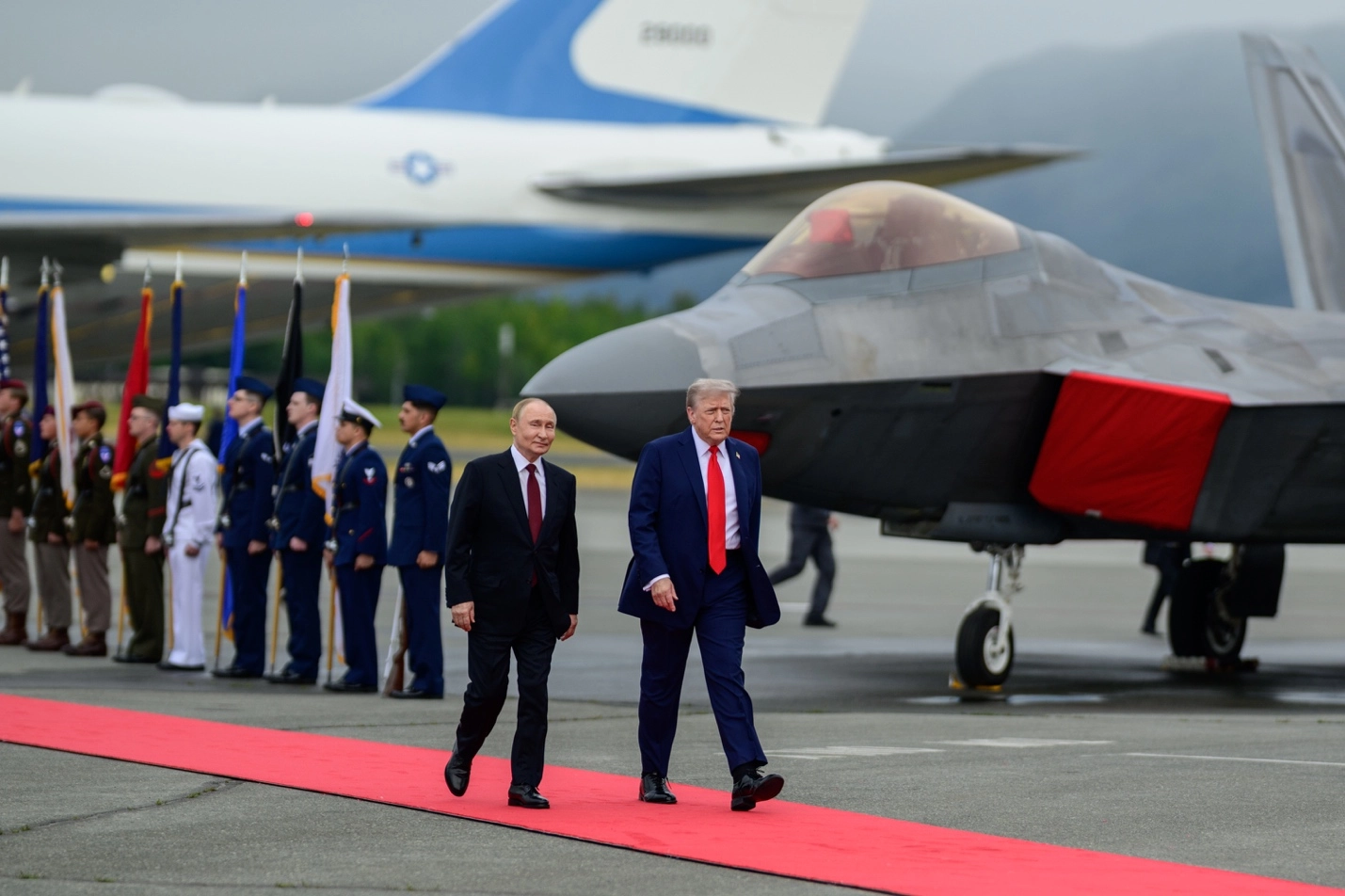
ANCHORAGE, ALASKA – The high-stakes summit between US President Donald Trump and his Russian counterpart Vladimir Putin in Alaska on Friday was a study in contrasts. A choreographed display that masked a profound divergence of goals. While the White House framed the meeting as a “listening exercise” for Trump, it was widely viewed as a significant legitimacy-seeking endeavor for Putin.
The meeting, which took place without Ukrainian President Volodymyr Zelensky, concluded with no concrete, publicly announced agreements on ending the war.
JOIN US ON TELEGRAM
Follow our coverage of the war on the @Kyivpost_official.
However, the optics and post-summit commentary have provided ample material for analysis, revealing a new, more transactional era of diplomacy.
Meeting of contrasts and symbolism
The backdrop to the summit was a banner reading “Pursuing Peace,” but the symbolism extended far beyond the tarmac.
Russian Foreign Minister Sergey Lavrov wore a CCCP (the Cyrillic letters corresponding to USSR) sweatshirt, a gesture noted by veteran diplomat Richard Kauzlarich as a “signal of the future,” not just a reminder of the past.
The meeting itself saw Trump deliver unusually brief and, to some ears, defensive-sounding remarks, in contrast to a more confident Putin.
As former US envoy Daniel Fried told Kyiv Post, “the initial greeting is less important than what happens at the meeting and how Trump portrays it.”
Trump’s portrayal of the summit was an unreservedly positive one. He rated the meeting as a “10” on a scale of 1 to 10, telling Fox News’s Sean Hannity after the summit that it was a success because it showed that the leaders of two nuclear-armed nations “could cooperate.”

Russian Drone Attack Hits Gas Station in Sumy, Injuring 4
Trump’s “special talent” and lack of concrete progress
Trump, who has often boasted of a “special talent” for ending wars, framed his role as that of a facilitator. He told Hannity that he and Putin had “made a lot of progress” and “largely... agreed on” several points.
He insisted, however, that there was “no deal until there’s a deal,” and that a final agreement hinged on “one or two significant items” that remained unresolved.
He also refused to share details of the negotiations, a stark contrast to his public pronouncements.
Trump’s reticence left many observers skeptical, as the summit yielded no concrete outcomes such as a full ceasefire, which Fried had said was a necessary push for Trump to make.
Trump’s advice to Zelensky: “Make a deal”
A key moment in Trump’s interview with Hannity was his direct advice to Ukrainian President Zelensky: “Make a deal, you’ve got to make a deal. Russia’s a very big power, and they’re not.”
While he later insisted that “Ukraine has to agree, President Zelensky has to agree,” his public urging has placed immense pressure on Kyiv.
He claimed to have agreed on “a lot of points” with Putin and that they were “close to the end,” but ultimately, he said, “Now it’s really up to President Zelensky to get it done.”
Trump’s focus on a personal rapport with Putin was clear. He said it was “a warm meeting,” and that Putin “spoke very sincerely” about a desire to end the war. This came with no mention from Trump that Putin initiated the conflict in 2014 or intensified it in 2022.
Warning of Putin’s strategy
Experts, however, have voiced deep concerns about the summit’s implications. Doug Klain, a policy analyst for Razom, a US-based organization that advocates for Ukrainian interests, told Kyiv Post on Friday evening that Putin’s actions were a deliberate attempt to sow discord among Western allies.
“Putin knows exactly which levers to pull with Trump,” he emphasized.
Klain believes that Putin “is trying to drive a wedge between Trump and his allies in Europe and lay the groundwork for Europe and Ukraine to be blamed for a ‘deal’ being rejected.”
The analyst stressed that the path forward for Ukraine and its allies must be one of unity. “The big task for Ukraine and the rest of Europe now is to try to replicate their recent call with Trump and make clear that it’s far more likely Trump can get a successful deal by working with them than with Putin.”
He praised the United Kingdom’s announcement to send troops to enforce a ceasefire as a positive step, adding that “this kind of major political will is what it will take to make it through this crisis.”
Veteran ambassador Daniel Fried warned that Trump must push for a serious move from Putin, such as a full ceasefire. At the same time, Richard Kauzlarich suggested that Trump “clearly wanted to have this meeting” because Putin is “someone he can relate to.”
Legitimization of Putin and a perilous future
The summit’s most significant outcome may be the one that was perceived as unintended. For Putin, the meeting was a major diplomatic victory. After years of isolation, simply meeting with the American president on US soil was a powerful legitimizing event.
The sight of the two leaders on seemingly equal footing sent a clear message to the world that Russia was not a pariah nation but a global power. Putin’s parting remark, ”Next time in Moscow,” underscored this sense of renewed influence. As the world awaits details of what, if anything, was truly accomplished, the summit appears to have served as a legitimizing exercise for Putin.
But it also suggests a new chapter in the ongoing conflict, one in which the lines between a just and unjust war may become increasingly blurred, and the pursuit of peace is defined by the players at the table, not by the nation that has been left out.
The situation feels eerily reminiscent of past negotiations that ignored Ukrainian voices, raising fears that Ukraine’s interests could be sidelined in favor of a deal that benefits both the US and Russia.
It is a moment that calls for unified action from Washington and its NATO allies to ensure pressure is applied on Putin for a genuine and lasting peace.
You can also highlight the text and press Ctrl + Enter