Russia is systematically remaking the symbolic landscape of occupied Ukrainian territory, tearing down or sidelining Ukrainian memorials while erecting its own monuments that fuse Kyivan Rus, WWII and the modern invasion into a single “Russian” story.
Research by historian Yurii Latysh for Novaya Gazeta Europe has shed light on how the new memorials present Russia’s war as the latest chapter in a centuries-long struggle for “Russian land” – and as proof that these regions have “always” belonged to Moscow.
JOIN US ON TELEGRAM
Follow our coverage of the war on the @Kyivpost_official.
The scale of altered, dismantled and newly erected monuments across occupied territories is so extensive that a comprehensive listing is no longer possible.
All wars rolled into one
In occupied Donetsk, the Kremlin is using newly built memorials to recast slain separatist commanders as martyred defenders of “Russian Donbas.”
On Nov. 2, occupation authorities unveiled a new memorial complex at the city cemetery known as “Donetsk Sea.” The site features a ceremonial alley leading to a black-granite stele crowned by the Archangel Michael and inscribed “In memory of the defenders of Donbas,” flanked by granite slabs bearing the names of separatists who fought for the self-proclaimed Donetsk People’s Republic (DPR), and a large mosaic icon of the Mother of God titled “Unbreakable Wall.”
Those buried at the site include commanders of the separatist “Somali” and “Sparta” units – Mikhail Tolstykh (“Givi”), Arsen Pavlov (“Motorola”), his successor Vladimir Zhoga (“Vokha”), as well as Colonel Olha Kachura (“Korsa”) and the first self-proclaimed “head of the DPR,” Oleksandr Zakharchenko, whose public glorification continues to be actively cultivated across the occupied region.
Latvia’s PM to Russia: ‘There Are No Jokes With Us’
The day before, a reconfigured memorial complex by the Mius River was unveiled in Khrustalnyi, in the occupied Luhansk region. Originally built in 1967 at the site of the defeated German “Mius Front,” it has been altered so that the Soviet “Stairway of Heroes” is now flanked by pylons depicting a warrior from the era of Kyivan Rus, dated to Prince Igor’s campaign against the Cumans, alongside a fighter from the so-called special military operation (SMO) – Russia’s official term for the Ukraine invasion – bearing the year 2025.

The site has been transformed into a carefully choreographed stage, designed to project sacrifice, imperial continuity and manufactured heroism.
A triumphal arch was erected, officially described as a “symbol of the continuity of generations of defenders of the Luhansk land – from Prince Ihor to the heroes of the SMO.” A T-72 tank that took part in combat against the Ukrainian Armed Forces was installed at the site, while the eternal flame was lit using fire brought from the Alexander Garden by the walls of the Moscow Kremlin.
At the opening, Sergei Kiriyenko, first deputy chief of staff of Russia’s Presidential Executive Office, said the new memorial “unites the entire significance of Donbas for Russia and Russian history,” according to a press release from the Russian Military Historical Society (RIVO).
Kiriyenko highlighted the dates 1185, 1941-43 and 2022-25 as proof of why Donbas is called “the heart of Russia.”
A Kremlin-run memory machine
The Russian narrative of an unbroken “continuity of generations of defenders of Russian land” also runs through official rhetoric across occupied Ukrainian territories, with particular emphasis on glorifying contemporary separatist figures as successors to WWII heroes.
Denis Pushilin, the head of the so-called DPR, has argued that the cult of these commanders should shape the historical consciousness of younger generations, stating: “Our children, grandchildren, great-grandchildren will also be brought up on the exploits of the defenders, the memory of which is immortalized at the memorial complex.”
Latysh noted the rank of officials attending ceremonies, such as the one at Khrustalnyi, has been consistently high, underscoring the importance of these projects to the Kremlin. New monuments are typically inaugurated by Kiriyenko, who stresses that they are being built on the personal instructions of Kremlin leader Vladimir Putin and financed from the Russian president’s reserve fund.
The RVIO, headed by former Russian Culture Minister Vladimir Medinsky – the same historian who led the Russian delegation in the Istanbul talks with Kyiv – has become the key actor in state memory policy on occupied territories.
Since 2022, regional branches have been set up in the so-called DPR and Luhansk People’s Republic (LPR), and later in occupied Kherson and Zaporizhzhia, with local offices in cities such as Debaltseve, Horlivka, Mariupol, Berdiansk and Melitopol. However, these branches are led not by historians but by senior local officials.
Under RVIO’s patronage, “patriotic” events, conferences, forums and exhibitions promote a Russian identity among residents. Schools open special classes on military history with a focus on the “feats of the Russian army.” RVIO has effectively taken responsibility for the Russification of the memorial landscape in occupied regions.
Updating Soviet monuments, elevating today’s fighters
Similar to the Mius River monument, most new monuments are tied to WWII, reflecting how the “Great Victory” narrative has filled the ideological vacuum in post-Soviet Russia. As one scholar quipped – cited by Latysh – “victory became everything, and everything became victory.”
In occupied territories, Soviet war monuments are routinely restored, expanded and ideologically repurposed.
A striking example is the Savur-Mohyla memorial near Snizhne. During the fighting in 2014, the hill changed hands several times before ultimately remaining under the control of the so-called DPR. Since then, the site has been used for ceremonies that deliberately equate the Soviet struggle against Nazi Germany with Russia’s current war against Ukraine, casting Ukrainian forces as “Nazis” in a recycled wartime narrative.
Russia rebuilt the heavily damaged memorial in just 90 days, adding imagery of Donetsk separatist commanders Tolstykh, Pavlov, Zhoga and Kachura.
The restored complex was unveiled on Sept. 8, 2022, in a highly staged ceremony featuring a video address by Putin and timed to “Donbas Liberation Day,” marking the Red Army’s 1943 offensive against German forces. Putin used the occasion to praise a “modern generation of heroes,” explicitly linking the separatist fighters of 2014 to the legacy of WWII.
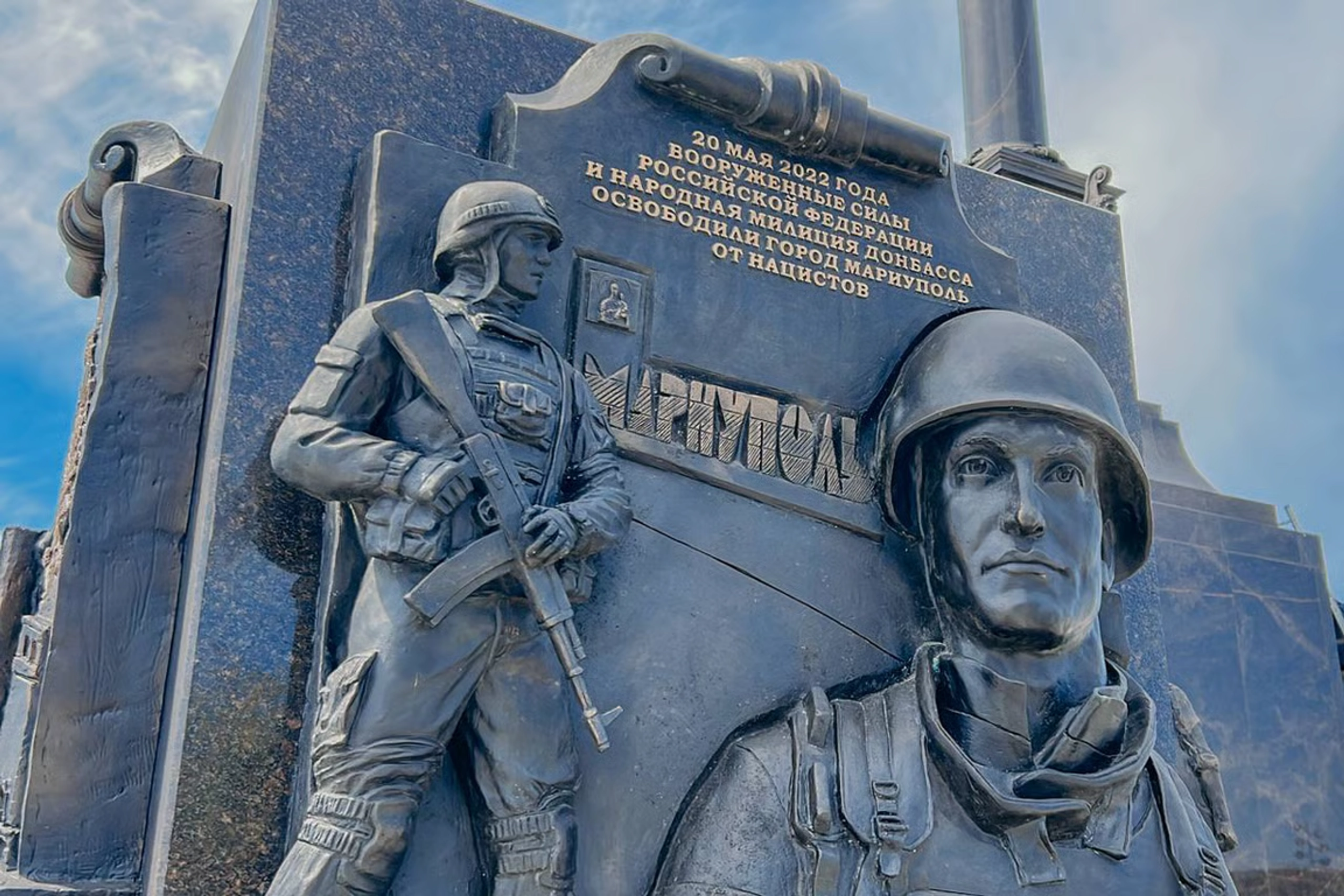
Even Nazi crimes are repurposed. In May 2025, a 17.5-meter (57-feet) granite stele titled “Mariupol – city of military glory” was unveiled, crowned with the Russian coat of arms. Seven reliefs depict episodes from the city’s history; the Russian capture of Mariupol in 2022 is described as its “liberation from the Nazis.” Other inscriptions declare “Forever with Russia” and “Russian is our native language.”
After the reconstruction of the memorial “Shurf Mine 4/4-bis” in Donetsk – a site of mass executions where the German Nazis killed over 75,000 people – Kiriyenko called Russia’s role there a “special mission” of remembrance and linked those buried in the pit to “heroes who continue the fight against Nazism and fascism today on the battlefield.”
Destroying Holodomor sites, capturing what’s left
Alongside this imperial narrative runs a targeted campaign against specifically Ukrainian places of memory.
Latysh wrote that monuments have effectively been divided into two groups: Those that fit the idea of a “shared” Russian-Soviet past and those that do not, such as Holodomor memorials.
The accepted ones are restored and recast as expressions of Russian identity and proof that the territory belongs to Russia, while sites honoring Ukrainian soldiers and figures who resisted Russian influence are removed.
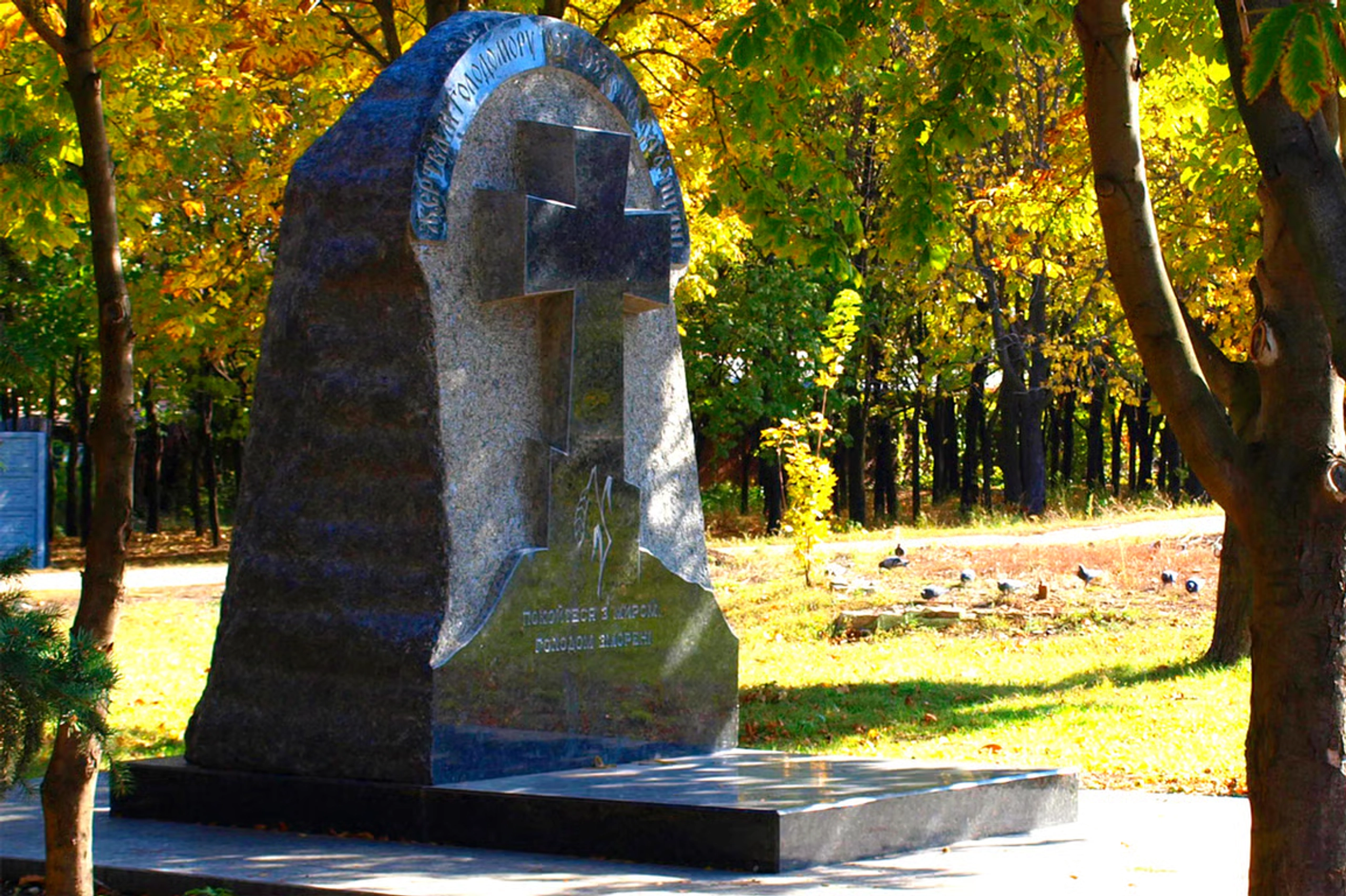
In areas occupied by the so-called DPR and LPR, demolition of Holodomor monuments began in 2014. After the occupation of Mariupol, the memorial “To the victims of the Holodomor of 1932-1933 and political repressions” in the city centre was dismantled.
In 2023 alone, Russian forces destroyed 14 Holodomor memorials in the Ivanivka community of Henichesk district in the Kherson region. In July 2024, two memorials in occupied Luhansk – To the victims of Stalinist repressions” and “To the victims of the Holodomor” – were torn down after occupation authorities claimed they were responding to “numerous requests” and insisted the markers had been installed by “Ukrainian nationalists.”
“In April 2025, three crosses on Holodomor graves in the Luhansk region were also removed.
Sites honoring Ukrainian Armed Forces personnel have been targeted too, including a “Glory to Ukraine” monument in Kherson dedicated to Euromaidan victims and fallen soldiers.
Yet Latysh said that large-scale destruction of Ukrainian monuments remains relatively limited compared to the systematic erasure of Soviet and Russian monuments in government-controlled Ukraine. More often, Russia tries to appropriate Ukrainian heritage, removing only what it sees as openly “anti-Russian,” while folding the rest into an imperial story.
Donbas heroes and “soft” Russification in occupied southern Ukraine
In the east, local elites had long promoted the idea of Donbas as a distinct region that “feeds all of Ukraine” and belongs culturally to the Russian world.
After 2014, this evolved into an official doctrine of “Russian Donbas,” which describes residents as part of a single Russian nation and casts Donetsk and Luhansk – along with other southern and eastern regions – as “historical Novorossiya.”
Russia tightly controls Donbas through appointed officials, revised school curricula and pressure on the Ukrainian language, while simultaneously absorbing the separatist Donetsk hero pantheon into its broader state mythology and projecting it beyond the region. Questions about separatist commanders now appear in Russia’s unified state exam.
In regions where pro-Russian sentiment remains comparatively weak – such as occupied parts of the Kherson region – Moscow turns to monuments that appear cultural rather than overtly ideological, yet still tie the local historical narrative to Russia.
In the village of Novoukrainka, the RVIO has erected monuments to actor Yevgeny Matveyev, known for his portrayals of Soviet patriots, and to Leonid Brezhnev, the long-serving General Secretary of the Communist Party of the Soviet Union and a central figure of the late Soviet era.

Symbolic front lines in a continuing war
Latysh said the installation of new Russian monuments on occupied territory “has not stopped.”
In Mariupol, work is nearing completion on a memorial titled “To the Liberators of Donbas – Participants of the Special Military Operation,” featuring sculptural groups of Red Army soldiers and contemporary Russian troops positioned on either side of an anchor-shaped stele.
An inscription taken from a modern poem proclaims: “Write about love, don’t write about sorrow, write that I took Mariupol.”
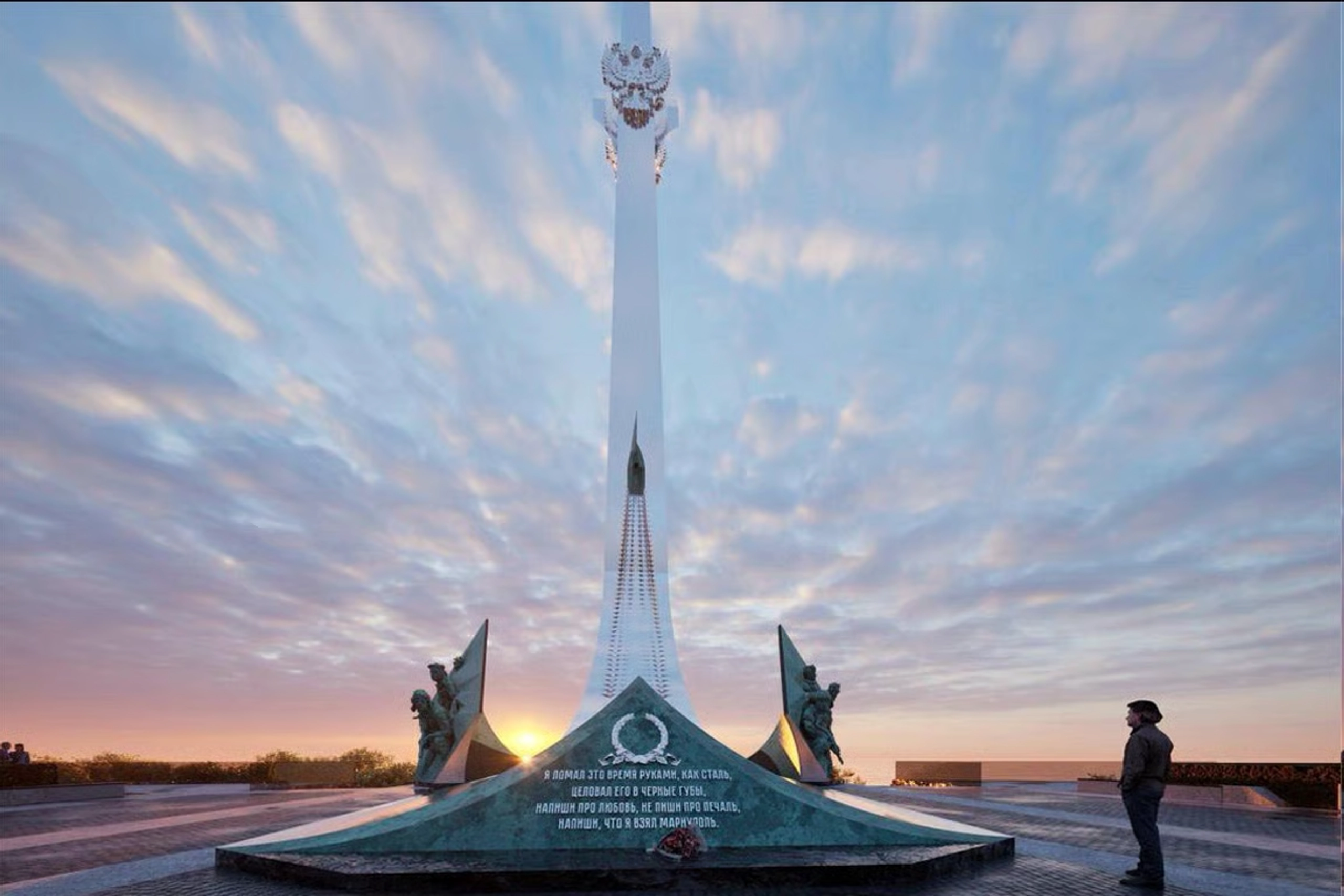
For the Kremlin, these monuments are not decorative but strategic.
As Latysh put it, the monumental landscape in occupied Ukraine has become a symbolic battlefield – one where control over stone and bronze is meant to secure not only territory, but also the past, and to anchor Russia’s claims far beyond the front.
You can also highlight the text and press Ctrl + Enter
Putin’s Worst Nightmare
Zelensky Reveals Intercepted Intel From Putin’s Desk