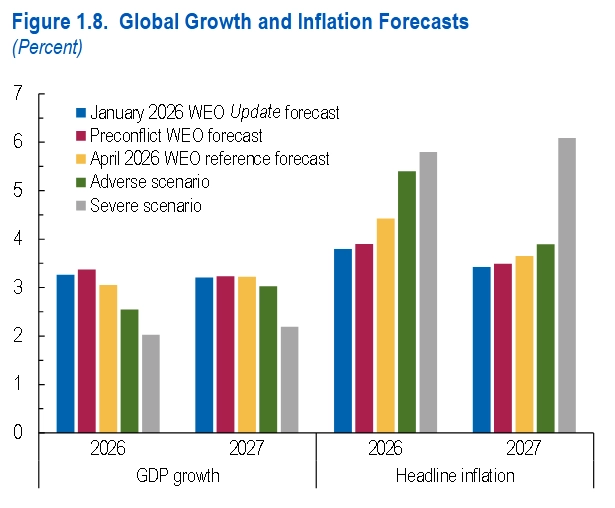
The global economy is facing “another difficult test” because of the fuel price shock from the war in the Middle East – the latter made global 2026 real GDP growth decrease to 3.1%, and dropped headline inflation to 4.4% in 2026.
The International Monetary Fund (IMF) published the figures in its April 2026 World Economic Outlook – its key report outlining economic forecasts for the global and local economies.
JOIN US ON TELEGRAM
Follow our coverage of the war on the @Kyivpost_official.
This time, the IMF made three forecasts depending on how the war in Iran goes: the reference forecast, assuming a short-lived conflict with a roughly 19% rise in energy prices, and two forecasts if the war becomes more sustainable and worse, the adverse scenario and severe scenario.
The 2026 global GDP growth in the adverse scenario, a prolonged disruption, is estimated to be at 2.5% real GDP, and 2% in the severe scenario (a conflict extending into 2027). Inflation will rise further if the war in the Middle East worsens, reaching 5.4% in the adverse scenario and 5.8% in the severe scenario.
IMF Chief Economist Pierre-Olivier Gourinchas said that this fuel price shock is different to the energy crisis in the 1970s and 2022: economies became less dependent on oil due to a higher share of renewables, and the central banks now are “reining in inflation” rather than supporting economic activity.
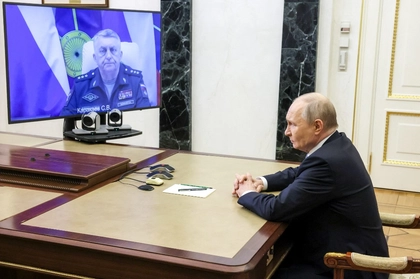
Putin Convenes Emergency Fuel Meeting as Gasoline Shortages Hit Russia Amid Ukrainian Strikes
“There are many other sources of energy, renewables, nuclear and other things, and also the global economy has become much more efficient in terms of how much it needs oil to produce GDP. … Central banks… have learned. They’ve built frameworks. They’ve become more independent. They’ve adopted frameworks that allow them to focus on price stability,” Gourinchas said during the briefing at the IMF on Tuesday.
Gourinchas said the reference forecast assumes oil averaging around $80 for the year, but with prices near $100, the world is drifting between the reference and adverse scenarios.
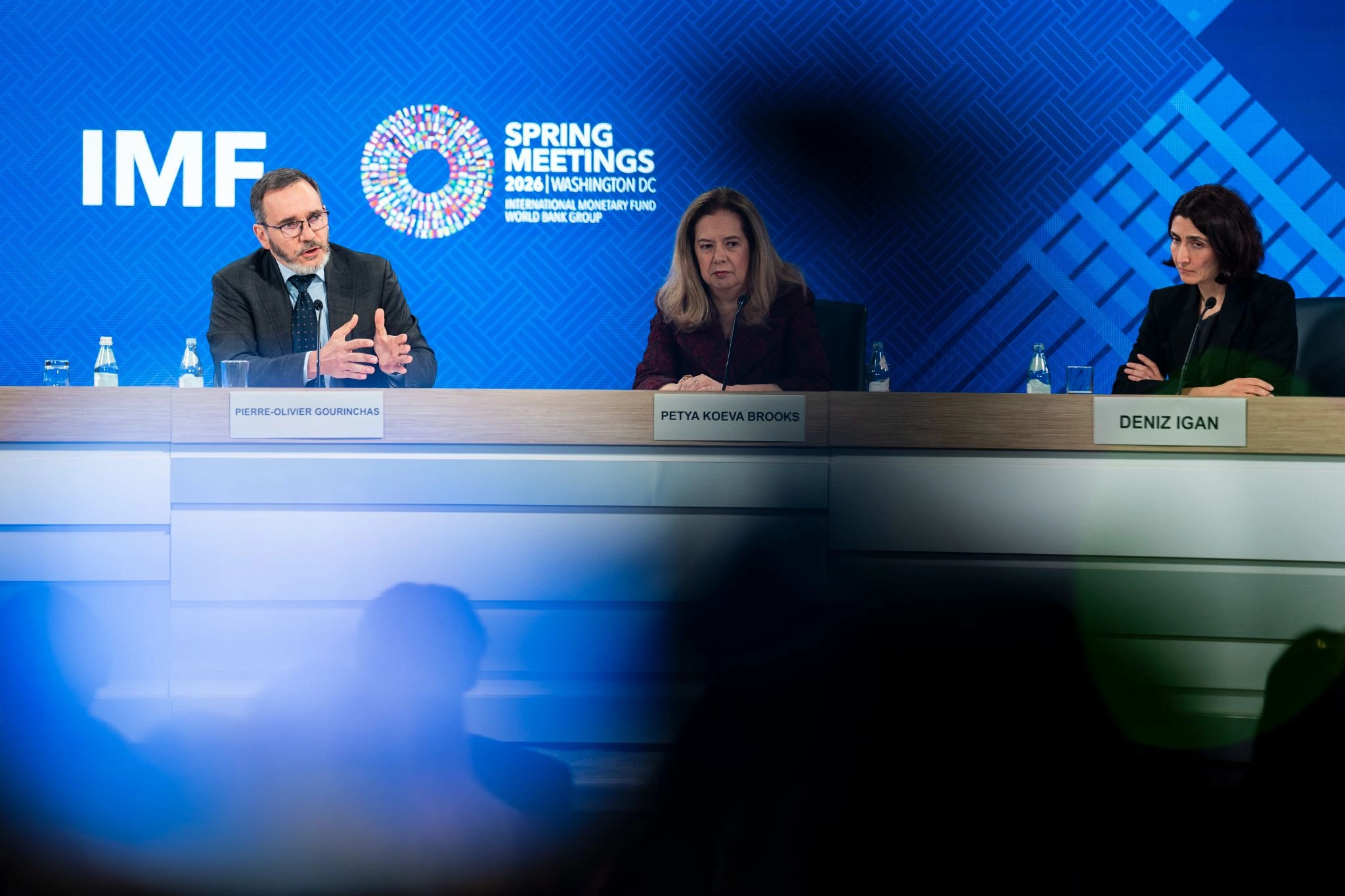
Low-income energy importers and Gulf states face the greatest exposure. Central banks can afford to “wait and watch” for now, provided inflation expectations remain anchored, Gourinchas indicated, but must be ready to act if pressures broaden.
National governments face limited fiscal room to respond. Broad-based subsidies – widely used during previous energy shocks – are costly and difficult to reverse.
Instead, the IMF recommends targeted, temporary support for vulnerable households and businesses.
With oil prices hovering closer to $100 rather than the roughly $80 assumed in the IMF’s baseline, the global economy is already drifting between the reference and adverse scenarios, Gourinchas said.
Still, the key risk remains that a relative price shock could evolve into sustained, broad-based inflation – a dynamic policymakers would like to avoid.
You can also highlight the text and press Ctrl + Enter


Ukraine Annual Inflation Decelerates for First Time After Fuel Price Spike